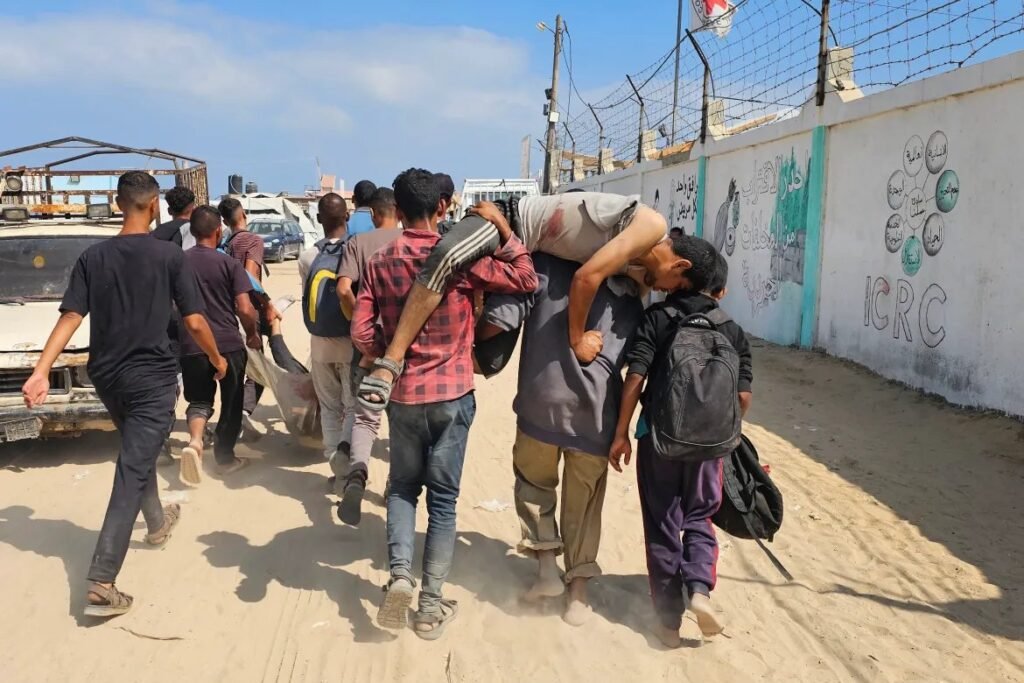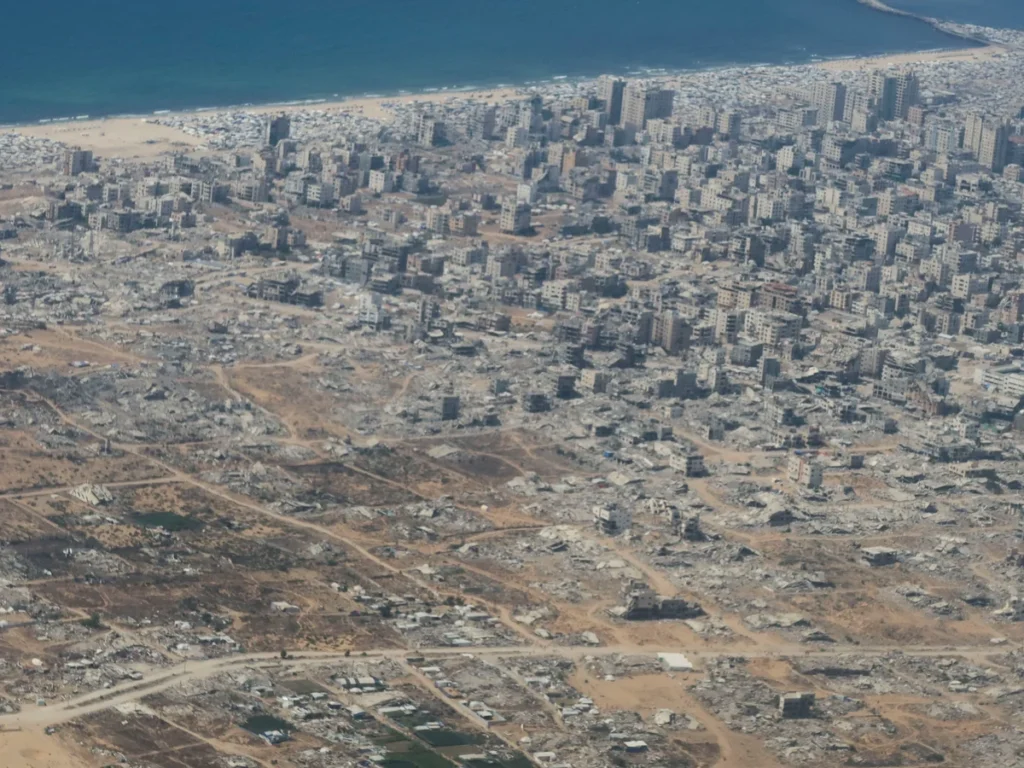
Gaza Herald _ As Gaza continues to endure the devastating consequences of Israel’s ongoing military campaign, newly revealed documents point to a controversial U.S.-Israeli initiative, funded by the United Arab Emirates, to establish what is being described as the first “planned community” in southern Gaza, near Rafah. Presented under the banner of post-war reconstruction, the project proposes to deliver essential services to Palestinians in exchange for intensive security screening, biometric data collection, and tightly regulated movement, conditions that have triggered deep concern among human rights advocates and political analysts.
While officials frame the plan as a humanitarian response to Gaza’s destruction, critics warn it may represent a sophisticated form of demographic engineering designed to reshape Gaza’s social, political, and geographic reality.
Rebuilding or Reshaping Gaza?
According to an investigation published by The Guardian, the UAE is set to finance the construction of a so-called “planned city” on land currently under Israeli military control near Rafah. The project envisions a fully serviced urban complex providing housing, education, healthcare, and water infrastructure for Palestinians displaced by the war. Entry into the city, however, would be conditional upon undergoing security vetting and biometric data registration.
This initiative marks the UAE’s first publicly disclosed financial involvement in Gaza’s reconstruction efforts. Yet the broader framework, sometimes referred to as “alternative safe communities,” reveals ambitions that extend far beyond humanitarian relief. Internal documents reviewed by The Guardian indicate that Israeli military planners have approved the proposal, while U.S. officials describe it as a scalable model for similar developments across Gaza.
At the heart of the plan lies a controversial territorial division of Gaza into so-called “green zones,” overseen by Israeli and international authorities, and “red zones,” where hundreds of thousands of displaced Palestinians currently reside. Movement between these zones would be tightly controlled, raising fears of permanent population segmentation.
A City Built on Surveillance
The documents indicate that residents permitted to enter the Rafah development would undergo extensive background checks, with biometric data collected and stored. Educational curricula would be carefully vetted to exclude any material deemed politically sensitive, particularly content linked to Palestinian resistance movements. Yet the identity of those conducting the security screenings and managing the vast data infrastructure remains unclear.
Under the proposal, the first city, labeled “New Rafah,” would include 100,000 permanent housing units, 200 educational institutions, and 75 medical facilities. Analysts caution that the scale and structure of the project suggest more than reconstruction, pointing instead to a long-term plan to restructure Gaza’s population distribution.
Mohammad Shehadeh, a visiting fellow at the European Council on Foreign Relations, argues that planners appear to assume Palestinians can be incentivized into relocation simply through access to aid and services. He warns that such assumptions ignore Gaza’s deeply rooted political, cultural, and social dynamics, and risk inflaming tensions rather than resolving them.
Human Rights Groups Sound the Alarm
Human rights organizations have issued stark warnings about the implications of the project. The Euro-Mediterranean Human Rights Monitor has described the proposed “green city” in Rafah as a mechanism that could effectively impose forced ghettoization on Palestinians. The organization argues that the plan risks creating enclosed population centers surrounded by military control, restricting freedom of movement and undermining fundamental civil rights.
According to the group, such measures could pave the way for mass displacement from original residential areas, transforming large portions of Gaza into militarized zones and placing civilians under permanent surveillance. These conditions, they argue, violate international legal protections guaranteeing freedom of residence, movement, employment, and political participation.
Beyond physical displacement, rights advocates warn of a deeper demographic restructuring that threatens Gaza’s social fabric. By fragmenting communities and imposing rigid security classifications, the plan could entrench long-term inequality and institutionalized segregation.
Gaza as a Laboratory of Control
Experts in digital surveillance and human rights have raised particular concerns about the biometric components of the plan. Matt Mahmoudi, a Cambridge University researcher and advisor to Amnesty International, reviewed the planning documents and warned that the project would significantly expand biometric surveillance across Gaza.
Mahmoudi argues that Israel’s increasing reliance on biometric technologies serves to entrench systems of control and domination, transforming civilian life into a monitored existence. He describes the project as a large-scale experiment in population management, one that could normalize mass data collection and deepen systemic repression.
Other analysts caution that the initiative could serve as a prototype for future population control strategies. Should the model succeed, Gaza could become dotted with highly controlled enclaves, while remaining areas are left marginalized, impoverished, and vulnerable to further displacement.
Legal and Political Consequences
Legal experts stress that any forced or coerced relocation of civilians violates international humanitarian law and may constitute a war crime. The Fourth Geneva Convention strictly prohibits the transfer of civilian populations under military occupation, particularly when accompanied by coercion, deprivation, or fear.
The proposed model raises urgent questions about accountability, consent, and sovereignty. Critics argue that presenting such projects as humanitarian relief risks masking coercive policies behind the language of reconstruction. Without a genuine political framework addressing Palestinian self-determination and sovereignty, reconstruction efforts may instead entrench occupation under a humanitarian guise.
Reconstruction Without Justice
For many observers, the central concern is that rebuilding Gaza is being reduced to a technical challenge, detached from the political realities of occupation, siege, and systemic inequality. By prioritizing infrastructure over rights, critics say the project risks transforming reconstruction into an instrument of control rather than liberation.
As Gaza struggles to survive amid relentless destruction, Palestinians and human rights advocates insist that true reconstruction must begin with freedom, justice, and accountability, not surveillance, segregation, and engineered displacement.