
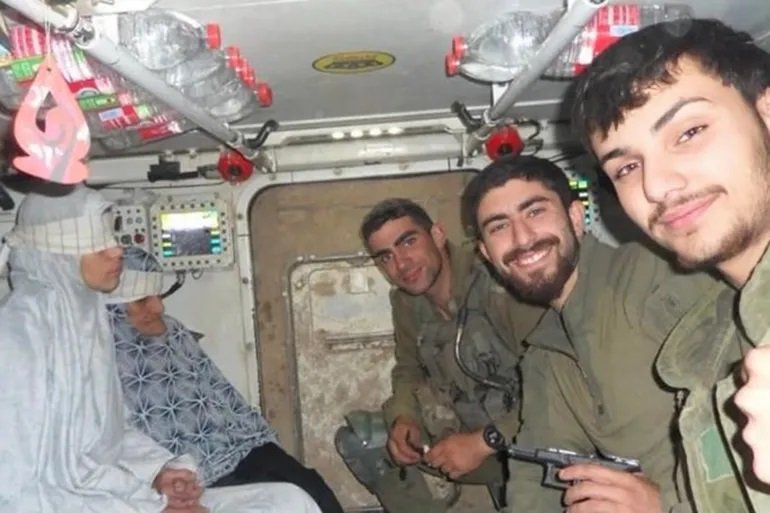
Gaza Herald – A photo posted by Israeli army sergeant Dolev Mor Yosef on Instagram has reignited fears over the fate of thousands of missing and forcibly disappeared Palestinians in Gaza after it showed two blindfolded and handcuffed Palestinian women inside an Israeli military vehicle.
The image, which later spread widely across social media platforms, showed the Israeli soldier smiling while the two restrained women sat behind him. According to investigative reports cited by Al Jazeera, the women were identified as Aisha Ahmad Bakr Al-Aqqad and her daughter Huda from Khan Younis in southern Gaza.
The photo became the first clue in uncovering part of the fate of Al-Aqqad family, whose traces disappeared during the Israeli aggression of Khan Younis in December 2023. The family had refused forced displacement and chose to remain in their home in the western Rabwat area. During the early days of the siege, the family’s patriarch, Mohammad Asouli Al-Aqqad, was reportedly killed by Israeli gunfire, while several relatives, including Iyad and Zakaria, vanished without confirmed information about their whereabouts.
Thousands Still Missing
The renewed circulation of the image has once again drawn attention to Gaza’s growing file of missing and forcibly disappeared persons amid the continued absence of clear information regarding thousands who disappeared during the genocide.
Human rights estimates suggest the number of missing people in Gaza may exceed 11,200, including more than 4,700 women and children, while hundreds of official disappearance reports remain unresolved.
Nada Nabil, director of the Palestinian Center for Missing and Forcibly Disappeared Persons, said around 1,500 Palestinians are believed to be held in undisclosed detention sites. She accused Israeli authorities of deliberately withholding detainee lists and preventing the International Committee of the Red Cross from accessing prisoners, describing it as a “policy of concealment” that prolongs the suffering of families trapped between hope and uncertainty.
Legal experts warn that enforced disappearance constitutes one of the gravest crimes under international law and may amount to a crime against humanity under the Rome Statute of the International Criminal Court.
Meanwhile, psychologists describe the emotional condition endured by families as “ambiguous grief,” where relatives remain suspended between mourning and waiting, unable to confirm whether loved ones are alive or killed as Gaza’s genocide continues to erase lives, identities, and traces beneath the rubble.

