Gaza Herald – In Gaza, maps are no longer just political drawings on paper. What residents now describe as the “Orange Line” has become a symbol of a new military reality, where geography is being continuously reshaped under expanding Israeli control. Although never officially announced, the line represents a gradual extension beyond the previously known “Yellow Line,” which was established under the ceasefire agreement of October 10, 2025, to separate Israeli-controlled zones in the east from areas where Palestinians could remain in the west.
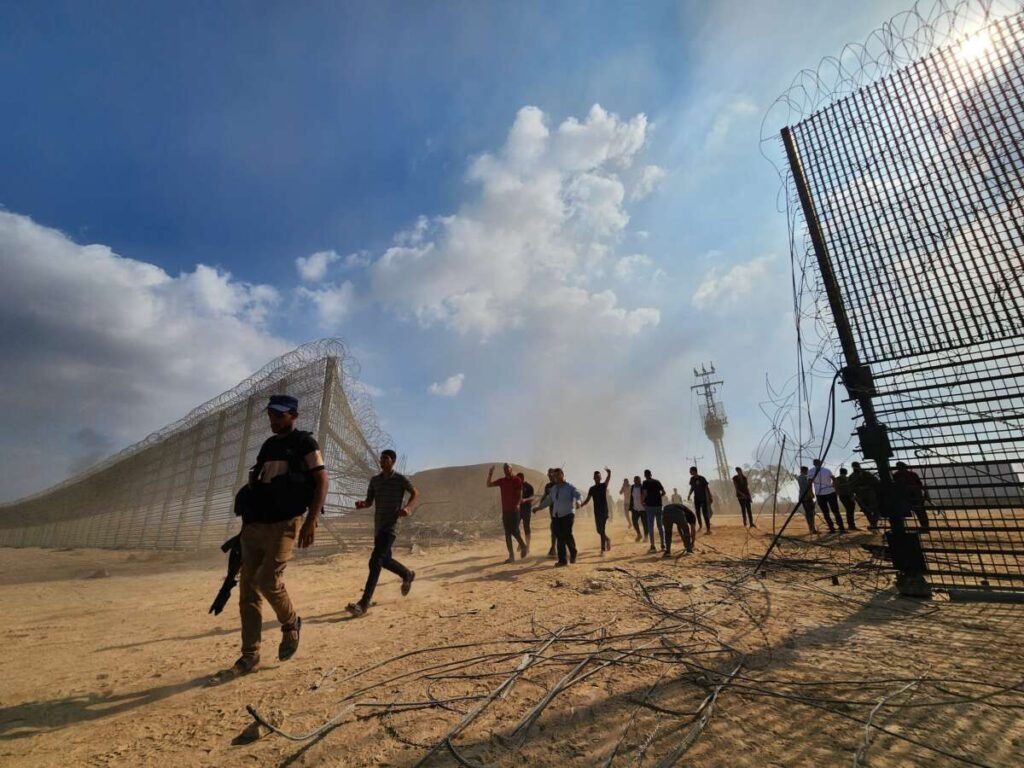
What followed, however, moved far beyond the original framework of the ceasefire. Field reports, satellite imagery, and international assessments indicate that Israeli military boundaries have steadily shifted deeper into Gaza through the repositioning of concrete barriers, separation points, and military infrastructure. This evolving reality has led observers and residents to refer to a new unofficial boundary, the “Orange Line”, reflecting a wider zone of effective military control that continues moving westward into densely populated civilian areas.
The expansion is not measured only in percentages on a map but in the shrinking of daily life itself. Areas once filled with neighborhoods, roads, farms, and homes have increasingly become empty spaces marked by destruction, danger, or forced evacuation. Reports suggest that while the earlier “Yellow Line” covered roughly 53% of Gaza’s territory, current estimates indicate Israeli-controlled or restricted areas may now reach nearly 59%, and in some assessments even approach 64%. In several locations, the bombing has reportedly reached near Salah al-Din Road, the main route connecting northern and southern Gaza.
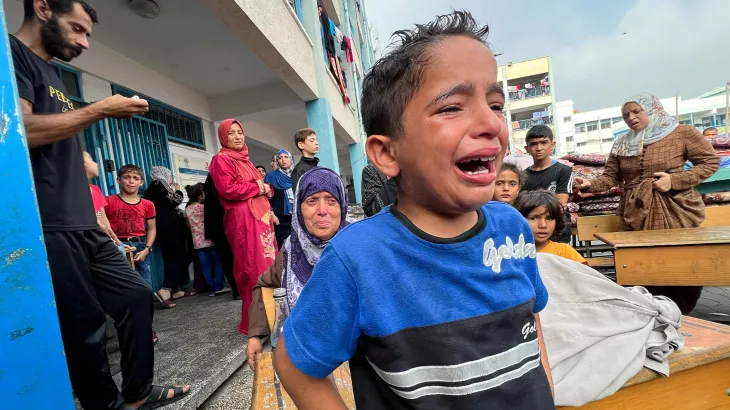
For civilians, these shifting lines represent far more than military terminology. Local residents describe them as invisible walls that restrict movement, compress the population into increasingly overcrowded areas, and transform temporary security arrangements into long-term realities. Humanitarian estimates indicate that the truly livable space remaining in Gaza may now be limited to around 15% of the territory, where hundreds of thousands of displaced people are living in tents, damaged buildings, or overcrowded shelters under worsening humanitarian conditions.
Legal experts and human rights advocates warn that this process could amount to a broader attempt to impose demographic and geographic changes by force. Palestinian legal analyst Osama Saad described the “Orange Line” as a serious violation of the ceasefire agreement and argued that restricting civilians to narrow, unsafe spaces while limiting freedom of movement may violate international humanitarian law. He emphasized that the danger lies not only in the immediate military impact, but also in the gradual normalization of temporary measures into permanent boundaries that reshape Gaza without any political resolution.
As these lines continue to move across Gaza’s landscape, many fear that the “Orange Line” is becoming more than a military description. For Palestinians living in the territory, it increasingly symbolizes a larger strategy of fragmentation and control, one that determines not only where people can go, but where they can live, rebuild, and imagine a future.