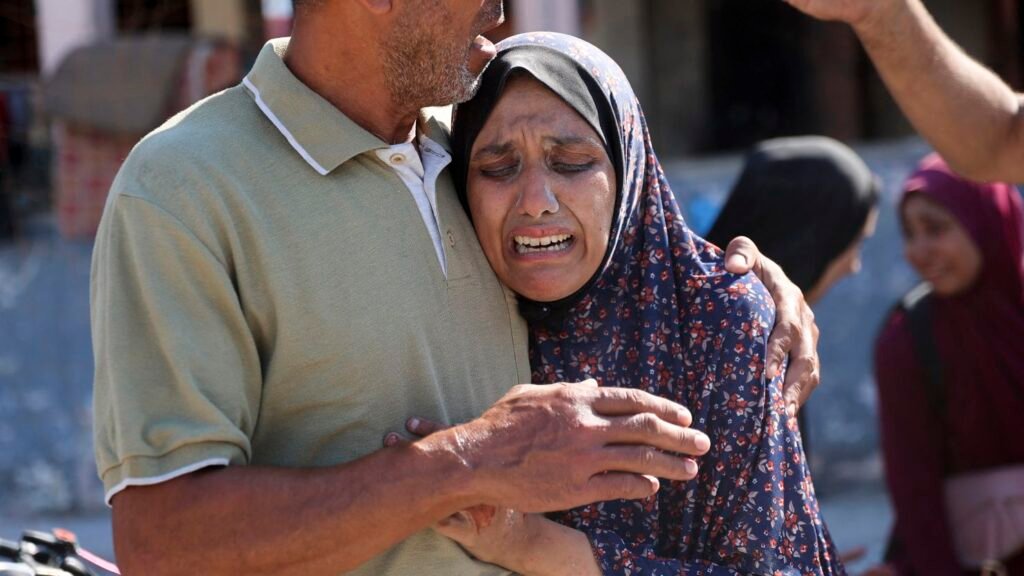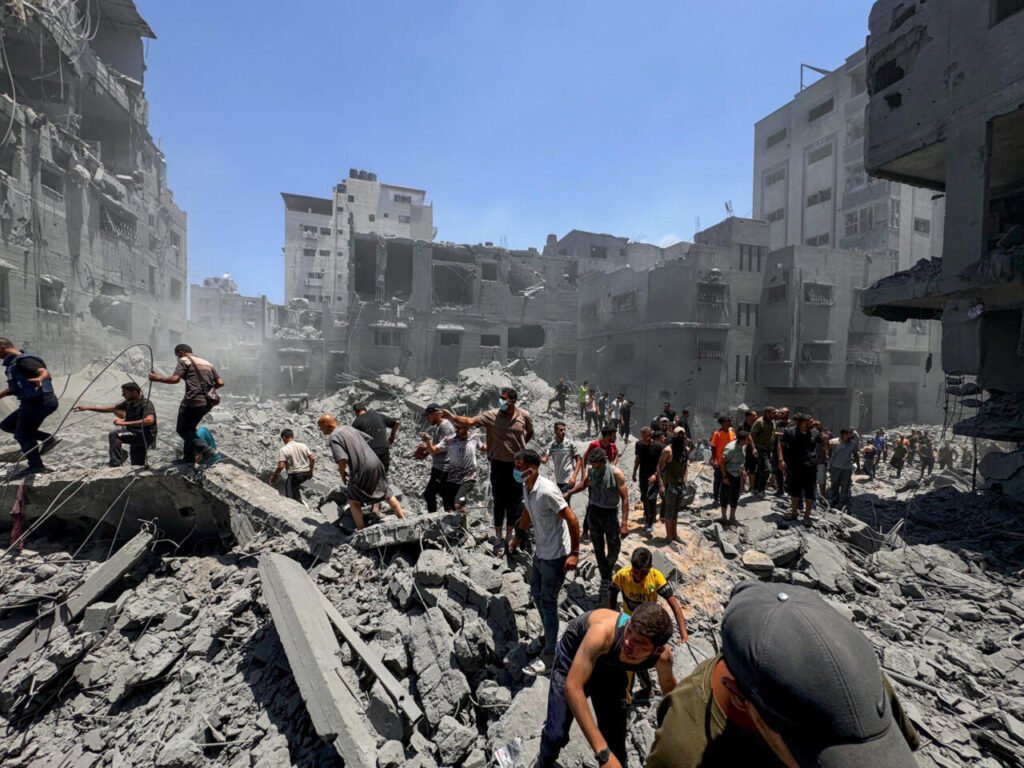
Gaza Herald — Since the ceasefire in Gaza came into effect on October 10, thousands of displaced Palestinians have been forced to return to bomb-damaged buildings in a desperate search for shelter from the cold and relentless rain. With tents offering little protection and no safe alternatives available, families have taken refuge in structures left cracked, unstable, and at constant risk of collapse after months of Israeli bombardment.
These buildings, often reduced to fractured walls, exposed steel bars, and hanging concrete slabs, have become makeshift shelters for entire families, including children and infants. The lack of options has been compounded by Israel’s continued refusal to allow the entry of mobile homes and temporary housing units for displaced civilians.
Storms Turn Ruins into Death Traps
With every winter storm sweeping across the Strip, the danger grows. Strong winds and heavy rainfall seep into weakened walls, accelerating the risk of sudden collapse. This grim reality became deadly on Tuesday, when a partial building collapse west of Gaza City killed one Palestinian and injured four others.
The same storm system also flooded and swept away thousands of tents across Gaza on Monday night. It marked the second severe weather system in less than a week. The first—Polar Storm “Peron”—killed 14 Palestinians, including 11 who died when more than 13 damaged buildings collapsed, and three who succumbed to extreme cold. Official figures indicate that approximately 53,000 tents were destroyed or damaged, either partially or completely.
Mahmoud Basal, spokesperson for Gaza’s Civil Defense, warned in a statement that thousands of damaged buildings are at imminent risk of collapse due to intensified rain and wind. He called for urgent international intervention to allow the entry of safe shelters, warning that Palestinians face “preventable deaths” if action is delayed.
A Landscape of Destruction
According to Gaza’s Government Media Office, Israeli attacks over the course of the genocide have completely destroyed around 268,000 housing units, rendered 148,000 uninhabitable, and partially damaged 153,000 more. Nearly 90 percent of Gaza’s civilian infrastructure has been affected.
Despite the ceasefire, Israel continues demolishing and detonating what remains of homes in areas under its control, extinguishing hopes for displaced residents to return even after a full military withdrawal.
A Forced Choice
In the heavily bombed Hamad City residential complex in southern Gaza, Hiyam Abu Nadda sought refuge in a damaged building after being displaced from the Shujaiya neighborhood in eastern Gaza City.
“With no alternatives, we were forced to live inside a cracked building,” she said. “Every day, we hear small collapses inside the walls as rainwater seeps in. The remaining walls don’t block the freezing cold.”
Her relative, Mustafa Abu Nadda, confirmed that these structures offer no real safety. “We live here out of necessity, terrified of a sudden collapse. My children have fallen sick from the cold and dampness.”
Awni al-Hajj, another resident of Hamad City, said life in tents has become impossible. “Most buildings here are at risk of collapse. We constantly call civil defense teams to remove hanging concrete slabs from ceilings.”
Fatima Obeid, who lost her husband during the war and whose son remains imprisoned, described these dangerous structures as families’ “last refuge,” despite the presence of a newborn infant and fears of worsening storms.
In western Gaza City, near the heavily destroyed Rashad Shawa Cultural Center, displaced woman Halima Aslim and her children live in a tent pitched beneath the roof of a damaged building. “Winter nights are unbearable,” she said. “I stay awake fearing a sudden collapse. What I thought was a safe shelter has become a constant source of terror.”
Primitive Attempts to Survive
Mahmoud Hamouda shares the same fears, worried the ceiling above his tent could collapse at any moment. He called for the immediate entry of mobile homes to protect displaced families from rain and falling debris.
In Khan Younis, the family of Mohammed al-Shaer attempted to rebuild a single room using mud and stones salvaged from rubble after tents failed to provide adequate shelter. With cement barred from entering Gaza due to the closure of crossings, they resorted to mud, despite knowing it dissolves in heavy rain and could collapse at any time.
The family now lives between two dangers: random Israeli gunfire and the risk of their shelter collapsing during the next storm. Outside the structure, Um Imad, who lost three sons and whose fourth remains imprisoned, cooks over firewood instead of gas.
“The war pushed us back a hundred years,” she said.
Death Delayed
Despite the ceasefire, Israel continues to evade its obligations, particularly the opening of crossings and the entry of essential supplies. Palestinian government reports estimate that at least 300,000 tents and mobile housing units are urgently needed.
Until then, thousands of families remain trapped, caught between rubble, cold, and a slow, postponed death.