
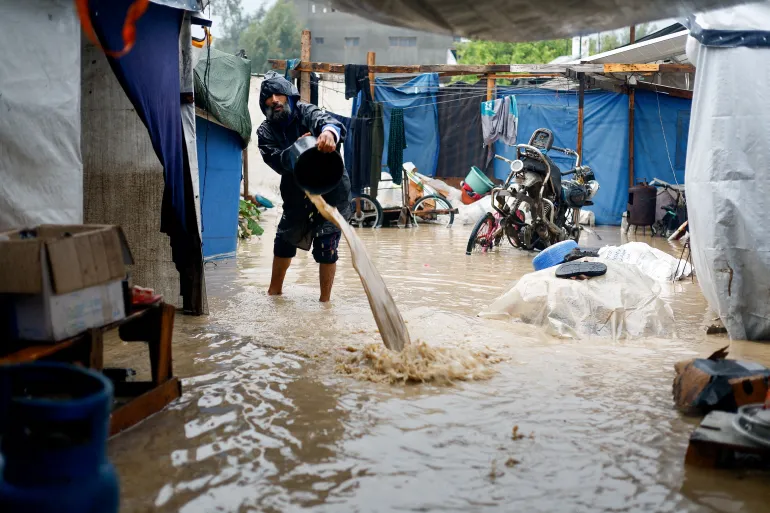
Gaza Herald_ Winter arrived in Gaza last month, not gently, but violently. A powerful storm tore through the Strip, and I woke in the middle of the night to catastrophe. Our tent was underwater. What passed for our floor had become a shallow pool. Mattresses and pillows were soaked through, cooking utensils submerged, clothes drenched, and even our bags, our makeshift closets, were filled with water. Nothing was spared. Nothing stayed dry.
As I struggled to grasp what was happening, I heard children crying at the entrance of our tent. When I opened it, three children from a neighboring tent stood there, their lips blue with cold. Behind them, their mother was shaking uncontrollably. “We are completely soaked,” she said. “The rain leaked inside. Water is everywhere.”
A Scene of Collective Suffering
That moment was not unique. It was repeated across the area. Women, children, and elderly people sat in the streets under heavy rain, their bedding ruined, their few belongings scattered in the mud. Confusion, panic, and crying filled the air.
That day, all 1.4 million displaced Palestinians without proper shelter suffered. There was no protection from the weather, no defense against sudden storms. For us, it took two full days for our belongings to dry, as the sun barely made an appearance. Everything remained cold and damp. We did not relocate. We stayed because there was nowhere else to go, salvaging what little we could.
Storm After Storm, With No Escape
Just one week later, an even more violent storm arrived. Torrential rain flooded the tents again. Once more, small children stood shivering in the cold rain.
Then came Storm Byron. Despite all our efforts to reinforce the tents, tighten ropes, secure edges, and add thicker tarps, it was useless. The winds were stronger, the rain heavier. Water forced its way in from every direction. The ground could no longer absorb anything. Within moments, the area beneath our feet turned into a swamp.
Authorities later reported that at least 27,000 tents were destroyed by the storm. That is 27,000 families, already displaced, already struggling, now left with nothing. No shelter. No refuge from the cold or rain.
Death Beneath Collapsing Concrete
The rain also caused partially destroyed buildings where some families had taken shelter to collapse. Every storm brings the terrifying sound of falling debris and cracking concrete pillars from nearby damaged homes. This time, the destruction was deadly. Eleven people were killed when buildings collapsed around them.
After everything we have endured, it is painfully clear that we, like so many displaced Palestinians, cannot survive a third winter like this. We have already lived through two winters in displacement under tents that protected us neither from rain nor cold—waiting with exhausted patience for a ceasefire that would end our suffering.
The ceasefire came. Relief did not.
We remain where we are, our bodies weakened by malnutrition and illness, beneath tents worn thin by sun and wind. We are seven people living in a tent measuring four by four meters. Among us are two children, aged five and ten, and our grandmother, who is 80.
As adults, we force ourselves to endure the cold and hardship. But how can children and the elderly survive this reality day after day?
We sleep on mattresses placed directly on the ground, with cold seeping in from below and above. We have no electricity, no heater, no source of warmth. Each person has two blankets, barely enough to offer temporary relief during freezing nights. We are exhausted bodies trying to share the little warmth that remains.
My grandmother cannot tolerate the cold at all. I watch her shiver through the night, her hand pressed to her chest as if holding herself together. All we can do is pile every blanket we own on top of her and wait anxiously until she finally falls asleep.
Many Live in Even Worse Conditions
Many families cannot afford even a modest tent. Prices have skyrocketed; tents can cost up to $1,000, and renting a small patch of land to pitch one can reach $500. Those who cannot pay live in the open streets.
Along Salah al-Din Street, makeshift shelters line the road, thin blankets hung together for minimal privacy, offering no protection from rain or wind. With a single strong gust, they fall apart.
Children sleep directly on the cold ground. Many have lost one or both parents during the war. When you pass by, you see them sometimes silent, sometimes crying, sometimes desperately searching for food.
Aid That Barely Reaches the Ground
Despite repeated promises of aid and reconstruction, what has entered Gaza has made almost no difference. Earlier this month, the United Nations said it managed to distribute only 300 tents during November. About 230,000 families received a single food parcel each.
We received nothing.
There are simply too many people in need, and the supplies are far too limited. Even if we had received a food parcel, it would not have lasted more than a week or two.
Food prices remain unbearably high. Meat and eggs are either unavailable or unaffordable. Most families have gone months without a proper source of protein.
There is no large-scale effort to remove rubble or level the land so people can safely pitch tents. Equipment shortages have halted such work. No concrete steps have been taken to provide permanent housing.
All of this leaves us facing a terrifying possibility: that life inside a fragile tent, one that can flood or be ripped apart at any moment, may become permanent. The thought is unbearable.
During the bombardment, we lived with constant fear of death. The intensity of the war overshadowed everything: the cold, the rain, the shaking tents above our heads. But now, with the mass bombing paused, we are forced to confront the full ugliness of Gaza’s “new normal.”
Winter as a Silent Killer
I fear this winter will be even worse. With no heating, no real shelter, and worsening weather, deaths among children, the elderly, and those with chronic illnesses are inevitable. Already, the first victims of hypothermia have been reported: infants Rahaf Abu Jazar and Taim al-Khawaja, and nine-year-old Hadeel al-Masri.
If the world is truly committed to ending the genocide in Gaza, words are no longer enough. Urgent, real action is required, to ensure at least the most basic conditions for survival: food, shelter, and medical care.

