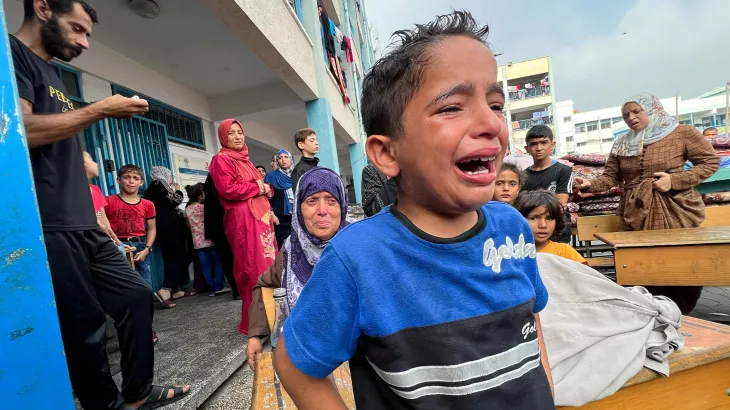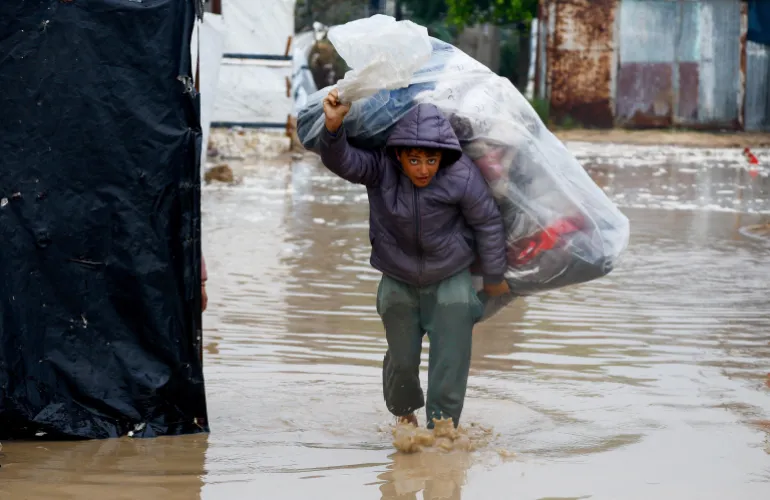
Gaza Herald_ As winter storms sweep across Gaza, displaced Palestinian families are discovering that the so-called “ceasefire” has brought no real safety. Instead of returning to their homes, thousands now face the cold, rain, and collapsing ruins in fragile tents and damaged buildings that offer little protection from the elements.
For many families, winter has become a new form of violence, one that arrives silently, soaking bedding, flooding shelters, and turning survival into a daily struggle.
“I Held the Tent with My Hands”
For days, Saber Dawas and his wife have fought to keep their seven daughters warm and dry after heavy rain and strong winds destroyed their tent at al-Yarmouk Stadium in central Gaza. The family has lived there since Israeli attacks destroyed their home in Beit Lahia.
Since the start of winter, Saber says he has lived in constant fear. The tent they relied on barely shielded them from rain or wind, and he knew it could collapse at any moment. Two weeks earlier, floodwater rose nearly 30 centimeters inside the tent, soaking everything and leaving his daughters sick for days.
Desperate to prevent another disaster, Saber borrowed money from a relative to buy plastic tarpaulins and reinforced the tent with wooden poles. But when the latest storm struck Gaza, none of it mattered.
“I spent the first night holding the tent up with my own hands as the rain poured in from every direction,” he said. “It felt like everything I did was useless. The tent collapsed within hours.”
By morning, their clothes, blankets, and food were drenched. His daughters shivered through the night as water pooled beneath them.
“I didn’t know where to take my family,” Saber said. “There was nowhere to go.”
A Child With Cancer in a Flooded Camp
Among Saber’s children is his youngest daughter, just two years old, who is battling stomach cancer and has a severely weakened immune system. As the rain spread through the camp, Saber moved her from one tent to another, searching for anything dry.
“She has the flu now,” he said. “Everything is flooded. I can’t even get her medicine.”
His voice broke as he added: “I wish I had died before seeing my daughters freeze while I can’t protect them. Is this what a ceasefire looks like? Dying of cold in tents instead of living in our homes?”
Around them, dozens of families in the camp face the same ordeal, especially those trapped in worn-out tents that cannot withstand Gaza’s winter storms.
Water From the Sky, Sewage From the Ground
Just a few tents away, 36-year-old Sanaa al-Ayubi lives with her husband and two children in conditions that grow more dangerous by the day. Her husband lost both legs in an Israeli airstrike that destroyed their home in Tel al-Hawa, west of Gaza City, in December 2024. Sanaa, who was pregnant at the time, was also seriously injured.
Since then, the family has survived in a deteriorating tent pitched over damaged sewage infrastructure.
“For three days, the rain hasn’t stopped,” Sanaa said. “Water comes down on us from above, and sewage rises from beneath the tent.”
During the storm, the tent’s main wooden pole snapped and collapsed on the family. Her husband, unable to stand without prosthetic legs, crawled through filthy water as she tried in vain to hold the structure up with a broomstick.
“The tent was completely flooded,” she said. “I had to carry him outside. He can’t use his prosthetics now because everything is soaked.”
Prolonged exposure to dirty water has caused bacteria to form on her husband’s legs. Most of their clothes and bedding, contaminated by sewage, had to be thrown away.
Sanaa contacted Gaza Municipality after a sewage pit burst beneath their tent. “They said they would come,” she said. “No one came.”
Before the war, Sanaa was a primary school teacher and ran a small learning center under her home. Today, her family depends entirely on charity meals. “We can’t afford clothes, medicine, or a new tent,” she said.
Living Inside a Collapsing Home
The suffering is not limited to tent camps.
In al-Karama neighborhood in northern Gaza City, 28-year-old Nesma Hassan lives with her four-year-old daughter inside what remains of her family’s destroyed home. Her husband, Ali, was killed in an Israeli airstrike in 2024.
Only two roofed rooms remain standing after the family’s four-story building was heavily damaged weeks before the ceasefire. Nesma tried to prepare for winter with plastic sheets, wood, and tarps, but the storm tore everything away.
“The wind ripped it all off,” she said. “Water leaked into every corner. We spent the entire night scooping water out.”
Her daughter has been cold for days despite being wrapped in layers, gloves, and a hat. “It still feels like we’re sleeping in the street,” Nesma said.
Thunder and rain echo through the broken structure, mixing with the unsettling sound of wind brushing against loose rubble. “She panics every time she hears it,” Nesma added.
Nesma now plans to pitch a tent on the rubble outside, believing it may be safer than waiting for the rest of the house to collapse.
“Before the war, I loved winter,” she said. “It meant warmth and family. Now I just wait for it to end.”
Death Beneath the Ruins
According to Gaza’s civil defense, at least 11 Palestinians were killed and 11 others injured over the past three days after partially destroyed homes collapsed under heavy rain and strong winds.
Rescue teams responded to the collapse of at least 13 damaged buildings, most of them in Gaza City and the north. Civil defense crews also worked to drain flooded tents and open emergency drainage channels across displacement camps.
But for families trapped between rain, rubble, and displacement, emergency response offers little comfort.
As winter deepens, Gaza’s displaced population faces a brutal reality: survival is no longer threatened only by bombs, but by cold, water, neglect, and the long-term consequences of destruction left unaddressed.