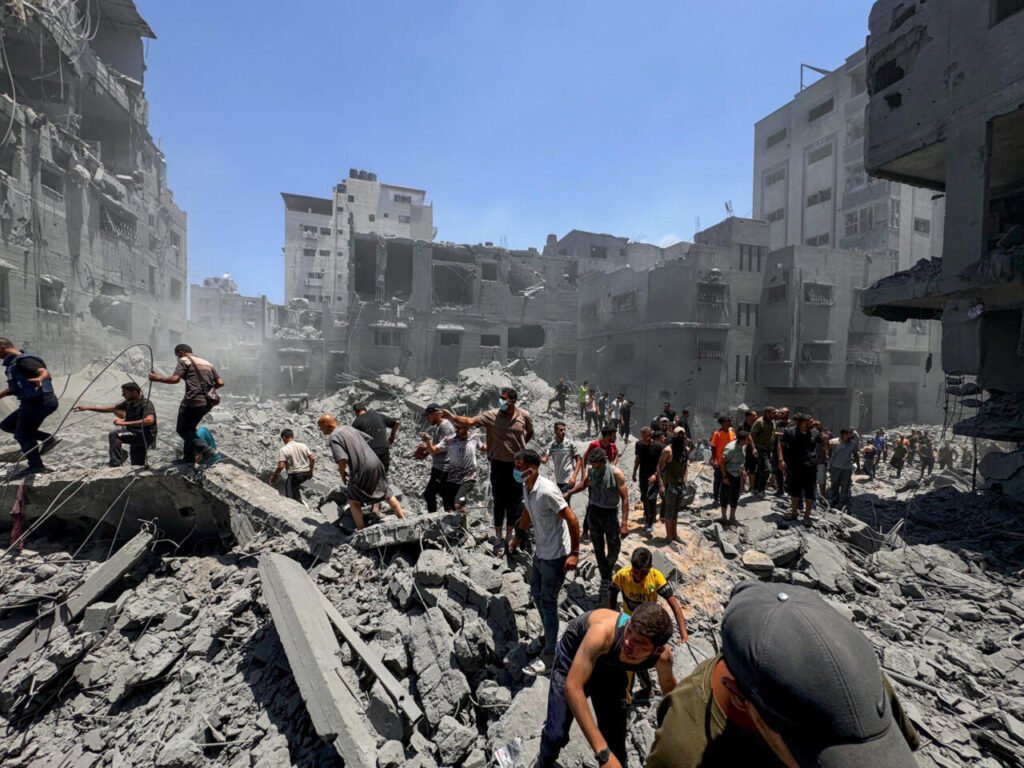
Gaza Herald _ Israel has reportedly agreed to shoulder the cost of a major rubble-clearing operation in the Gaza Strip, an expense estimated at nearly $300 million, following sustained pressure from the United States, according to a new report published by the Israeli outlet Ynet.
The report indicates that Washington pressed the Israeli government to assume financial responsibility for at least part of Gaza’s massive debris-removal effort, a task that requires extensive engineering equipment, heavy machinery, and months of coordinated logistical work.
According to Ynet, the operation could reach up to $312 million, though the exact scope of Israel’s commitment remains unclear. What is known is that the level of destruction across Gaza makes rubble clearance not only a humanitarian necessity but a prerequisite for any future reconstruction or safe return of displaced Palestinians.
A Landscape of Destruction Measured in Tens of Millions of Tonnes
The United Nations estimates that Gaza now contains around 68 million tonnes of debris, a level of devastation unprecedented in the modern Middle East. Entire neighborhoods have been flattened, infrastructure has been pulverized, and critical civilian facilities such as hospitals, schools, roads, mosques, and churches lie in ruins.
The UN places Gaza’s total reconstruction cost at approximately $70 billion, a staggering figure that underscores the scale of destruction inflicted by Israel’s military campaign.
Unclear Where the Money Will Actually Go
Despite agreeing to cover a portion of the rubble-removal bill, Israel has not disclosed which specific projects it will fund, whether the payment will be made directly to UN agencies or contractors, or if it will oversee the operation through its own military engineering units.
This ambiguity is further complicated by the fact that Israel continues to occupy roughly 58 percent of Gaza, according to recent assessments. In many of the occupied zones, Israeli forces still restrict civilian movement, humanitarian access, and independent debris-removal teams, making large-scale clearance efforts nearly impossible without Israeli coordination or approval.
A Fraction of What Is Needed, and a Fraction of What Israel Can Afford
Economically, the cost is negligible for Israel. The country’s GDP in 2024 stood at around $540 billion, meaning the rubble-removal sum represents less than a tenth of a percent of its annual economic output.
Yet the symbolic significance is substantial: the reported payment acknowledges, even if indirectly, Israel’s responsibility for the destruction it has caused, something Israeli officials have consistently refused to accept publicly.
A Step Forward or Political Optics?
Experts say the move appears to be driven more by US strategic pressure than by any shift in Israeli policy. The Biden administration has faced mounting international criticism for supporting Israel’s military operations while failing to ensure the protection of civilians. Pushing Israel to finance rubble removal may be an attempt by Washington to show that it is taking steps to hold its ally accountable for at least part of the war’s humanitarian fallout.
For Palestinians, however, the gesture is likely to be viewed as too little, too late. The amount covers only a small portion of the destruction. Unless Israel lifts its restrictions, humanitarian agencies will remain unable to operate freely or safely inside much of the Strip.
As Gaza continues to dig out from beneath millions of tonnes of shattered homes, crushed dreams, and the remains of entire communities, the question remains:
Will this payment mark the beginning of real accountability, or simply another attempt to manage the optics of an ongoing catastrophe?