
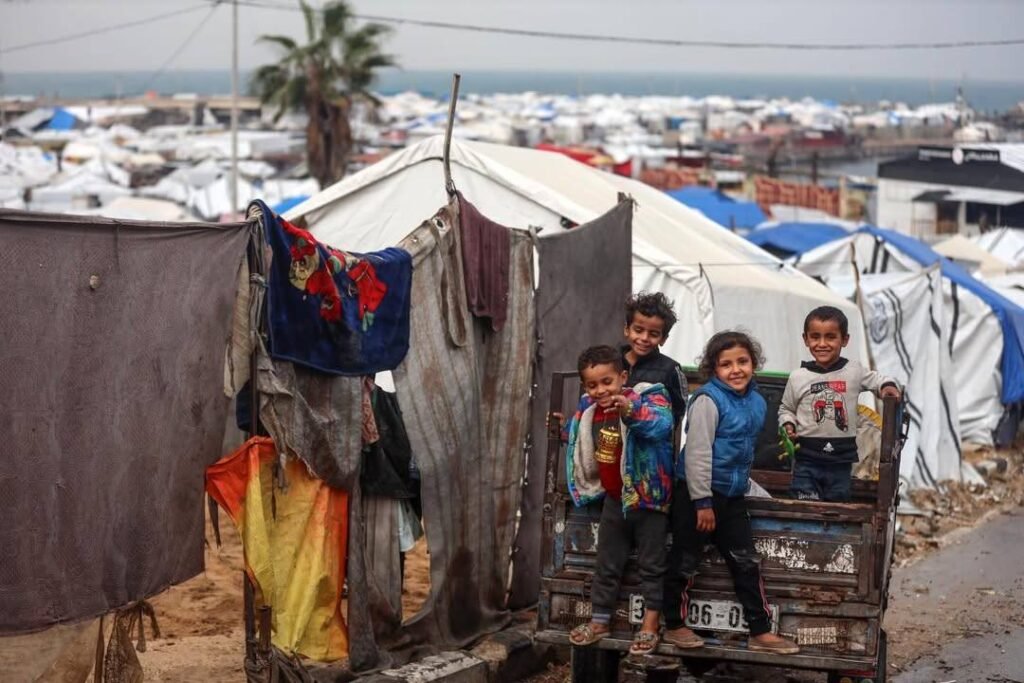
Gaza Herald _ A powerful winter storm sweeping across the Gaza Strip has transformed thousands of makeshift tents and plastic-sheet shelters into dangerous, collapsing structures, trapping families who have already endured repeated displacement throughout the war.
In al-Mawasi, a narrow coastal zone in southern Gaza’s Khan Younis, where tens of thousands sought refuge after being pushed from their homes, the situation has rapidly deteriorated. Officials warn that the storm, bringing floods, heavy rain, fierce winds, and hail, is expected to continue through the day, threatening the lives of more than 850,000 people sheltering in 761 overcrowded displacement sites.
Tents Flattened, Families Exposed to the Storm
Across al-Mawasi, strong gusts and unrelenting rainfall have shredded tents, flooded living spaces, and sent entire families scrambling for cover. What were once flimsy shelters cobbled together from tarps, scraps of wood, and salvaged debris now lie torn apart, the contents soaked and scattered.
“Everything is wet. The tent is gone. We have nowhere left to go,” one father said as he held his shivering children under a plastic sheet.
Humanitarian workers describe scenes of chaos, with families desperately trying to hold down their tents against the storm or salvage blankets and mattresses that have been ruined overnight.
A Coastline on the Verge of Collapse
Hundreds of thousands of displaced Palestinians are crammed along Gaza’s coastline in al-Mawasi, an area never meant to host large populations. With the storm battering the shore, parts of the ground have begun to collapse, sending sand and mud sliding down under the weight of the overcrowded camps.
In several locations, the earth near the shoreline gave way, causing tents to tip or fall into pits. Residents say they are terrified that another heavy wave or burst of rain could swallow more of the fragile encampments.
Two Years of Displacement, and Still No Safety
For many families, this is not the first time their shelter has been destroyed , merely the latest in a long chain of forced relocations stretching back more than two years of Israeli bombardment and ground operations.
Some have fled five, six, or even ten times since the beginning of the war, carrying nothing but the clothes on their backs. Now, even the little they managed to save is being washed away by the storm.
A woman from Khan Younis, standing in ankle-deep mud, said:
“Every time we think we have found somewhere safe, something new destroys it. First the bombs, and now the sky.”
Humanitarian Officials Warn of Catastrophe
Aid agencies say the storm could deal a devastating blow to a population already surviving without adequate food, sanitation, clean water, or proper shelter.
Health workers warn that exposure to the freezing temperatures, especially for children, the elderly, and the chronically ill, could cause a spike in respiratory infections, hypothermia, and waterborne diseases as floodwaters mix with sewage from shattered infrastructure.
With Israel continuing to block the entry of critical supplies, including winter tents and insulation materials, humanitarian groups caution that the storm will deepen an already unbearable crisis.
A Storm Made Deadlier by Siege and War
While storms are natural events, Gaza’s catastrophe is not. Years of siege, the destruction of infrastructure, and the forced displacement of nearly the entire population have turned ordinary weather into a lethal threat.
The Palestinian families of al-Mawasi are not simply battling rain; they are battling the consequences of a manufactured humanitarian collapse.

