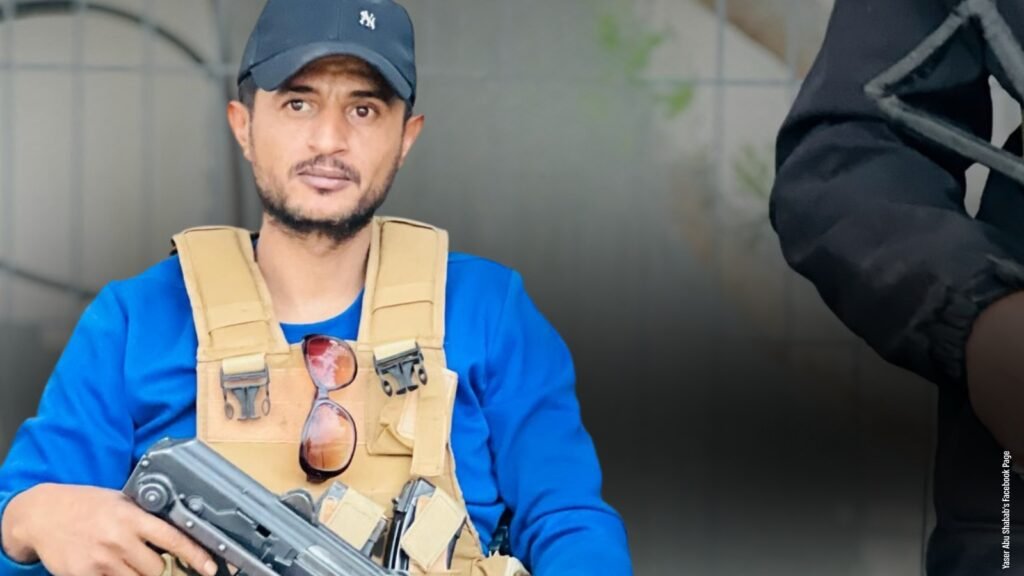
Gaza Herald_ The killing of Yasser Abu Shabab in Rafah has uncovered deep confusion within Israel’s security establishment and cast serious doubt on its attempts to build proxy forces inside the Gaza Strip. Although Israeli media outlets offered conflicting accounts of how he died, both Israeli and Palestinian analysts agree that his death marks a significant setback to Israel’s vision for governing Gaza after the war.
Israeli military radio confirmed that Abu Shabab was assassinated by unidentified individuals, describing the incident as “a negative development” for Israel. Meanwhile, Channel 12 claimed he died from injuries following a family dispute. Despite the contradictory narratives, what remains clear is that Abu Shabab was a central figure in Israel’s effort to create a model of local governance separate from Hamas, a plan that has now suffered a major blow.
Abu Shabab, a Palestinian from Rafah born in 1990, had been detained on criminal charges before October 2023. He was released when Israeli strikes destroyed Gaza’s security headquarters. His prominence grew after a May 2025 resistance operation that exposed an undercover Israeli unit operating near Rafah, revealing that Abu Shabab had been leading a group working directly with Israeli forces.
Military and security analyst Rami Abu Zubaida told Quds News Network that Abu Shabab’s death represents “the natural outcome for any militia operating under occupation.” He said the incident goes beyond a security failure, illustrating Israel’s inability to form a local alternative force inside Gaza or replicate a “South Lebanon Army”–style model. He noted that the group’s activities were quickly uncovered by the resistance and widely rejected by the local population, leaving Abu Shabab exposed despite Israeli protection.
Abu Zubaida added that Israel’s failure to protect him, as acknowledged in its own media, reinforces the reality that no proxy militia operating under Israeli supervision can survive inside Gaza. He emphasized that the resistance continues to maintain internal security oversight despite the conditions of war.
Israeli affairs specialist Alaa al-Rimawi noted that public debate in Israel has shifted from the details of the killing to concerns about the broader strategy of relying on local militias. He said Israeli officials are now questioning whether such groups can serve any meaningful role. Some view them as expendable assets pushed into frontline operations to reduce Israeli military casualties, while others argue they lack the social or political legitimacy required to govern the Strip.
Growing frustration within Israel has been highlighted by local media, with Channel 13 reporting that “Israel’s hopes of administering Gaza under its control are no longer viable.” Efforts to establish “green zones” in Rafah and Khan Younis, areas meant to be rebuilt under Israeli oversight, have also faltered.
Despite the setbacks, al-Rimawi noted that the Netanyahu government continues trying to recruit new local figures from influential families to form Israel-backed administrative structures, with American support. However, these attempts face a deep legitimacy crisis, as Gaza’s population remains firmly opposed to any body seen as collaborating with the occupation.
The killing of Yasser Abu Shabab has ultimately exposed the fragility of Israel’s plans for the “day after” in Gaza. It underscores the persistent inability of the occupation to engineer a local alternative capable of replacing the existing Palestinian political framework. More importantly, it reinforces a central reality: any force created under occupation lacks the political foundation, social acceptance, and security stability needed to survive within Gaza.