
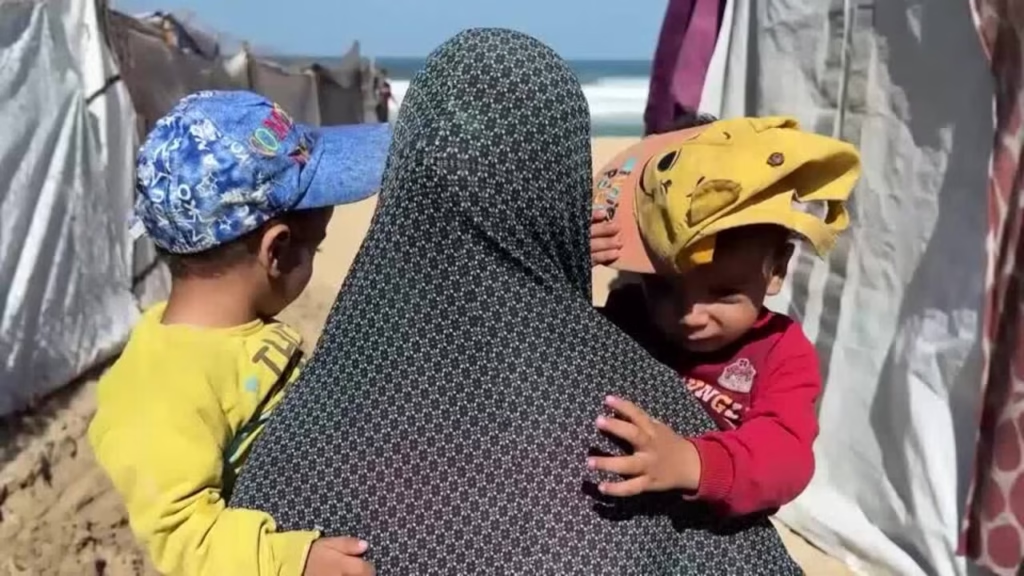
Gaza Herald_ Pregnancy and childbirth, the fragile beginning of human life, are difficult even in the best of circumstances. But for one Palestinian mother, among countless others in Gaza, the journey was a descent into terror.
When 35-year-old Iman al-Zard, living in the Tel al-Hawa area of Gaza City, discovered she was pregnant in early December 2024, she was already enduring Israel’s unrelenting bombardment and the near-total collapse of food, water, and essentials. She and her husband, Fadi al-Drimli, along with their two young children, Karim (4) and Mariam (3), were barely surviving amid daily scenes of death, wreckage, and chaos.
From the first days, Iman’s pregnancy was fraught with danger. Food was nearly impossible to find, prices had surged beyond anything affordable, and every morning began with a desperate search for a single meal. An egg, a basic source of nutrition for one child, was either absent from the markets or priced like a luxury they could never afford. Their hunger was constant; their bodies were weakening. While carrying her unborn child, Iman suffered without nourishment, medical follow-up, or rest.
What should have been months of preparing for a new life became months of gnawing hunger, dizziness, and sleepless nights drenched in fear. She drank water to quiet her stomach. She smiled at her children to hide the agony she felt. And each night, she whispered her prayers into the darkness, begging only for her baby to survive inside her fragile frame.
The Birth of a Child Under Fire
Iman went into premature labor, unable to complete eight months of her pregnancy. On July 2, 2025, she delivered her baby girl by C-section with no anesthesia at Al-Sahaba Medical Complex, the last functioning medical facility nearby. The newborn, weighing just two pounds, was named Mira. Iman returned home exhausted, physically shattered, and terrified of what awaited her and her baby.
Almost immediately, reality struck harder: diapers, formula, and basic infant supplies were nowhere to be found. She depended on relatives abroad to send small amounts of money to buy even the simplest necessities. There was barely enough food or clean water for the family of five. Still, Iman refused to give up; she sacrificed her own needs and often those of her older children to provide for her fragile newborn.
Nearly two months later, on August 26, Iman excitedly awaited her mother’s first visit since the birth. Her mother had been too frightened to travel during constant bombardment, but that afternoon, there was a rare moment of quiet. Iman allowed herself to hope, just briefly, that perhaps the worst had passed.
But in Gaza, quiet is always the prelude to disaster.
A Baby’s Life at Risk
Minutes before the afternoon call to prayer, Israeli special forces swept into Tel al-Hawa. Heavily armed vehicles stormed the streets, and explosions tore through the neighborhood. Doors blew apart, windows shattered, and dust and debris filled the air.
Iman’s mother, hearing the blasts, turned back for safety. Fadi had stepped out moments earlier to look for formula, flour, or any food he could find. That left Iman alone in the house with her three children as the attack began.
Panic overwhelmed her. Karim cried uncontrollably. Mariam screamed in terror. Baby Mira gasped for breath in the polluted air. Iman herself felt she might collapse, but she refused to. She knew they needed to escape, yet Israeli military vehicles boxed in the area.
Displaced neighbors who had lost their own homes rushed into hers seeking shelter. Amid the chaos, a stranger reached out toward Mira:
“Give her to me, I will protect her.”
Shaking and unable to manage her terrified older children, Iman handed him her baby. Clutching Karim and Mariam, she stayed frozen in place, helpless and desperate.
A Stranger’s Protection
After more than four hours trapped, Iman finally found a way to flee and reached a tree at the end of the street. But her heart was breaking. Had she made the right decision? Would the stranger return? Could he even find her through the smoke, gunfire, and collapsing buildings?
Then, through the haze of dust and destruction, she saw him, carrying baby Mira tightly in his arms as if she belonged to him. Relief washed over Iman like breath returning to her lungs. All three of her children were safe in her arms once more.
But the moment didn’t last. As she looked down at Mira to reassure herself, a massive explosion rocked the area, turning what had moments earlier been a neighborhood full of families into a wasteland of rubble and bodies. Iman screamed for help as her children wailed.
The only escape was by ambulance; any movement on foot was impossible under Israeli fire. Iman and the children were evacuated and, miraculously, reunited with Fadi, who had been blocked from returning by the heavy assault. Karim had suffered minor shrapnel wounds while sheltering behind the tree. Iman remained in shock.
They had survived, but their home had not.
Life Continues, But Without Stability
Today, Iman, Fadi, and their three children live in northern Gaza City in their mother’s overcrowded home, sharing space with dozens of other displaced people. Iman’s heart is still trapped in that day when she nearly lost everything. She is grateful for her children’s survival, but haunted by the reality into which she has brought her newborn.
Her story is not unique. It reflects the experiences of thousands of Palestinian mothers enduring identical terror every day, mothers who ask only for the most basic human rights: safety, food, clean water, and a future where their children can sleep without fear.
The people of Gaza are not asking for the extraordinary.
They are fighting simply to live.

