
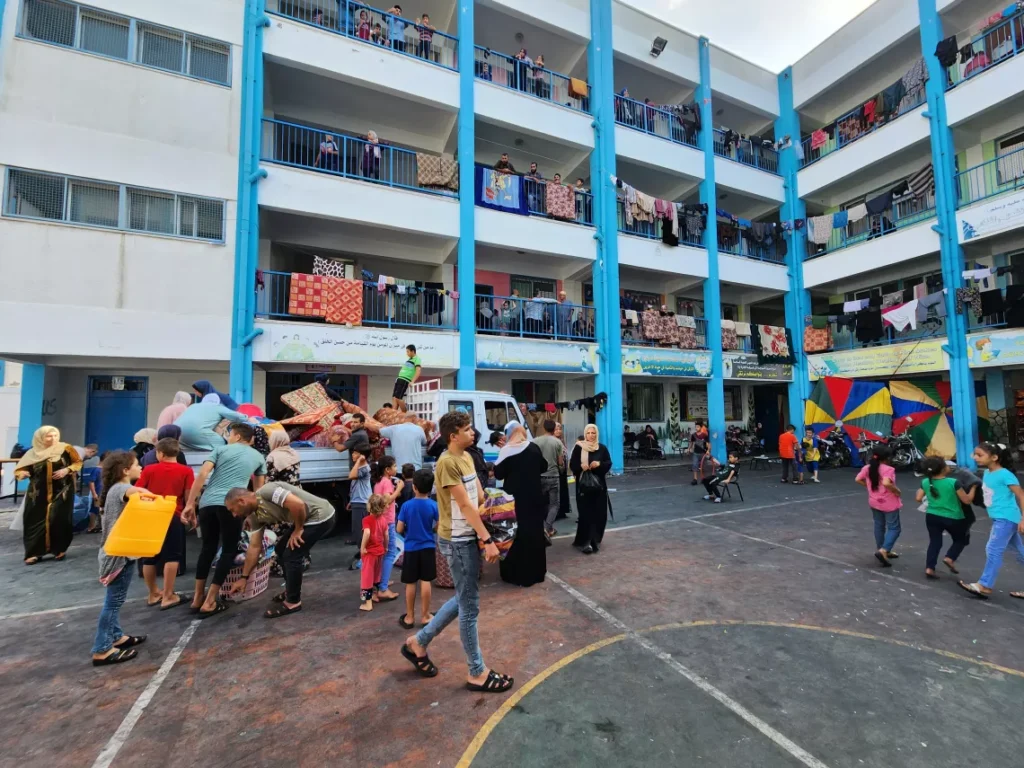
Gaza Herald_In Gaza, where devastation stretches as far as the eye can see, schools are among the few places where fragments of normalcy are being pieced together. After more than two years of relentless Israeli bombardment, the United Nations Relief and Works Agency for Palestine Refugees (UNRWA) is slowly reopening classrooms, even as many of them still bear the scars of war.
The reopening comes four weeks into a United States-brokered ceasefire that has done little to halt the suffering of Palestinians in the besieged enclave. Israeli air raids continue to strike various parts of Gaza, while restrictions on food, fuel, and medical aid keep daily life on the brink of collapse.
Since Israel’s campaign began in October 2023, Gaza’s education system has been gutted. More than 300,000 UNRWA students have been deprived of formal schooling, while 97 percent of the agency’s educational facilities have been damaged or destroyed.
What were once centers of learning have now become shelters for hundreds of thousands of displaced families. In many schools, children’s voices echo through the same rooms where families sleep, cook, and mourn their dead.
Reporting from Deir el-Balah, journalist Tareq Abu Azzoum found students and displaced families coexisting in cramped classrooms. Among them was Inam al-Maghari, a young Palestinian girl determined to reclaim her education.
“I used to study before, but we have been away from school for two years,” she told Al Jazeera. “I didn’t complete my second and third grades, and now I’m in fourth grade, but I feel like I know nothing.”
Her classroom looks different now. Desks are gone, replaced by thin mattresses and salvaged blankets. “Today, we brought mattresses instead of desks to sit and study,” she said.
UNRWA is attempting to rebuild a shattered education system from the ground up. According to Enas Hamdan, head of the agency’s communication office, “UNRWA strives to provide face-to-face education through temporary safe learning spaces for more than 62,000 students in Gaza. We are working to expand these activities across 67 sheltering schools throughout the Strip.”
Despite the devastation, the agency continues to provide online education for nearly 300,000 students—an extraordinary challenge in a place where electricity is scarce and most families have lost their devices or internet access.
For many displaced Palestinians, education has become both a symbol of resilience and an act of defiance. Um Mahmoud, a mother of five sheltering in one of UNRWA’s schools, said she and her family vacate their classroom several times a week to make space for lessons.
“We vacate the classrooms to give the children a chance to learn because education is vital,” she said. “We’re prioritising learning and hope that conditions will improve, allowing for better quality of education.”
But even as classes resume, Gaza’s children carry invisible burdens. Psychologists warn that more than 80 percent of them show symptoms of severe trauma, including insomnia, depression, and post-traumatic stress.
According to UNICEF, over 64,000 children have been killed or injured since Israel’s war began. For those who survived, the classroom is both a refuge and a reminder, a fragile space where they try to imagine futures that the war has repeatedly tried to erase.
Edouard Beigbeder, UNICEF’s regional director for the Middle East and North Africa, described Gaza as “the world’s most dangerous place to be a child.” He said:
“One million children have endured the daily horrors of surviving in Gaza, leaving them with wounds of fear, loss, and grief.”
In a land where even education has become a casualty, Gaza’s schools are trying to teach the one lesson that still matters: how to survive, and how to hope, against all odds.

