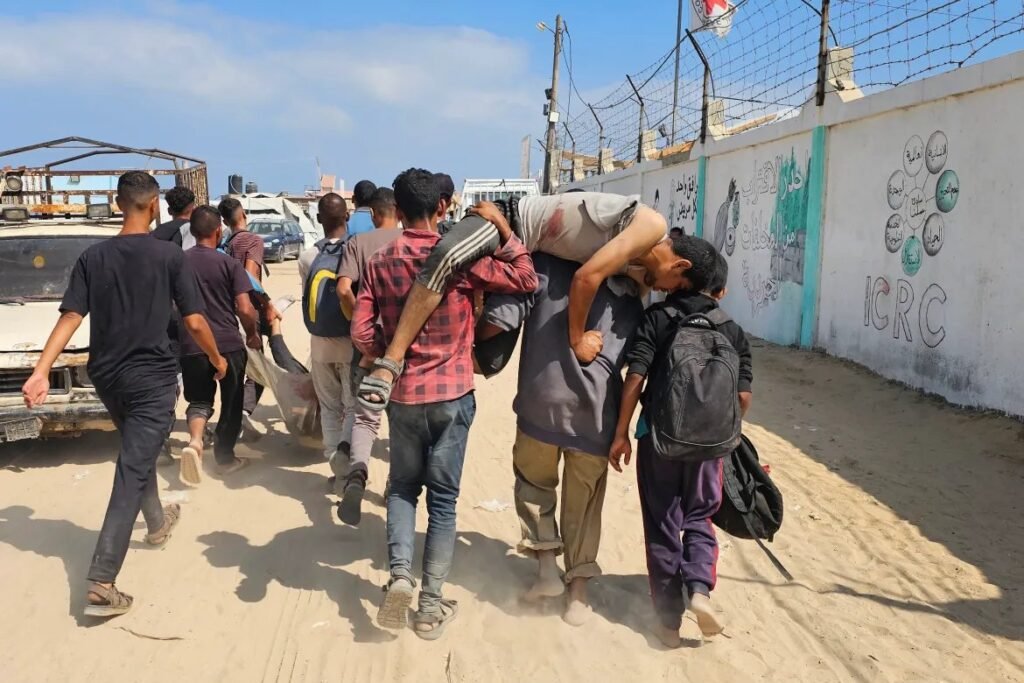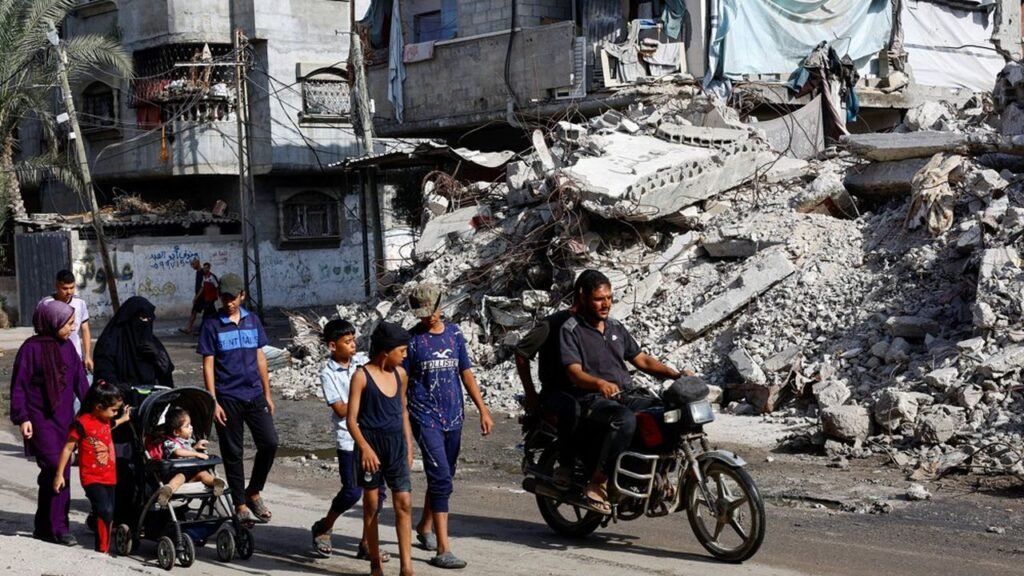
Gaza Herald — Palestinians in Gaza endured one of the deadliest days since the start of the U.S.-brokered ceasefire between Israel and Hamas, with more than a hundred people, including forty-six children, killed in Israeli air strikes across the Strip. The attacks, launched late Tuesday and continuing into Wednesday, shattered any illusion that the truce had brought calm or stability to the devastated enclave.
By noon on Wednesday, the Israeli military announced that it was “returning to the ceasefire” following “instructions from the political leadership,” but added that it remained ready to strike again “if necessary.” The admission came after Israeli warplanes hit more than thirty targets across Gaza, most of them residential areas.
Entire families were wiped out in the latest onslaught. In one central Gaza neighborhood, at least eighteen members of the same family, children, parents, and grandparents, were killed when their home was bombed. Civil Defense teams were once again seen digging through the rubble with bare hands and makeshift tools, searching for survivors. Several tents sheltering displaced families were also struck.
According to Gaza’s Ministry of Health, more than 68,600 Palestinians have been killed and 170,000 wounded since Israel’s genocidal war began in October 2023, numbers that continue to rise despite the ceasefire.
Israel’s Justification: A Dispute Over a Captive’s Remains
The Israeli government justified its latest attacks by citing what it called a “breach” in the ceasefire arrangement. On Tuesday, Israel claimed that the body of a captive transferred from Gaza did not match one of the 13 it expected under the terms of the agreement. Forensic tests later confirmed the remains belonged to Ofir Tzarfati, an Israeli soldier captured on October 7, 2023, whose partial remains had already been recovered months earlier.
The revelation sparked outrage among far-right members of Israel’s governing coalition, who have long opposed any truce or prisoner exchange. Families of Israeli captives also called for immediate retaliation. Within hours, Prime Minister Benjamin Netanyahu ordered a series of “powerful strikes” on Gaza, triggering widespread bombardment across the Strip.
Hamas’s armed wing, the Qassam Brigades, said it had planned to hand over the remains of another Israeli captive that evening but postponed the transfer after Israel’s attacks resumed. Israeli officials later accused Hamas of “staging” the recovery of the body, a claim the group dismissed as fabrication.
The International Committee of the Red Cross, which oversees the exchange of remains, confirmed that its staff “were not aware that a deceased person had been placed at the location before their arrival.”
Terms of the Ceasefire and Israel’s Violations
Under the October 10 ceasefire agreement, Hamas was to release the remaining twenty living captives in Gaza over several days and hand over the bodies of fifteen deceased Israelis. In exchange, Israel pledged to allow 600 aid trucks per day to enter Gaza and to refrain from new military operations.
In practice, these commitments have largely been ignored. Humanitarian aid entering the Strip remains a fraction of what was promised. Food, fuel, and medicine remain in critically short supply, while tents and prefabricated shelters are still banned. Israel has allowed limited heavy machinery only to retrieve the remains of its own citizens, not to assist in Gaza’s mass recovery of Palestinian victims.
A second phase of the truce, which would involve the deployment of an international stabilization force to oversee reconstruction, remains uncertain. Israeli officials continue to insist that Gaza will never become a sovereign Palestinian state and have openly advanced plans to annex large parts of the occupied West Bank.
Hamas Accuses Israel of Fabricating Excuses
Hamas described Israel’s latest attacks as “deliberate provocations” aimed at undermining the truce. The movement said Israel had already committed more than 125 ceasefire violations before the latest strikes.
Since the ceasefire began, at least 211 Palestinians have been killed and nearly 600 wounded in Israeli attacks, according to Gaza’s Health Ministry. Hundreds more bodies have been recovered from bombed areas.
Hamas also accused Israel of using the issue of captives’ bodies as a pretext for renewed aggression while simultaneously obstructing recovery efforts by preventing heavy equipment from entering Gaza. The group said its fighters recently discovered the remains of two deceased Israeli captives during search operations and were prepared to hand them over, a gesture disrupted by Israel’s latest air raids.
Hamas and other Palestinian factions have stated that they are willing to hand over Gaza’s civil administration to an independent technocratic body, while maintaining that armed resistance will continue as long as Israel’s occupation and apartheid policies persist.
Civilians Bear the Brunt Once Again
For Gaza’s civilians, the fragile ceasefire has meant little. The Israeli strikes of the past 24 hours have left entire communities in mourning once again. Nowhere in Gaza is safe; tents, shelters, and temporary housing have all become targets.
Residents spent the night in fear, as Israeli warplanes and drones circled overhead, and children clung to their parents amid explosions in the distance. Most Gazans say they have lost faith in any “ceasefire” that can be broken and reinstated at Israel’s discretion.
Since the beginning of the war, Gaza’s civilian population has borne the overwhelming burden of Israel’s military campaign. Families have been displaced multiple times; hospitals and schools have been reduced to rubble; and famine continues to stalk the population under blockade.
Global Reaction and the Path Ahead
Despite Israel’s repeated violations, Washington continues to offer full political and military backing. The U.S. administration insists that Israel has a “right to defend itself,” even as the truce collapses in practice.
President Donald Trump claimed on Wednesday that the ceasefire “is not in jeopardy,” a statement that drew widespread disbelief among Palestinians and international observers alike.
Mediators Qatar and Egypt, while condemning Israel’s violations, are working to keep the fragile deal from falling apart entirely. But on the ground, the reality is clear: for the people of Gaza, the ceasefire has offered neither peace nor protection.
As the rubble continues to rise and families bury their dead, one truth remains — Israel’s war on Gaza never truly stopped. It merely changed its name.