
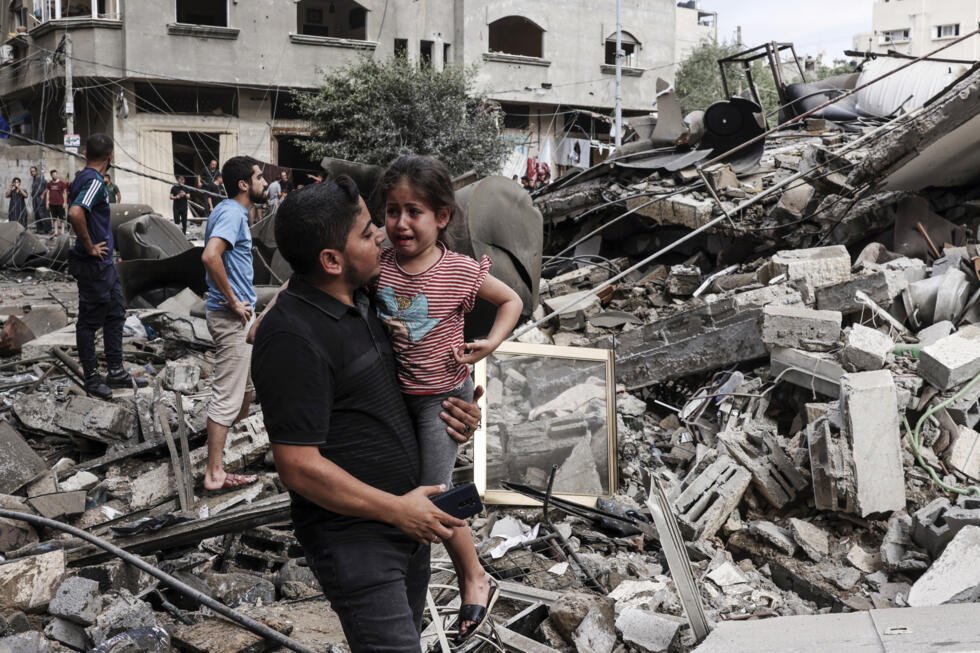
Gaza Herald_ In Gaza, the war’s end has not brought safety. Across the ruins of shattered neighborhoods, tens of thousands of tonnes of unexploded Israeli bombs remain buried beneath debris, posing a constant and deadly threat to survivors trying to rebuild their lives. As bodies continue to be recovered and rubble cleared by hand, Israeli restrictions on the entry of heavy machinery have left Gaza’s reconstruction efforts paralyzed.
At a news conference on Sunday, Gaza City Mayor Yahya al-Sarraj warned that the Strip faces an unprecedented humanitarian and environmental crisis. He stated that the city urgently requires at least 250 heavy vehicles and 1,000 tonnes of cement to restore basic infrastructure, such as water networks and wells. However, only a handful of aid trucks have been allowed to enter, far below the amount required to begin meaningful reconstruction.
According to local officials, around 9,000 Palestinians remain trapped under the rubble, yet new equipment entering Gaza is being directed primarily toward efforts to recover the remains of Israeli captives, not Palestinian civilians. “Palestinians understand that progress in ceasefire arrangements depends on the return of all the captives’ bodies,” one official said, highlighting how humanitarian priorities have been subordinated to political considerations.
Video footage shared online showed Red Cross vehicles arriving in southern Rafah after consultations with the Qassam Brigades, Hamas’s armed wing, to locate the remains of one Israeli captive. Israeli authorities have reportedly permitted Red Cross and Egyptian teams to operate beyond the so-called “yellow line”, an area that grants Israel effective control over 58 percent of Gaza, even under the current ceasefire terms.
For weeks, Israel had insisted that Hamas knew the exact locations of all captives’ bodies. But recent changes now allow limited foreign involvement in search and excavation efforts, suggesting a quiet policy shift. The decision followed reports that some tunnels remained inaccessible due to massive bomb damage, further complicating recovery operations.
Meanwhile, Prime Minister Benjamin Netanyahu reaffirmed Israel’s authority over Gaza, declaring that no foreign forces may operate in the territory without Israel’s approval. “We control our own security,” he said, emphasizing that the U.S. had accepted this stance. Analysts believe Netanyahu’s comments were aimed at reassuring his far-right base, amid growing signs that Israeli field operations are being constrained by international oversight. Washington reportedly now requires prior notification for any Israeli attacks inside Gaza.
Gaza: A City Buried Under Bombs
Experts warn that Gaza is effectively one giant minefield. Nicholas Torbet, Middle East director of the UK-based HALO Trust, described the territory as “a single vast city where explosives have hit every neighborhood.” He explained that many munitions designed to detonate upon impact have instead failed, leaving behind hidden killers scattered through residential zones. “The safest way to remove them,” he said, “is to detonate them in place using small controlled explosions.”
While his teams plan to work directly within communities to identify and clear bombs, progress is slow. Torbet noted that while the equipment required is simple, the danger is immense, and Gaza’s density makes large-scale clearance nearly impossible without heavy machinery, which Israel continues to block.
According to Mahmoud Basal, spokesperson for the Palestinian Civil Defense, Israel dropped at least 200,000 tonnes of explosives during its campaign on Gaza, and roughly 70,000 tonnes failed to explode. The unexploded ordnance now litters streets, schoolyards, and residential buildings, turning everyday life into a deadly gamble.
The danger is especially acute for children. In one tragic case, seven-year-old Yahya Shorbasi and his sister Nabila discovered what they thought was a toy near their home. “She was holding it, then he started tapping it with a coin,” their mother, Latifa Shorbasi, said. “We heard an explosion. It went off in their hands.” Yahya lost his right arm, while Nabila remains in intensive care.
Doctors at al-Shifa Hospital have described the situation as “a public health catastrophe in waiting.” Many injuries are caused by objects that appear harmless, cans, debris, or fragments of toys, but are, in fact, live bombs. The United Nations Mine Action Service reports that at least 328 people have already been killed or injured by unexploded ordnance since October 2023.
The Long Road to Recovery
The sheer scale of destruction means that clearing Gaza’s remaining bombs could take years and cost tens of millions of dollars. Experts estimate that tens of thousands of buried explosives, including landmines, mortar shells, and large bunker-buster bombs, still lie hidden beneath collapsed homes. For the families living above them, every step could be fatal.
Palestinian officials say the challenge is not just technical but political. Israel’s refusal to allow the entry of sufficient equipment or personnel for large-scale clearance has slowed progress to a crawl. “People are desperate,” one aid worker said.
“They want to rebuild, to move freely, to feel that the ceasefire actually means life, not waiting for another explosion.”
As Gaza’s residents sift through the wreckage of their homes, the war’s remnants continue to dictate their fate. Every piece of rubble may conceal a body or a bomb. For a people denied safety in life and in death, the path to rebuilding remains strewn with danger, defiance, and the unending demand to be free.

