
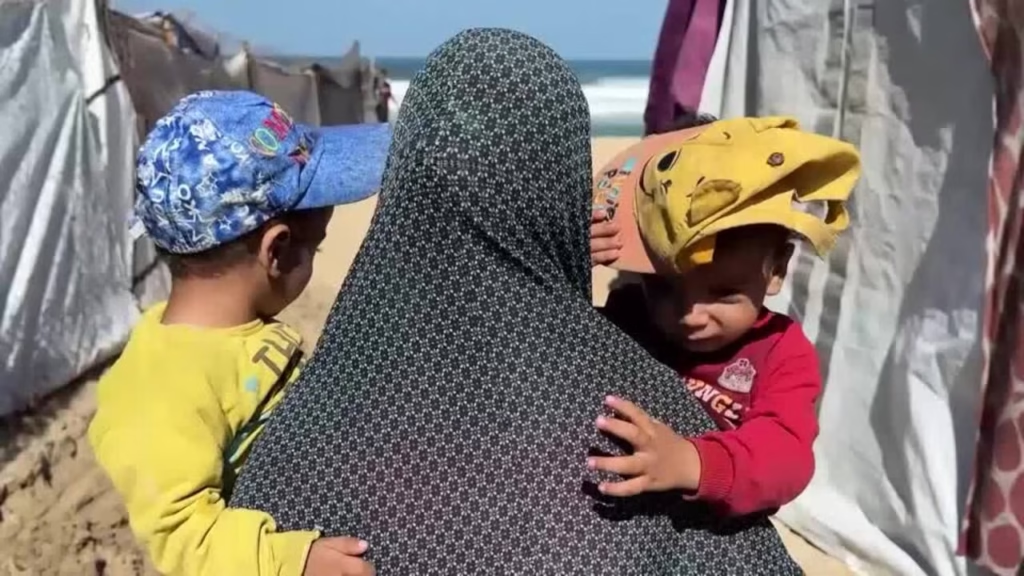
Gaza Herald_ In the aftermath of Israel’s genocidal war on Gaza, women across the devastated enclave continue to face unimaginable suffering. For many, the ceasefire has brought no peace, only the cruel endurance of slow death, untreated illness, and the trauma of shattered families. Amid the wreckage, their voices rise not in defeat but in desperate appeals for life, dignity, and justice.
Palestinian survivor Rasha Abu Sbeaka endured the full force of two years of relentless bombardment, four separate airstrikes, and two times being buried alive beneath collapsed concrete. Though she narrowly escaped death, the war left behind another deadly mark: stage 3 breast cancer. Israel’s destruction of Gaza’s health system, coupled with its ongoing blockade that bars her from traveling for treatment abroad, has trapped her in a race against time with no medical lifeline.
“I often feel like I’m going to die,” she said. “I hug my children every day as if it’s the last time.” The lack of medicine, functioning hospitals, and electricity has left thousands like her stranded in pain, their conditions deteriorating by the day.
Abu Sbeaka believes her illness may be linked to toxic emissions and residues from Israel’s extensive use of explosives. The skies of Gaza, long filled with smoke and ash, now hang heavy with invisible poisons. “I struggle to breathe sometimes,” she said, recalling nights when the air felt thick with death. Gaza’s once-fragile medical infrastructure now lies in ruins, with no chemotherapy, no radiology, and no alternative treatments available. “Everything is at a standstill,” she added. “We live in a state of waiting, waiting for medicine, waiting for a permit, waiting for a miracle.”
Beyond the physical suffering, the mental toll of isolation and despair is immense. “My psychological health has been destroyed,” she confessed. “I used to love life. Now I can barely recognize the person I’ve become.”
International organizations have managed to evacuate a few critical cases, but the numbers remain devastatingly small. With more than 15,000 patients in need of evacuation, including nearly 4,000 children, only a handful are being transferred each week. At this pace, it could take a decade for all those in need to reach treatment, while many will not survive that long. Despite the ceasefire’s terms, Israel continues to block the Rafah crossing, preventing medical evacuations and the entry of essential aid.
In southern Gaza, Mervat Sarhan fights her own battle, not against disease, but against the trauma of detention and loss. Sarhan was arrested by Israeli forces in May after soldiers disguised as women raided her home in Khan Younis. “They broke in at dawn,” she said. “They shouted, ransacked everything, and kept asking, ‘Where are you hiding them?’ We didn’t even understand what they were talking about.”
Moments later, her husband was killed before the eyes of their children. She was handcuffed and taken away, leaving her young ones behind in terror beside their father’s body. “They took me and my 13-year-old son,” she said. “The younger ones were left crying next to their dead father.”
During her five months of captivity, Sarhan endured beatings, electric shocks, and threats to kill her children. She was held for weeks in a dark, solitary cell “not fit for human beings,” she recounted. Interrogators questioned her about her husband’s alleged contacts, taunted her with threats, and told her she would never see her children again. “Every day felt like another death,” she said.
After her release under the ceasefire’s prisoner exchange, Sarhan returned to find her home destroyed and her life unrecognizable. “I came back, but everything I had was gone, my husband, my home, my peace,” she said. Many of the Palestinians released alongside her bore visible marks of torture and abuse; some of those who never returned were found blindfolded, mutilated, or executed.
The stories of Abu Sbeaka and Sarhan reflect the broader reality faced by Gaza’s women, mothers, daughters, and survivors who now carry the dual burden of physical wounds and unseen scars. Their testimonies stand as living proof of the lasting human cost of Israel’s war, a war that continues to claim lives long after the bombs have stopped falling.
Despite everything, hope persists. “We are determined to live,” Abu Sbeaka said. “But they must open the crossings, let us breathe, let us heal.”
Gaza’s women, standing amid the rubble, remain symbols of endurance, not merely victims of war, but witnesses to its cruelty and custodians of its truth. In their survival lies Gaza’s resistance, and in their voices, the world can still hear the echo of an unbroken people calling for justice.

