
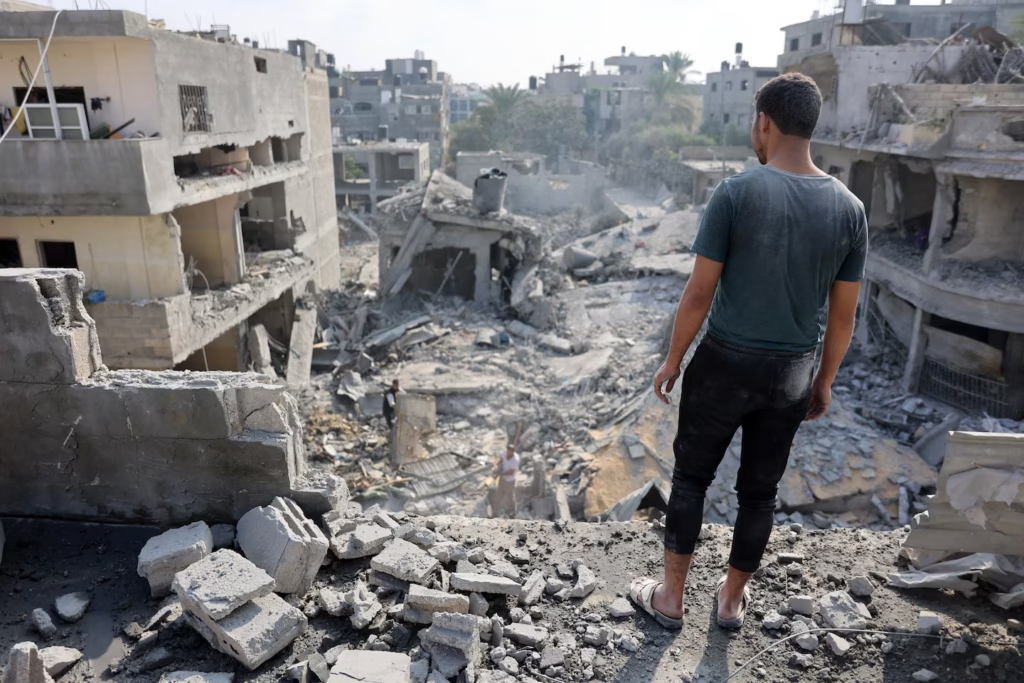
GAZA Herald— In the heart of Gaza City, amidst the skeletal remains of homes flattened by Israeli bombs, Palestinians continue to claw through the rubble with little more than hammers and shovels, searching not for survivors, but for the bodies of their loved ones.
Two weeks before the fragile ceasefire came into effect, an Israeli airstrike struck the home of Vivian al-Har, killing her entire family, her husband, four daughters, son, and brother-in-law. Their disfigured bodies were eventually pulled from the ruins and buried, but her eldest son still lies beneath the wreckage.
“I am left alone. I have no sons, no daughters, no husband, no one,” al-Har told Drop Site, tears streaking her face. “All the floors collapsed on my son. There are no tools, no equipment, and no one to help us. We appealed to the civil defense, but there are no services available. There is nothing left in Gaza.”
According to Gaza’s Civil Defense, the bodies of an estimated 10,000 Palestinians remain entombed beneath the ruins, as Israel continues to block the entry of heavy machinery and equipment needed to retrieve them. Among the dead are also several Israeli captives killed during the war, the only remains the world seems to care about.
At a press conference in Israel on Tuesday, U.S. Vice President JD Vance said, “It’s a focus of everybody here to get those bodies home so families can have a proper burial.” Yet he made no mention of the thousands of Palestinians still buried under the rubble, nor of the cemeteries bulldozed by the Israeli army.
Graveyards Turned to Dust
When al-Har visited the cemetery opposite the Al-Ahli Baptist Hospital, where her family is buried, she was met not with solace but devastation.
“I came here to see my son,” she said softly. “I buried him, but I don’t know where he is. The graves are destroyed, the tombstones broken. Everyone searches, but no one knows where their child lies. The dead are tormented, and the living are tormented.”
Across Gaza, families echo her despair. The Ministry of Health says only 432 bodies have been recovered since the ceasefire began, a fraction of those still missing.
“The issue of the martyrs under the rubble is one of the most difficult humanitarian challenges we face,” Civil Defense spokesman Mahmoud Bassal told Drop Site. “We are dealing with more than 71,000 tons of debris scattered across the Strip. Without heavy equipment or international experts, this task could take months, even years.”
In many parts of Gaza City, desperate residents have taken matters into their own hands. On Monday, groups of men and women were seen breaking through slabs of concrete with hammers, searching for the dead with bare hands. In one scene, a bloodied body was found, wrapped in a blanket, and carried to an ambulance.
“This is what shocks us,” Bassal said. “The world mobilizes its power to recover Israeli hostages, while ignoring ten thousand Palestinians under the rubble. A human being is a human being; both deserve a dignified burial. But the occupation, and the international system that enables it, seem to have forgotten what humanity means.”
The Missing
Beyond the dead are the missing, thousands whose families do not know whether they were killed, abducted, or imprisoned. Among them is 16-year-old Obeida Abu Mousa, who disappeared on May 29 after going to an aid distribution point run by the Gaza Humanitarian Foundation (GHF) near the Netzarim Corridor.
“I haven’t heard anything about him,” said his mother, Amina Salem Abu Mousa. “I don’t know if he’s dead, imprisoned, or eaten by dogs. I just want someone to tell me something.”
Over 2,600 Palestinians have been killed at or near aid sites operated by the GHF, a controversial U.S.- and Israel-backed entity that replaced the UN’s relief system earlier this year. “He went to get flour, food, anything,” Amina said. “We were starving. His brothers came back. He didn’t.”
Since the ceasefire and the dismantling of GHF’s operations, Amina visits the desolate site every day. “I come here just to breathe his scent. To know if he’s here. He was my companion, my helper. The house feels empty without him,” she said. “People say the army took him. I just want to know, did they detain him, bury him, or kill him? It’s my right to know where my son is.”
Bodies Returned, Bound and Burned
Over the past two years, Israel has detained thousands of Palestinians from Gaza and the West Bank, doubling the total prison population to more than 11,000. As part of the ceasefire deal, Israel released nearly 2,000 Palestinian prisoners, including 1,700 from Gaza, in exchange for 20 Israeli captives.
The remains of 165 Palestinians were also returned, some bearing the marks of torture and execution. Many arrived in Gaza blindfolded, with their hands and feet bound, their bodies burned or mutilated.
Health Ministry Director-General Dr. Munir al-Bursh condemned the treatment of the dead: “They were not returned as martyrs but as evidence of war crimes. These bodies were executed while restrained. The world must investigate this brutality and hold Israel accountable.”
Officials said at least 135 of the bodies had been held at Sde Neiman, an Israeli prison camp in the Negev desert infamous for torture and degradation. Leaked photos showed detainees caged, blindfolded, and shackled to hospital beds, many forced to wear diapers.
A Landscape of Loss
Across Gaza, grief is layered upon devastation. Families like Vivian al-Har’s dig with hammers, not excavators; mothers like Amina search the dust for their sons, not knowing if they are dead or alive. The rubble of Gaza is not only filled with the bodies of the dead, but with the shattered remains of dignity, memory, and humanity.
As Civil Defense teams continue to dig, often without tools or safety, Gaza stands as a mass graveyard, its people trapped between the living and the lost, waiting for the world to remember that they, too, are human.

