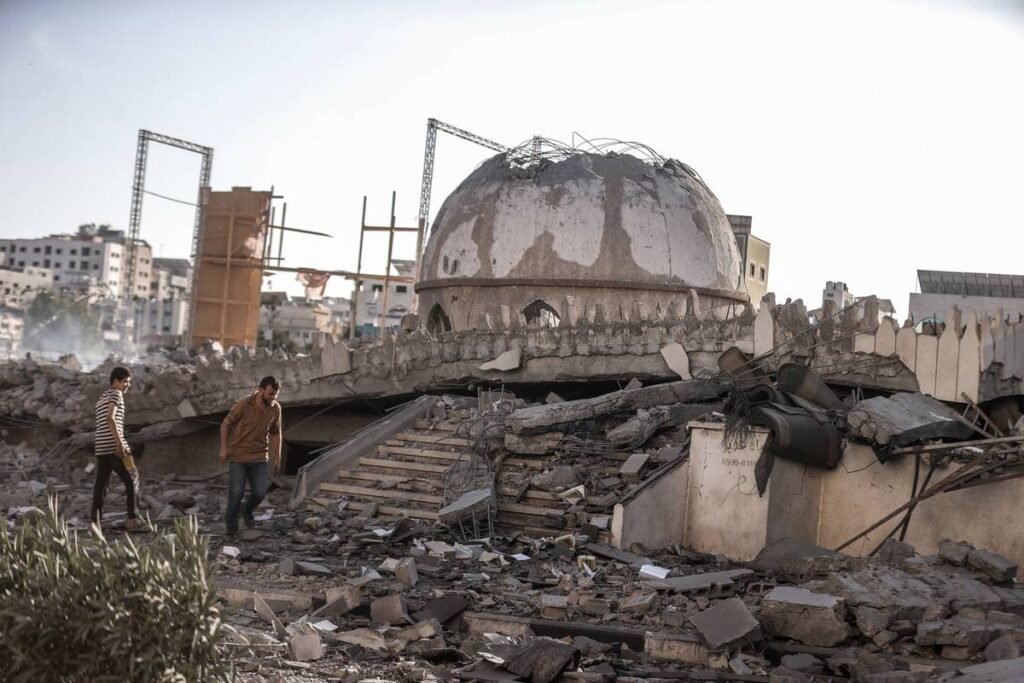
Gaza Herald_ Over the course of nearly two years of Israel’s genocidal war on Gaza, the ancient heart of Gaza City, once home to centuries of civilization, has been turned into a wasteland of rubble and ash. The old city, a living museum of Gaza’s layered history, has been deliberately erased by Israel’s relentless bombardment and ground assaults.
According to Gaza’s Government Media Office, more than 88% of the Strip’s infrastructure, including homes, hospitals, schools, and heritage landmarks, has been destroyed. Among the losses are Gaza’s oldest archaeological and cultural sites, many of which were not merely bombed but systematically looted and desecrated by Israeli soldiers.
Erasing a Civilization
The Old City of Gaza once consisted of four historic neighborhoods: Shuja’iyya, Al-Daraj, Al-Tuffah, and Al-Zaytoun, each rich with ancient mosques, Byzantine ruins, Ottoman-era buildings, and centuries-old streets that told the story of Palestine’s enduring identity. These neighborhoods came under intense and deliberate Israeli bombardment throughout the genocide, leaving behind a landscape unrecognizable to their own people.
A report by the Gaza Herald’s local correspondents confirmed that over 200 archaeological and historical sites across Gaza have been damaged or destroyed since the beginning of the war, including mosques, churches, hammams, and heritage homes that stood for hundreds of years.
The Plunder of Al-Basha Palace Museum
Among the most striking losses is the Al-Basha Palace Museum, a centuries-old Ottoman structure that once served as a cornerstone of Gaza’s cultural memory. The museum, known for its rare archaeological artifacts, was not only bombed but also looted by Israeli forces who advanced into the area during ground operations, according to museum director Nariman Khallah, speaking to Anadolu Agency.
“Many of the most valuable artifacts were stolen before the building was destroyed,” Khallah said, describing the invasion as an attack not just on the Palestinian people but on their history and identity.
Sites Reduced to Dust
During Israel’s ground invasion of Gaza City in December 2023, several of Gaza’s most iconic heritage sites were deliberately targeted, including the Great Omari Mosque, one of the oldest mosques in Palestine; Hammam al-Samara, a 700-year-old Turkish bath; the Al-Basha Palace, and Saint Porphyrius Church, one of the oldest Christian churches in the world. Many traditional heritage homes surrounding these landmarks were also demolished.
Experts and local historians accuse Israel of intentionally destroying cultural landmarks to erase Palestinian heritage and rewrite Gaza’s identity. “The occupation didn’t only bomb people, it bombed memory,” Khallah noted.
Once the last surviving example of Mamluk-Ottoman architecture in Gaza, Qasr al-Pasha has been turned into ruins by Israel’s bombardment. Located in the historic al-Daraj neighborhood, the palace had stood for nearly 900 years, built from Mamluk sandstone and Ottoman limestone, a timeless symbol of Gaza’s layered civilizations. Today, only fragments of its ancient walls remain.
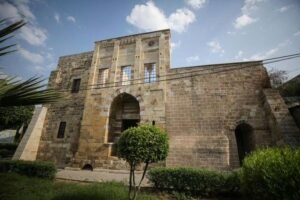
The site that once housed a museum of rare archaeological artifacts has now become a refuge for displaced Palestinians, whose homes were destroyed in Israel’s ongoing genocide. On the palace’s shattered foundations, families have pitched tents, a tragic symbol of how Gaza’s living heritage has been replaced by survival camps.
Speaking with deep sorrow, museum director Nariman Khallah recalled the palace’s long history: “This palace dates back to the late Mamluk period (1260–1516) and the beginning of the Ottoman era (1516–1917).” Over the centuries, the palace’s role evolved from a seat of governance and lawmaking to a police post, then an educational building. In 2010, it was transformed into a museum exhibiting relics from the Greek, Roman, Byzantine, and Islamic eras.
During Israel’s ground invasion of the area, its forces demolished and bulldozed most of the palace structure and looted several artifacts, according to Khallah. While she did not specify which items were stolen, local reporters confirmed that the museum section of Qasr al-Pasha was completely leveled, another act in Israel’s systematic erasure of Gaza’s cultural and historical identity.
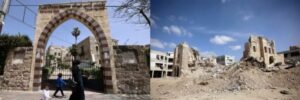
Pasha Palace before and after destruction
Standing for over 1,400 years, the Great Omari Mosque was one of Gaza’s most treasured religious and historical landmarks and the third largest mosque in Palestine, after Al-Aqsa Mosque in Jerusalem and the Ahmad Pasha al-Jazzar Mosque in Acre. Once a place of prayer and continuity for generations, it now lies in ruins after Israeli bombardment and bulldozing during the December 2023 ground assault.
Covering an area of 4,100 square meters, with a courtyard spanning 1,190 square meters, the Omari Mosque was not just Gaza’s largest but also one of its most sacred symbols of resilience and faith.
According to Nariman Khallah, director of Gaza’s archaeological museum, the Israeli army “deliberately bulldozed and shelled the mosque” during the same period that saw the destruction of nearby historic sites, including Qasr al-Pasha.
Once a cornerstone of Gaza’s spiritual and cultural identity, the Omari Mosque now stands shattered, its minarets and domes turned to rubble, another casualty in Israel’s ongoing war to erase the physical and cultural heritage of Palestine.
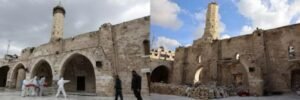
The Great Mosque before and after its destruction
Khallah explained that one of the main targets of Israel’s assault on the Great Omari Mosque was its historic library, which dated back to the Mamluk era. The library once housed rare manuscripts and ancient books frequently used by Palestinian researchers and scholars, a priceless intellectual treasure now lost beneath the rubble.
The Samra Bathhouse: Another Chapter of Gaza’s Erased History
Another historical landmark that fell victim to Israel’s campaign of destruction was Hammam al-Samra (the Samra Bathhouse), one of the oldest public baths in the region and a testament to Gaza’s centuries-old urban life.
In the latest chapter of cultural devastation, the historic Samra Bathhouse, Gaza’s last remaining traditional hammam, was deliberately destroyed during Israel’s ongoing genocide against the Palestinian people.
 Khala, a local historian, confirmed that “the Samra Bathhouse, the only remaining historic bathhouse in Gaza City, was completely demolished by the Israeli occupation.”
She voiced hope that Gaza’s archaeological and heritage sites could one day be rehabilitated and rebuilt “through the efforts of citizens, the Ministry of Antiquities, and with the support of international institutions.”
“These places tell the story of who we are,” she said, stressing that such landmarks embody the collective memory and resilience of the Palestinian people. “They must be preserved for future generations to study so that our history is not erased with the stones that once carried it.”
Church of the Privyrius
 Christian sites have not been spared from Israel’s deliberate targeting during the ongoing genocide, which has claimed numerous civilian lives. On October 19, 2023, the Israeli army deliberately struck the Church of Saint Preverius in Gaza City, the third-oldest church in the world, originally built in 425 AD.
The attack killed 19 people who had sought refuge inside the church to escape Israeli airstrikes. Observers described the bombing as a calculated attempt to erase Palestinian identity entirely and forcibly displace Palestinians from their land.
One Christian survivor, who lost 12 family members in the church strike, including three of his children, stated that the rocket attack “led to the martyrdom of a large number of members of the Christian community.”
This deliberate targeting of religious sites underscores Israel’s systematic campaign of destruction in Gaza, aiming to terrorize and displace Palestinians regardless of faith or age.
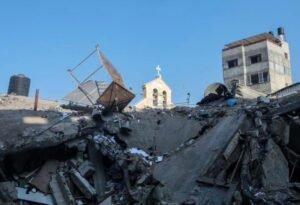
St. Porphyrius Church after the destruction
Christian places of worship in Gaza have not been spared from Israel’s deliberate bombardment campaign during the ongoing genocide, which has killed and wounded tens of thousands of civilians. On October 19, 2023, the Israeli army intentionally struck the Church of Saint Porphyrius in Gaza City world’s third-oldest church, originally built in 425 AD, killing 19 people who had sought refuge inside its walls to escape relentless airstrikes.
The victims were unarmed civilians who believed the church to be a sanctuary. For Gaza’s Christian community, the only option during the war was to take shelter in churches, long regarded as sacred spaces off-limits in war. “Unfortunately, for the Israeli occupation, nothing is sacred,” said one survivor who lost 12 members of his family, including three children.
Witnesses noted that the attack on the church was a calculated attempt to inflict both human and cultural loss on the Christian community. For decades, Gaza’s Christian population has been dwindling due to emigration, numbering fewer than 2,000 before the genocide began, according to local Christian institutions. Around 70 percent belong to the Greek Orthodox Church, while the rest are Latin Catholics.
The ongoing war has severely damaged three churches across the Strip and targeted the Orthodox Cultural Center in the southern Rimal neighborhood of Gaza City. According to Gaza’s Government Media Office, Israel has also destroyed 206 archaeological and heritage sites during the genocide.
Backed by the United States, Israel’s war on Gaza from October 7, 2023, to January 19, 2025, resulted in over 160,000 Palestinians killed or injured, most of them women and children, and more than 14,000 missing. A truce agreement between Hamas and Israel took effect on January 19, including a prisoner exchange and a phased ceasefire plan.
The Destruction of Gaza’s Cultural Memory
The war has also ravaged Gaza’s cultural and intellectual heritage. The historic al-Omari Library suffered cracks and severe structural damage, requiring urgent restoration. Known as Gaza’s largest public library and a vital repository of historical documents, it served as the collective memory of the city.
Eyewitnesses said Israeli forces deliberately bombed the municipal public office complex on al-Wehda Street, destroying thousands of books and archives across various fields. Gaza Municipality spokesman Hosni Mehanna described the attack as “a strike against culture, heritage, and collective memory,” adding that it reveals Israel’s broader goal of spreading ignorance and erasing Palestinian identity.
“The Israeli occupation executed thousands of historical documents and books with direct airstrikes,” Mehanna said. “This is a crime against Palestinian culture and knowledge itself.”
He also confirmed that Israel destroyed the Rashad al-Shawa Cultural Centerone of the oldest and most prominent cultural institutions in Palestine, alongside hundreds of other educational and cultural facilities.
Mehanna called on UNESCO and international cultural organizations to intervene immediately to preserve Gaza’s remaining heritage and protect what is left of its cultural institutions.
A Systematic Assault on History
Since the war began, Israeli bombardment has demolished 103 government facilities and 266 schools, 67 of which are now completely out of service. Many of these schools were turned into shelters for displaced families, leaving Gaza’s educational future in jeopardy. According to the Palestinian Central Bureau of Statistics, more than 1.3 million children in Gaza were enrolled in schools before the war.
Israel’s attacks have also destroyed four major museums, al-Khudari, al-Aqqad, Shahwan, and Khan Younis museums, alongside eight smaller heritage museums. Priceless artifacts have been lost, including the statue of the Canaanite goddess Anat from the Khan Younis Museum and a rare funerary mask from the Khudari Museum.
Archaeologist Dr. Abu al-Nasr confirmed that detailed reports documenting the destruction were submitted to the Arab Archaeologists Council, the Union of Arab Historians, and UNESCO. These findings were compiled in a book titled “Gaza’s Antiquities and the War on History,” which chronicles the destruction of Gaza’s archaeological sites before and after the war.
Abu al-Nasr noted that what has happened to Gaza’s historical sites is comparable to the devastation of world wars and the burning of Baghdad’s manuscripts during the Mongol invasion. Some sites can be restored, he added, but others are lost forever. “Rebuilding replicas may be the only way to keep their memory alive,” he said.
He urged that all destroyed or damaged sites be marked and documented as historical evidence to expose Israel’s systematic policy of erasing Palestinian history and identity.