
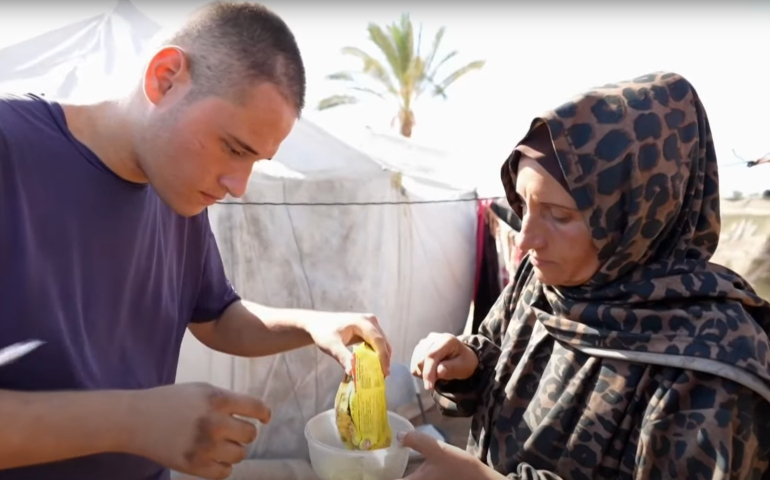
GazaHerald – In the heart of the Gaza Strip’s chaos, where bombs fall without warning and families are torn from their homes again and again, a mother clings to her son’s trembling hand, trying to shield him from a world collapsing around them.
For Abeer Hassan, every day is a fight not just for survival but for the fragile peace of mind of her son, Abdallah, who lives with autism. They were forced from their home in Deir el-Balah under relentless Israeli bombardment, another family among hundreds of thousands pushed into flight since the war began in October 2023.
But displacement is especially cruel for a child like Abdallah. “As people started fleeing, we were urged to leave too,” Abeer recalls. “Abdallah watched cars packed with families racing away. He would return to the tent tense and nervous, using sign language to express his fear.”
“No place to go”
Their first stop was a makeshift displacement camp known as Ameera. It was already overflowing; there was no space even for a small tent. From there, they were told to move near Salah al-Din Street, an area so dangerous that many fear passing through it at all.
“My daughters and I were crying, and Abdallah was getting more agitated, making strange sounds,” Abeer says. “The scorching heat is unbearable, and we don’t know where to go.”
The so-called “safe zones” offered by Israel, like Al-Mawasi, have proven to be anything but safe. Even there, air strikes rain down, turning the supposed refuge into another deadly trap. Each evacuation order brings another round of fear, confusion, and suffering, and for Abdallah, whose world thrives on routine and stability, it is a torment beyond words.
A child’s world unraveling
The unending explosions have changed Abdallah. He now spends his days wandering the streets, restless and anxious. He’s developed a compulsive habit of pulling out his hair, so much so that his family had to cut it short to stop him from hurting himself.
“I started giving him sleeping pills again, just to stop him from going outside during the heat,” Abeer says, her voice heavy with exhaustion. “My phone broke just before we were displaced. It was the only thing that calmed him: games and videos. Now, I have nothing to distract him.”
The burden is crushing. “We are all under immense pressure, young and old,” she whispers. “At one point, I asked God to take our lives together so Abdallah wouldn’t be left alone. Not everything he needs is available here.”
The scale of devastation defies comprehension. Nearly two years of relentless Israeli attacks have killed at least 66,005 people and injured 168,162 more, according to the Gaza Ministry of Health.
Each statistic hides a thousand shattered stories, children like Abdallah who cannot understand why the ground shakes, and mothers like Abeer who cannot explain why their world is gone.
For them, there is no “safe zone,” no escape from the trauma that seeps into every corner of their existence. They survive one day at a time, trapped between warplanes and tents, holding on to one another as the world turns its gaze away.

