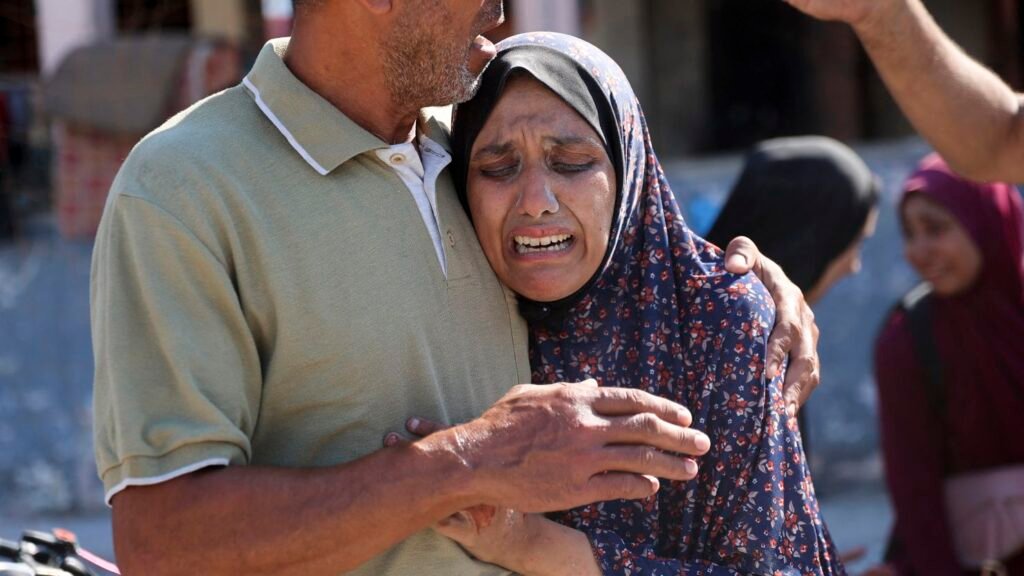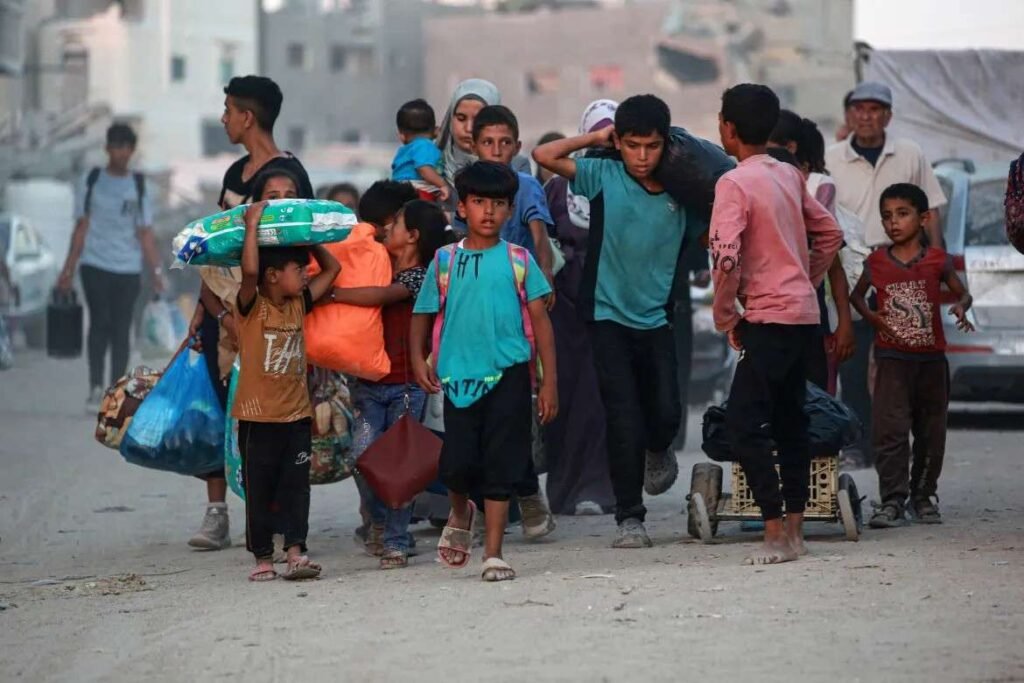
GazaHrerald – Palestinians fleeing Gaza City under heavy Israeli bombardment say they are being pushed into a life of desperation, with no safe place left to go. Families are pitching tents on highways, garbage dumps, and even cemeteries, as overcrowding and bombardment make survival nearly impossible.
On the coastal road, displaced families live under flimsy sheets beside speeding cars and shellfire. A pregnant woman was seen begging for drinkable water, saying she had not found any for more than a week.
“There are no food distribution centers. There’s no emergency response. There’s nowhere to go to the bathroom,” said one man.
With central and southern governorates overwhelmed, hundreds of thousands of people have been forced into al-Mawasi, west of Khan Yunis. Once a narrow strip of sandy land, it now holds nearly one million displaced people but has no infrastructure, healthcare, or sanitation.
Israel has continued to shell the area despite designating it a “humanitarian zone,” killing scores of evacuees in what survivors describe as massacres.
Collapsed Tents, Overcrowded Shelters, and Rising Deaths
Ismail al-Thawabta, director general of the Gaza Government Media Office, said the conditions for the displaced have become catastrophic. Out of 135,000 tents, he reported that 125,000 have collapsed due to bombardment, weather, and the lack of supplies since Israel sealed the crossings in March.
“About 93 percent of displacement tents are no longer suitable for living, leaving families to face hunger, disease, and death without shelter,” he warned.
Al-Thawabta added that Israel has directly targeted 293 shelters since the start of the war, compounding the suffering of nearly two million Palestinians forcibly displaced. He also accused Israel of “engineering chaos” by supporting armed gangs inside Gaza, creating a security vacuum that further threatens the lives of those displaced.
The desperation has pushed some families to rent small patches of land at exorbitant costs, while others have sought refuge among gravestones. “We settled here because we were forced,” said Randa Musleh, a displaced woman who fled Beit Hanoun with her eleven children. Sitting inside a thin tent in Khan Yunis cemetery, she explained that rent for a tiny piece of land can reach 1,000 shekels ($300) a month, far beyond the means of most families.
“I walked to find land for my children, somewhere with life and people,” Musleh said. “Here in the desert and cemeteries, there is no water. My children walk almost four kilometers just to bring some back. There are snakes and scorpions. Life here is unbearable.”
No Escape, No Shelter, No Relief
Doctors Without Borders has warned that over one million people in Gaza face renewed terror after receiving evacuation orders. For the elderly, pregnant women, the critically ill, and the wounded, fleeing is impossible.
Those who remain in Gaza City face death from constant bombardment; those who flee south encounter hunger, disease, and repeated Israeli strikes on displacement zones.
The suffering deepens daily. Survivors who manage to escape find themselves stranded in overcrowded camps or desolate stretches of land, often without food, clean water, or medical care. Even “safe havens” have been bombed, leaving families with the grim reality that no place in Gaza is safe.
Analysts and humanitarian officials say Israel’s campaign has gone beyond direct military operations. Forced expulsions, bombardment of designated safe zones, destruction of homes, and targeted strikes on shelters appear aimed at making displacement inevitable and permanent.
Ground invasions of residential neighborhoods, where houses are destroyed or booby-trapped, ensure return is impossible.
For Palestinians expelled from Gaza City, the choices are stark and cruel: to live on highways, garbage dumps, deserts, or cemeteries, or to face bombardment at home.
“Displacement in Gaza now means hunger, disease, and death,” al-Thawabta said. “This is the reality our people are enduring.”