Gaza Herald — With sunken eyes that reflect exhaustion and hunger, Mahmoud Ayoub, 33, carries his two young children and what little belongings he could save. He fled his home in Gaza City’s Sheikh Radwan neighborhood after relentless Israeli bombardment forced tens of thousands to abandon their homes since August, when the occupation army announced its intention to seize Gaza City.
Mahmoud’s journey has been one of repeated displacement. First, he sought refuge in the neighboring al-Nasr district, hoping to find a haven. But within a week, he was forced to move again. His neighbor, a well-known trader who owned a water well that supplied dozens of families, fled to central Gaza. The moment he left, water stopped flowing for the entire block. “Our lives were tied to that well,” Mahmoud explains.
Rejecting forced relocation to central or southern Gaza, Mahmoud has chosen instead to remain displaced within the city. A friend in the al-Sabra district, equally determined not to flee, now shelters him, though that neighborhood itself is collapsing under thirst.
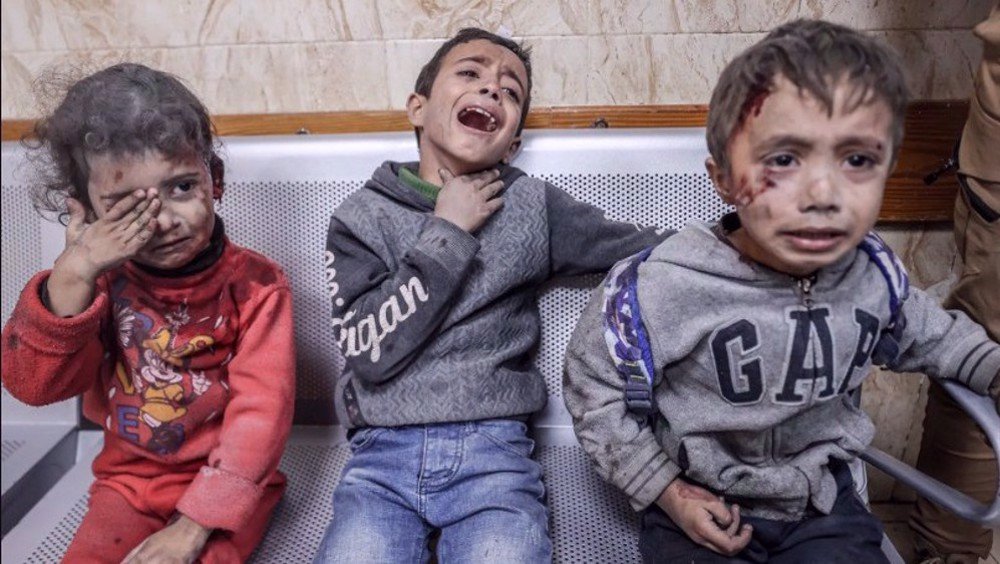
In Gaza today, water is no longer a right but a battlefield. Civilians line up for hours under bombardment, hoping to secure a few liters of drinking water from scarce donations. As Israel escalates its genocidal war for the 24th consecutive month, combining bombing, starvation, and forced displacement, thirst has become a new frontline in the struggle for survival.
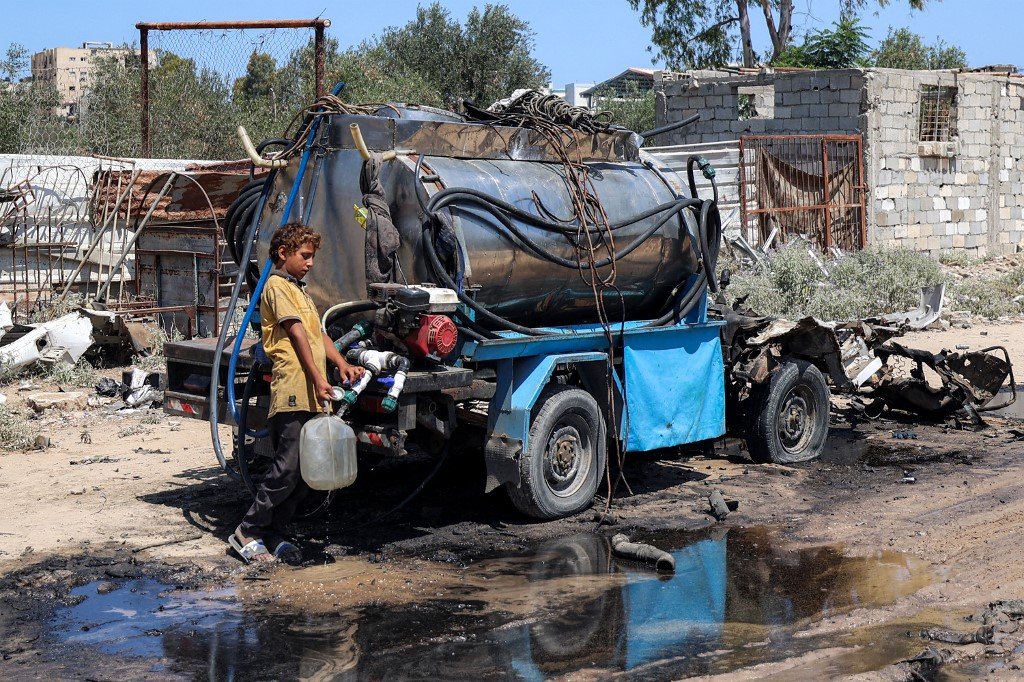
“I sometimes wait a week for a water truck that never comes,” Mahmoud says in despair. The few available bottles sell at impossible prices: 16 liters for 5 shekels. Many families, including his own, are forced to mix salty, brackish water with their drinking supply. Even the water once used for cooking, bathing, and washing is disappearing, poisoned by the destruction of wells and sewage systems.
Collapse of Water Systems
The Gaza Municipality has sounded the alarm, launching a campaign it calls “A Call for Life in Gaza.” Officials warn that available water has dropped to less than 25 percent of daily needs. Israeli-controlled pipelines provide around 15,000 cubic meters of water a day, often interrupted, while local wells produce an additional 10,000 cubic meters. This is far from enough for a population of more than 2 million under siege.
Sewage is now overflowing into streets and rainwater reservoirs, while mountains of uncollected garbage fester in residential areas. With the threat of an Israeli ground invasion still looming, municipal officials warn of “an accelerating humanitarian disaster” threatening hundreds of thousands of civilians who refuse to abandon Gaza City.
Epidemics on the Horizon
The UN Office for the Coordination of Humanitarian Affairs (OCHA) reports that over 70 percent of desalination plants have been destroyed or shut down due to Israeli airstrikes and a lack of fuel. Water networks and sewage lines have been widely damaged, causing serious leaks and contamination. OCHA warns that “the destruction of water sources is worsening the catastrophic situation and exposing civilians to deadly diseases.”
Oxfam estimates that Gazans are now surviving on less than 3 liters of water per day per person, far below the global humanitarian minimum of 15 liters. It condemns Israel’s use of water as “a weapon of war” and “a blatant violation of international humanitarian law.”
Doctors Without Borders (MSF) has also raised alarm over an “unprecedented rise” in cases of scabies, cholera-like diarrhea, and other waterborne diseases due to the collapse of sanitation systems. Their teams report being able to bring in only a fraction of the purification supplies needed due to Israeli restrictions.
The United Nations has stated plainly: “Depriving civilians of water and food constitutes the use of siege as a weapon of war.” It has urged the immediate opening of humanitarian corridors, blocked since March 2 when Israel sealed Gaza’s crossings to food, medicine, fuel, and aid.
Mounting Human Toll
Since the beginning of the genocide, Gaza’s health authorities have documented over 1.7 million water-related illnesses, including diarrhea, hepatitis, and intestinal infections. At least 447 Palestinians, among them 147 children, have already died from dehydration and malnutrition.
The reality for Mahmoud and countless others is stark: survival in Gaza is no longer about escaping bombs alone. It is about fighting for each sip of water, each drop that can mean life or death.