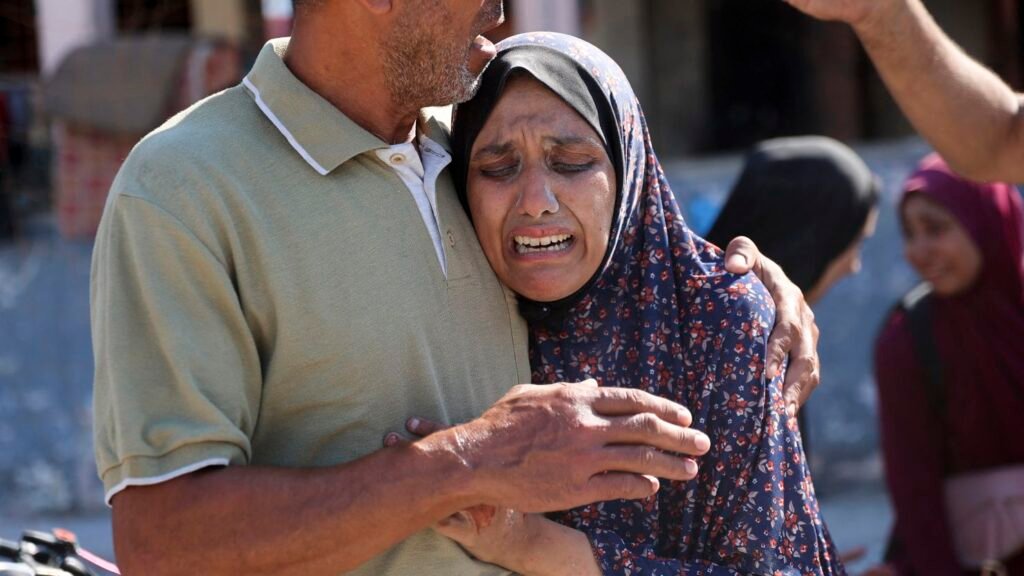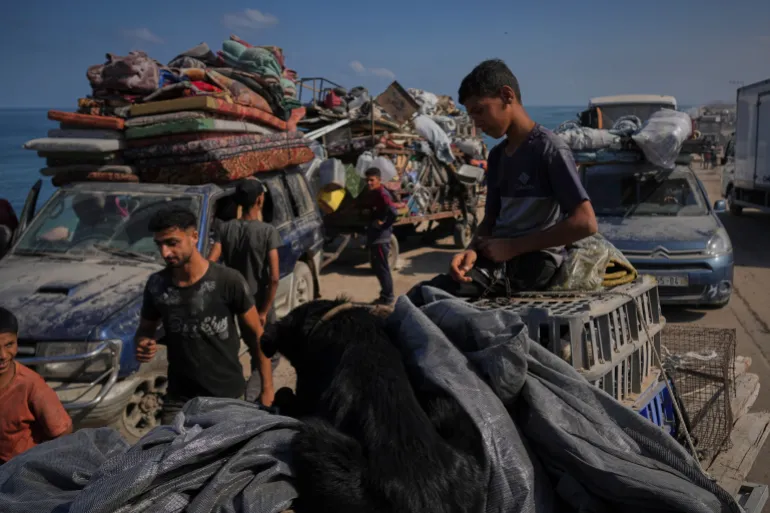
GazaHerald –Tears, fear, and desperation fill Gaza’s streets as hundreds of Palestinian families are forced to abandon their homes, fleeing into the unknown under constant fire.
Gaza City is burning. Amid a relentless wave of airstrikes, artillery shelling, drones, and armored vehicles, hundreds of families carry their children and clutch what few belongings they can salvage. Entire neighborhoods have been erased, while others are inaccessible, turning daily life into a struggle between survival and death.
Women cradle their infants, children stumble in exhaustion, and the elderly are pushed on makeshift carts. Many have been on the road since midnight. There is no transport, no refuge, only chaos and tears. Parents look into their children’s eyes, knowing they have nothing left to offer them, not food, not medicine, not safety.
“We have been fleeing since the morning. We are very desperate,” one father said, his voice breaking. “There is no shelter, no refuge, only fire from the sky.”
For families in Gaza City, displacement has become a way of life. Residents speak of packing “emergency bags,” a state of permanent readiness to abandon their homes whenever danger draws close. Thirty residential blocks have been struck in recent days, places where families had once sought safety. Now, people leave not by choice but because death stalks every street.
The destruction is staggering. Local officials confirm that between 70 and 80 percent of the city’s buildings and infrastructure have already been destroyed, along with most municipal vehicles and equipment. Over 1.2 million people, including 400,000 from the north, are now crammed into less than 40 percent of Gaza City. Families pitch tents on sidewalks and beaches, confined to a narrow strip bordered by the sea on one side and death on the other.
The human cost grows heavier with each passing night. Gaza endured one of its bloodiest nights after a storm of airstrikes, artillery, drones, and armored vehicles turned the city into a furnace of fire and smoke.
Residents compared the scenes to the horrors of Judgment Day, as entire neighborhoods collapsed into rubble. Dozens were killed, and countless others remain buried beneath the ruins.
“They are destroying everything,” said one survivor. “We hear the tanks, we hear the explosions, and we do not know if we will survive until morning.”
Amid this devastation, mothers carry a silent burden. Duaa Abu Mustafa sits next to her daughter, Maryam, praying for a miracle that would allow her to leave for medical treatment. “Every day, I die with her,” she whispered. “I am her sole provider, and I wish I could see her play like other children.”
For nearly two years, food and medicine have been turned into weapons of war. The blockade has condemned Gaza’s children to hunger and disease. Hospitals, stripped of supplies, cannot provide the most basic care. International relief organizations warn that the worsening crisis now threatens hundreds of thousands with death from starvation and untreated illness.
The residents ask a question that echoes through the ruins: How long will the international community watch in silence as Gaza burns? How long before action is taken to stop the killing, the displacement, and the slow death inflicted by blockade and bombardment?
Israeli leaders declare that Gaza is “burning” and promise not to retreat, signaling that the nightmare is far from over, yet its people remain steadfast. Amid smoke, rubble, and unending fear, they continue to survive and to bear witness to the destruction of their homes, their streets, and their lives.