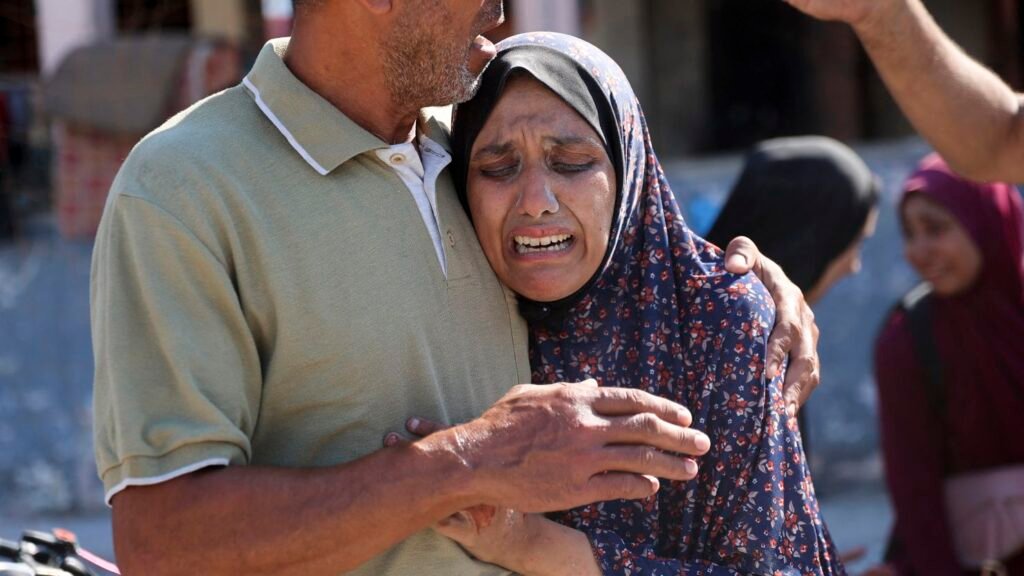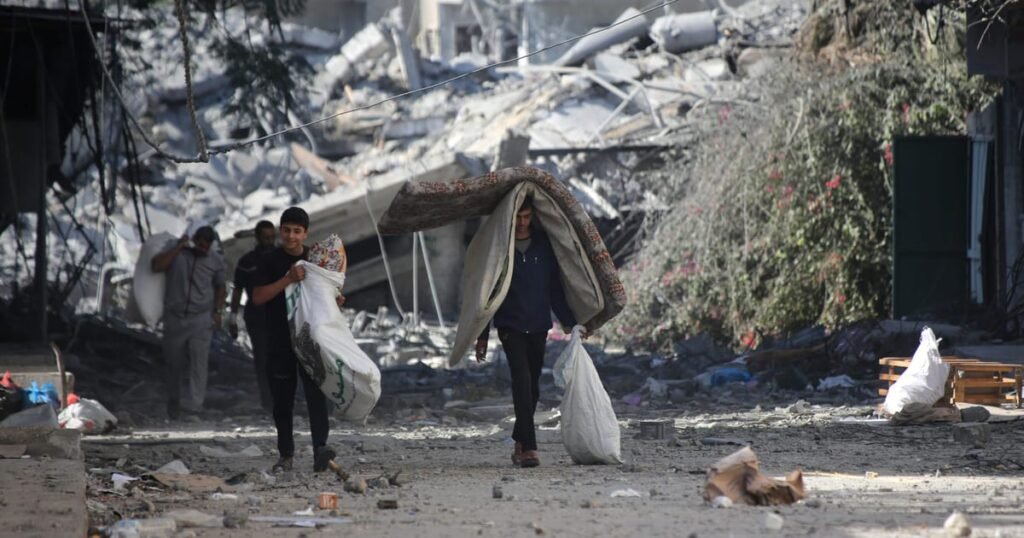
Gaza Herald — Within hours of the Israeli army ordering the evacuation of large areas in Deir al-Balah, central Gaza, the city was plunged into chaos, resembling a battlefield. Heavy Israeli airstrikes targeted residential homes, leaving civilians, many too exhausted, hungry, or lacking the means, unable to flee.
According to field sources , Israeli warplanes struck and destroyed three mosques in the city: Aqba Bin Nafi’, Ahl Al-Sunnah, and Al-Mujahideen. The attacks also hit homes belonging to the Laham and Salqawi families, resulting in multiple casualties, including both the dead and wounded.
Eyewitnesses reported that many bodies remain trapped under the rubble near the Wadi al-Salqa bridge in southern Deir al-Balah, as ambulance crews are unable to reach them due to ongoing shelling.
In the southwest of the Al-Baraka neighborhood, thousands of families remain besieged and unable to evacuate amid intense artillery shelling. The situation is worsened by widespread hunger and extreme fatigue, leaving many too weak to travel long distances on foot.
No Strength Left to Flee
Mahmoud Odeh, 61, a displaced resident from Khan Younis now sheltering in Wadi al-Salqa, told Quds Press:
“I’ve been displaced more than nine times since the war began. Today, I can’t even walk or stand because of hunger. I have no energy left and nowhere to go. Let the occupation do what it wants. I won’t leave my tent.”
Similarly, Abed Rabbo Siyam, who lives in a tent in Al-Baraka, said:
“The cost of a car to take me to the Mawasi area in Khan Younis is over 700 shekels (about $200), and I don’t have that kind of money. I also don’t have the strength to go through displacement again.”
Tanks Move In, City Under Siege
Field sources reported to Quds Press that several Israeli tanks advanced onto Salah al-Din Street from the Kisufim military gate, firing shells at homes in the Mash’ala and Abu Houli areas.
The UN Office for the Coordination of Humanitarian Affairs (OCHA) described the latest evacuation order as “a death blow to what remained of Gaza’s lifeline,” noting that Deir al-Balah was one of the few cities still sheltering hundreds of thousands of displaced people. It had previously been labeled a “safe zone” under Israel’s own classifications.
Deir al-Balah hosts logistical hubs for numerous international and humanitarian organizations, including the World Food Programme, the Red Crescent, the Red Cross, UNRWA, UNICEF, OCHA, and dozens of local humanitarian groups.
Displacement from “Safe Zones”
The latest evacuation orders affect entire neighborhoods, including Blocks 130, 132 to 134, 136 to 139, and 2351. This marks a major escalation since the Israeli offensive began on October 7. With these orders, Israel has effectively abandoned its designation of Deir al-Balah as a safe area.
Residents and displaced families now fear a repeat of what happened in Rafah and Khan Younis, where shelters themselves became direct targets and mass killings were carried out by Israeli forces.
Since October 7, 2023, Israel, backed by the United States, has been waging a campaign of genocide in Gaza, characterized by mass killing, starvation, destruction, and forced displacement. These actions continue despite international appeals and binding orders from the International Court of Justice to stop them.
The genocide has so far claimed the lives of over 200,000 Palestinians killed or injured, most of them women and children, while more than 11,000 remain missing. Hundreds of thousands have been displaced, and famine has claimed the lives of many, including children. The destruction is vast and ongoing.
With the fall of Deir al-Balah, Israel has once again erased the illusion of any safe refuge in Gaza. The forced evacuations and airstrikes are not just military maneuvers; they are acts of deliberate dismantling of the last spaces where life could cling to hope. Aid hubs, civilian shelters, and even mosques have been reduced to rubble, while the displaced are pushed beyond the limits of endurance, facing starvation, isolation, and the terrifying proximity of tanks.
As the world watches or looks away, the genocide in Gaza enters a new chapter, fueled by international complicity and a calculated disregard for Palestinian lives. The people of Gaza, exhausted but unbroken, continue to hold their ground under tents and in ruins, resisting erasure with every breath. What remains is a moral reckoning not only for the occupier but for every power that has allowed this horror to unfold in silence.