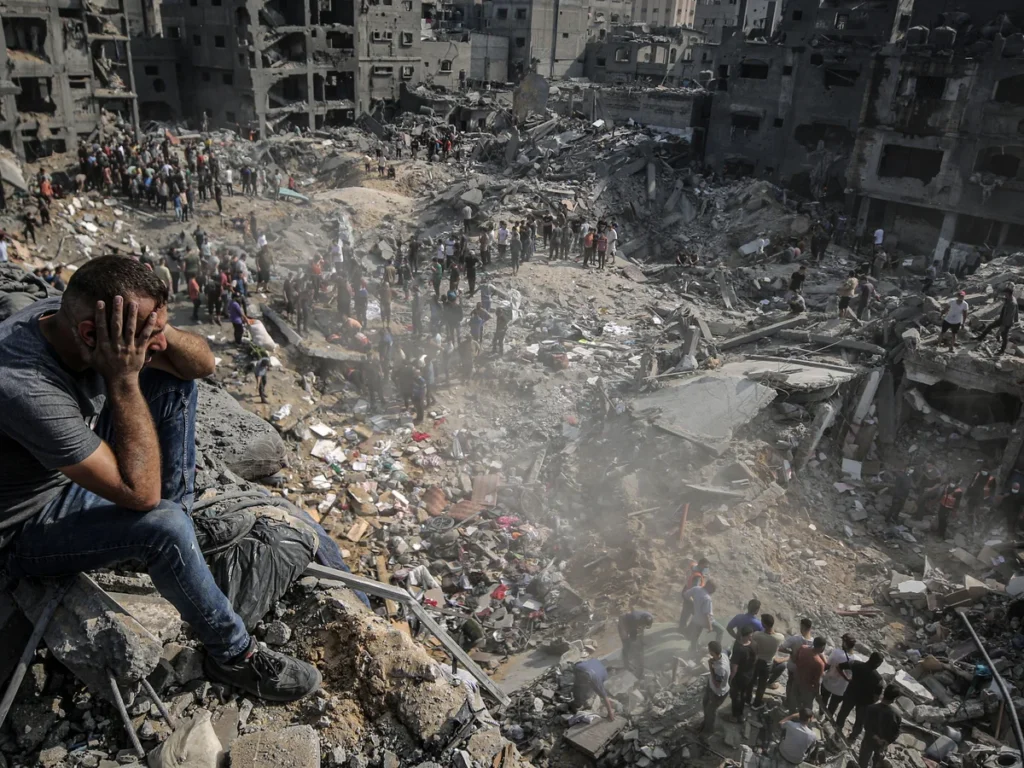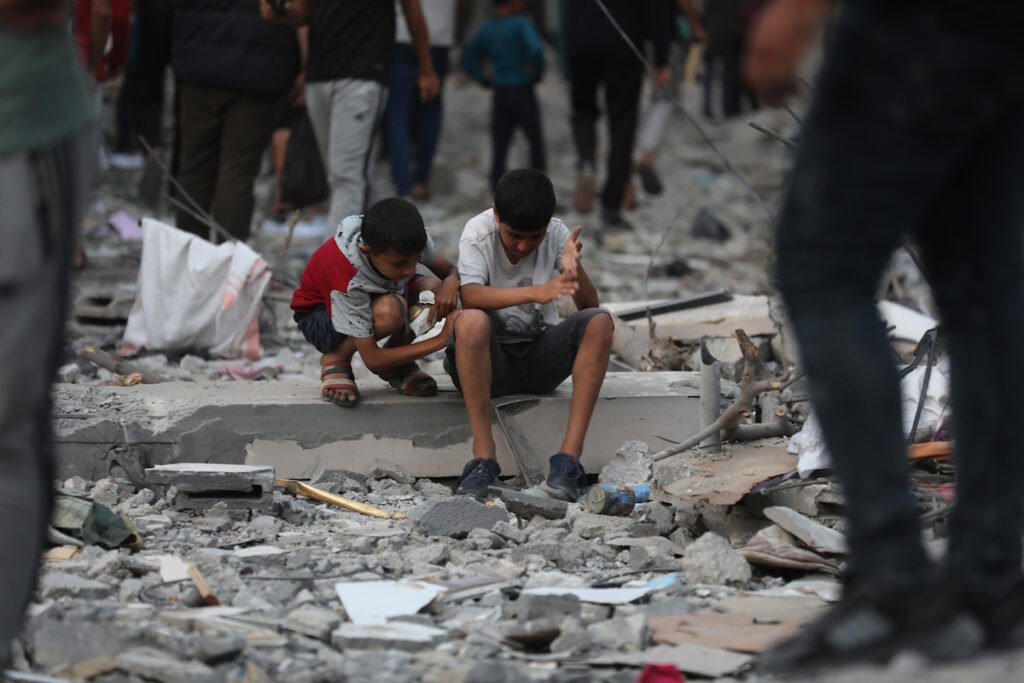
Gaza Herald – As the rubble of Rafah still smoulders from relentless Israeli bombardment, a new and deeply alarming chapter unfolds. Israel is now advancing with a plan to establish what observers and critics are calling a modern-day concentration camp for Palestinians, an enclosed zone on the ruins of southern Gaza where over 600,000 forcibly displaced civilians would be detained, unable to return home or move freely.
Despite international condemnation and warnings from legal and military experts, Israeli officials are pressing forward with a scheme that experts say amounts to ethnic cleansing under the guise of a so-called “humanitarian city.”
Originally proposed by Defense Minister Israel Katz, the scheme envisions a massive enclosure on the ruins of Rafah that would initially hold around 600,000 displaced Palestinians. Eventually, this zone—dubbed a “humanitarian city” by its proponents—would expand to accommodate the entire pre-war population of Gaza, approximately 2.2 million people. International forces would reportedly manage the area, which would be off-limits to Hamas, but Palestinians inside would not be permitted to return to other parts of Gaza. Instead, they would be encouraged to emigrate “voluntarily” to third countries, according to Katz.
Domestic Dissent: Israeli Voices Call Out the Horror
The proposal has triggered backlash at home. Former Prime Minister Ehud Olmert labeled it a “concentration camp,” while senior military figures, including Chief of Staff Eyal Zamir, dismissed it as impractical. Israeli legal scholars have condemned it as “blatantly illegal,” raising concerns about forced displacement under international law.
Abroad, the response has also been swift and negative. A British government minister said he was “appalled,” and foreign ministers from Austria and Germany voiced concern. The United Nations declared its firm opposition, reinforcing fears that the plan violates humanitarian principles.
Yet inside the Israeli government, the idea continues to gain traction. Prime Minister Benjamin Netanyahu has reportedly sought a faster, cheaper version of the army’s plan. The strategy also aligns with long-standing ambitions among far-right settler factions to depopulate Gaza entirely—a goal emboldened earlier this year when former U.S. President Donald Trump publicly floated the idea of relocating Gaza’s population abroad.
Finance Minister Bezalel Smotrich, a vocal supporter of population transfer, recently suggested pushing Gaza’s residents into a so-called “humanitarian zone” near the Egyptian border. Netanyahu has made similar statements, referring to future “sterile zones” for Gazans during the rollout of the U.S.-backed Gaza Humanitarian Foundation (GHF), a body ostensibly formed to deliver aid while Gaza remains under siege.
Analysts Warn of Ethnic Cleansing Disguised as Security
Political analyst Nimrod Flashenberg told Al Jazeera that the plan serves dual goals: security and ethnic cleansing. “Removing civilians from unconquered parts of Gaza into one space simplifies the process of locating and attacking Hamas,” he said. He warned that the policy would effectively function as an “ethnic cleansing terminal”, a staging ground for permanent displacement.
Aida Touma-Suleiman, an Israeli Knesset member from the Hadash-Ta’al party, warned that the policy reflects a deeply dehumanizing mindset: “They act as if these people aren’t human. Just the idea of trying to confine 600,000 people is outrageous. How could that happen without leading to a massacre?”
Israeli military lawyers have reportedly flagged potential legal repercussions, and a public letter from legal scholars flatly calls the proposal a violation of international law.
Meanwhile, conditions in Gaza remain dire. According to the UN, roughly 1.9 million Palestinians around 90% of the population, have been displaced by Israel’s ongoing assault, many multiple times. Amnesty International recently concluded that Israel is still employing starvation as a weapon of war, with widespread child malnutrition and a collapsing healthcare system exacerbating the crisis.
No Humanitarian Justification—Only Exile or Extinction
“There’s nothing humanitarian about this,” said Yossi Mekelberg, senior fellow at Chatham House. “It’s inhumane. These conditions would be appalling, and the only way out is exile. This should be condemned, and there must be consequences.”
He added that international actors still hold leverage. “Those who trade, cooperate, and partner with Israel have the power to stop this. By doing nothing, they hand the keys to Smotrich, Katz, and Netanyahu and signal that there are no red lines.”
This proposed plan is not a humanitarian solution; it is a humanitarian catastrophe in the making. By seeking to warehouse an entire population into controlled zones with no return, and by framing displacement as “voluntary emigration,” Israel is testing the boundaries of legality and human conscience. The world must not look away. The time for polite concern has passed. Real consequences, not rhetorical disapproval, are needed to halt what is increasingly being recognized as a deliberate campaign to erase a people from their homeland. If the international community fails to act, it will not just be complicit—it will be responsible.