
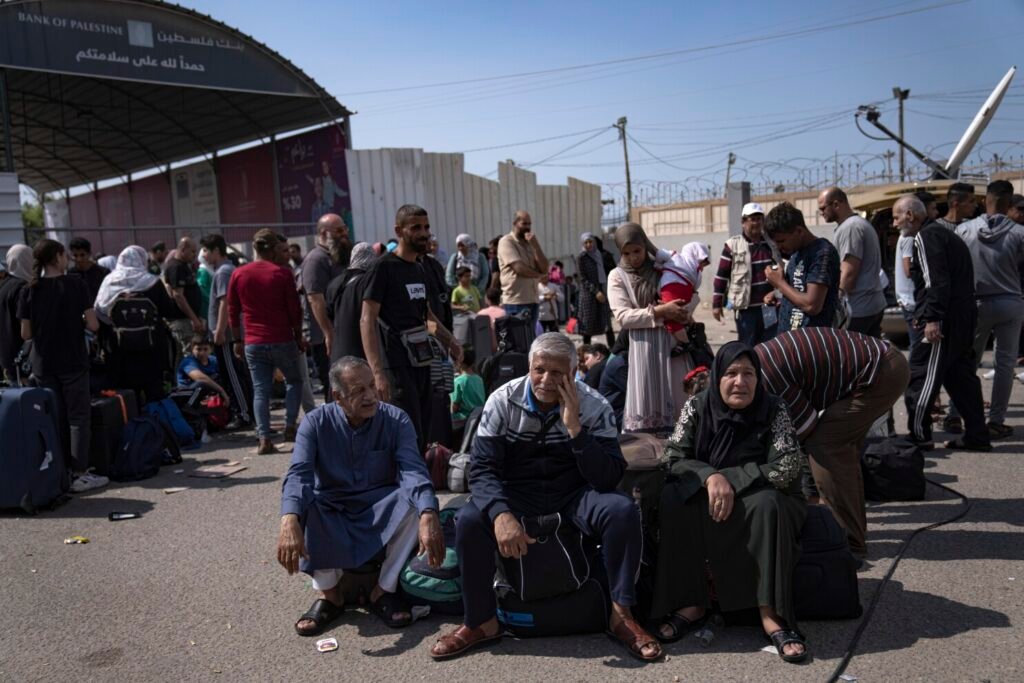
Gaza Herald- As the third anniversary of the October 7 events, Israel is not merely imposing temporary security measures. It is tightening its grip on Palestinians in the occupied West Bank and Gaza Strip by closing crossings and intensifying movement restrictions, while escalating raids and arrests and placing additional obstacles in the way of Palestinians seeking to travel or obtain basic necessities.
Israeli Defense Minister Israel Katz announced a comprehensive closure of crossings in the West Bank and Gaza Strip on October 5 and 7, alongside heightened Israeli security measures, while Israeli forces continued raids and arrests across a number of West Bank cities and towns.
The decision comes only days after another closure of crossings leading from the West Bank into areas under Israeli control, raising concerns that restrictions could expand to internal roads connecting Palestinian cities and towns from the northern West Bank to the south.
942 Checkpoints and Obstacles: The West Bank Under Closure
Palestinians in the occupied West Bank depend on an extensive network of roads and crossings that Israel can close or disrupt at short notice. The movement of workers, employees, students, farmers and patients between Palestinian cities and villages is consequently tied to Israeli measures at military checkpoints and gates.
According to the latest figures from the Colonization and Wall Resistance Commission, the number of Israeli military checkpoints, closure points and obstacles across the West Bank had reached 942 as of September 25. These included 824 permanent checkpoints and closure points, as well as 118 linear obstacles consisting of earth mounds, trenches and roadblocks extending for a combined 107.7 kilometers.
The largest concentration is in the Hebron governorate, with 221 such points, followed by Ramallah and al-Bireh with 160, Nablus with 120, Bethlehem with 78 and Jerusalem with 62.
In recent months, Israel has added 13 permanent gates and checkpoints, 10 of them in the Jenin governorate, raising the number of permanent points there from 16 to 26.
Restrictions are not limited to barriers erected by the Israeli military. Some areas of the West Bank have also seen gates controlled by Israeli settlers, including two established on land belonging to Kafr Ni’ma and east of Umm Safa in the Ramallah governorate, imposing additional restrictions on Palestinians seeking to reach their homes and land.
Political analyst Mohammed Mustafa Shaheen says Israel is using the anniversary of October 7 to tighten restrictions on Palestinians and advance broader measures and projects, adding that Israel views the Palestinian demographic presence as an existential challenge.
Israel Reshapes the Reality of the West Bank
Shaheen says the tightening of closures and movement restrictions coincides with efforts to use the anniversary to consolidate greater Israeli control over Palestinian movement and access points, arguing that recurring measures on the ground form part of a broader effort to reshape realities in the occupied territory.
In his assessment, checkpoints and closures do not function as isolated measures. Instead, they have become instruments of daily pressure that exhaust Palestinians, disrupt their work and movement and make everyday life increasingly difficult.
Checkpoints have consequently become a permanent feature of Palestinian life in the West Bank, evolving from what Israel presents as security measures into a system that directly affects workers, employees, farmers, students and patients.
Shaheen says Palestinians lose at least an hour and a half each week waiting at Israeli checkpoints. By his estimate, this translates into millions of lost hours for workers, employees and farmers, turning routine travel between Palestinian communities into an additional burden woven into everyday life.
Gaza: Crossings Control the Lives of Patients and Displaced Families
In the Gaza Strip, the movement of patients and travelers, as well as the entry of supplies, depends on a limited number of crossings whose operations and movement are controlled by Israeli authorities.
Data from the Crossings and Borders Authority for September shows that the Rafah crossing remained closed for 20 of the month’s 30 days, while passenger movement through the Kerem Shalom crossing was suspended for 26 days.
During September, 1,197 people left the Gaza Strip, including 485 patients traveling for medical treatment outside the enclave, 547 companions and 165 evacuation cases. No movement between Gaza and the occupied West Bank was recorded during the month.
For many patients, leaving Gaza is directly tied to accessing treatment at hospitals outside the Strip because numerous specialized medical services are unavailable inside the enclave. Delays in medical evacuation leave patients requiring advanced treatment trapped within a health system devastated by widespread destruction and severe shortages of medicines and medical supplies.
Shaheen says Israel used overwhelming military force in Gaza when conditions on the ground allowed it to do so, while employing different methods in the West Bank, where circumstances differ.
Those methods, he says, include daily pressure through closures, psychological exhaustion and economic pressure, alongside Israeli operations in Palestinian refugee camps. He believes the objective is to turn the West Bank into an increasingly unlivable environment by making everyday life more difficult and subjecting Palestinians to constant pressure in their work, movement and ability to live normally.
Food, Fuel and Medicine at the Mercy of the Crossings
Israeli restrictions have also affected the movement of trucks and supplies entering the Gaza Strip. The Zikim and Kissufim crossings remained closed throughout September, while Kerem Shalom remained the principal entry point for commercial and humanitarian goods, despite operations there being suspended for three days during the month.
A total of 5,265 trucks entered through Kerem Shalom during September, carrying varying categories and quantities of goods.
For shelter needs, 139 trucks carrying shelter materials entered Gaza, alongside five trucks carrying corrugated metal sheets, while large numbers of displaced Palestinians continue to live in tents and temporary shelters lacking basic protection.
Fuel deliveries included six trucks carrying gasoline, 147 carrying diesel and 87 carrying cooking gas. These supplies are vital for hospitals, water and sewage facilities, transportation and other essential services.
Another 104 trucks carrying medical supplies entered during the month amid growing demand for medicines and spare parts for medical equipment. Meanwhile, patients requiring treatment outside Gaza remained dependent on the operation of crossings and the approvals required for them to leave.
One System: Government, Military and Settlers
Shaheen says developments in the occupied West Bank cannot be understood simply as separate security measures or an economic crisis, pointing instead to what he sees as complementary roles played by the Israeli government, military and settlers in imposing pressure on Palestinians.
He says the government, military and settlers operate along an interconnected path, with roles divided between government and military measures and pressure exerted by settlers against Palestinians and their land.
Shaheen adds that these policies have prompted members of the U.S. Congress to request reports on conditions in the occupied West Bank and have also triggered European initiatives and measures.
Closure as a Tool of Pressure and Displacement
The announced closures on October 5 and 7 come against the backdrop of an already extensive system of restrictions governing Palestinian movement between areas of the occupied West Bank, the movement of patients and travelers from Gaza and the entry of food, medicine, fuel and shelter materials into the Strip.
Across the West Bank, hundreds of checkpoints, gates and physical obstacles cut through roads connecting Palestinian communities and reshape the routes residents must take in their daily lives. In Gaza, meanwhile, the movement of patients and the entry of humanitarian aid and essential supplies remain tied to a small number of crossings subject to Israeli control.
Shaheen believes measures that place sustained pressure on everyday Palestinian life serve broader plans of displacement and forced transfer. He says the continued use of closures, checkpoints, economic and psychological pressure and attacks on Palestinian land makes remaining in place increasingly difficult.
According to Shaheen, forcing Palestinians to confront these conditions every day creates accumulating pressures that can gradually push people toward considering leaving the places where they live, while daily restrictions weaken their ability to remain stable and rooted on their land.
The closures surrounding the October 7 anniversary therefore do not appear, in Shaheen’s assessment, as merely temporary security measures. They come within a broader reality of Israeli control over Palestinian movement, restricting access to work, education, medical treatment and land while controlling the entry of essential supplies into Gaza.
In this reality, siege, closure and checkpoints have become continuing instruments through which Palestinian daily life is subjected to pressure, restriction and exhaustion.

