
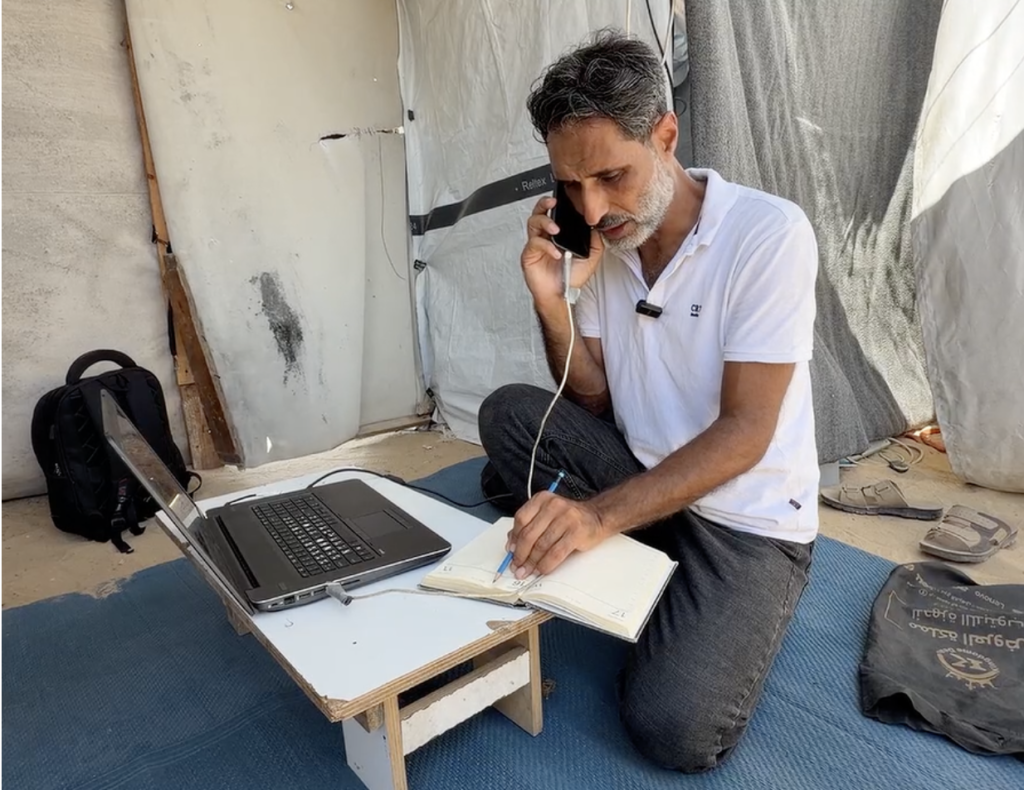
Gaza Herald — Before Mahmoud Seydam can deliver a university lecture on architectural design, he must first overcome a series of fundamental obstacles: securing a few hours of electricity, finding a stable internet connection, and ensuring his family has enough clean water to survive the day. Living inside a precarious canvas tent in Gaza, where basic utilities have been completely dismantled by ongoing military operations, the simple act of teaching has become a profound declaration of sumud, steadfastness, and intellectual resistance.
As the head of engineering sciences and applied arts at the University College of Science and Technology in Khan Younis, as well as a lecturer at Al-Aqsa University, Mahmoud once organized his professional life around modern classrooms, academic research, and campus mentorship. Today, after being forcibly displaced more than 15 times, at times leaving everything behind to escape incoming strikes, and once sleeping directly on the pavement, his academic life is conducted entirely from a makeshift shelter. Despite the suffocating heat, constant noise, and lack of privacy, he remains committed to keeping higher education alive for Palestinian youth amidst total destruction.
A typical workday begins long before his students log online. Rising at dawn after fitful nights spent worrying about the next evacuation order, Mahmoud conserves his limited phone battery to review overnight messages from students and colleagues. Before he can open his textbooks, he must complete the daily struggle for physical survival: carrying heavy plastic containers from incoming water trucks to fill a single 200-liter tank, all that remains after his family’s permanent home and original water storage systems were bombed.
Preparing for a digital lecture requires an entirely different set of technical maneuvers. Because grid power has been erased across the territory, Mahmoud relies on a small solar panel mounted above his tent. To ensure maximum efficiency for his laptop and mobile devices, a university lecturer’s class preparation involves climbing onto a plastic chair with a broom to sweep layers of dust and debris off the solar glass. When technical failures occur, he troubleshoots the wiring himself, knowing that his phone battery is the only bridge connecting his displaced students to their academic future.
When the lecture finally begins, Mahmoud sits outside his tent, opening a digital presentation on museum architecture and waiting for his scattered students to join. He speaks to them of spatial design and aesthetic theory, momentarily bringing back the familiar language of university life. When internet connectivity inevitably collapses mid-sentence, he does not abandon the lesson; instead, he records a voice lecture, uploads the file when a signal briefly reappears, and distributes the link to his class.
This relentless dedication highlights the broader struggle across Gaza, where physical university buildings have been flattened, but the commitment to learning remains indestructible. Online education under active siege presents endless hurdles, yet scholars like Mahmoud Seydam refuse to let the occupation erase Palestine’s academic future, proving every single morning that while classrooms can be bombed, the pursuit of knowledge endures.

