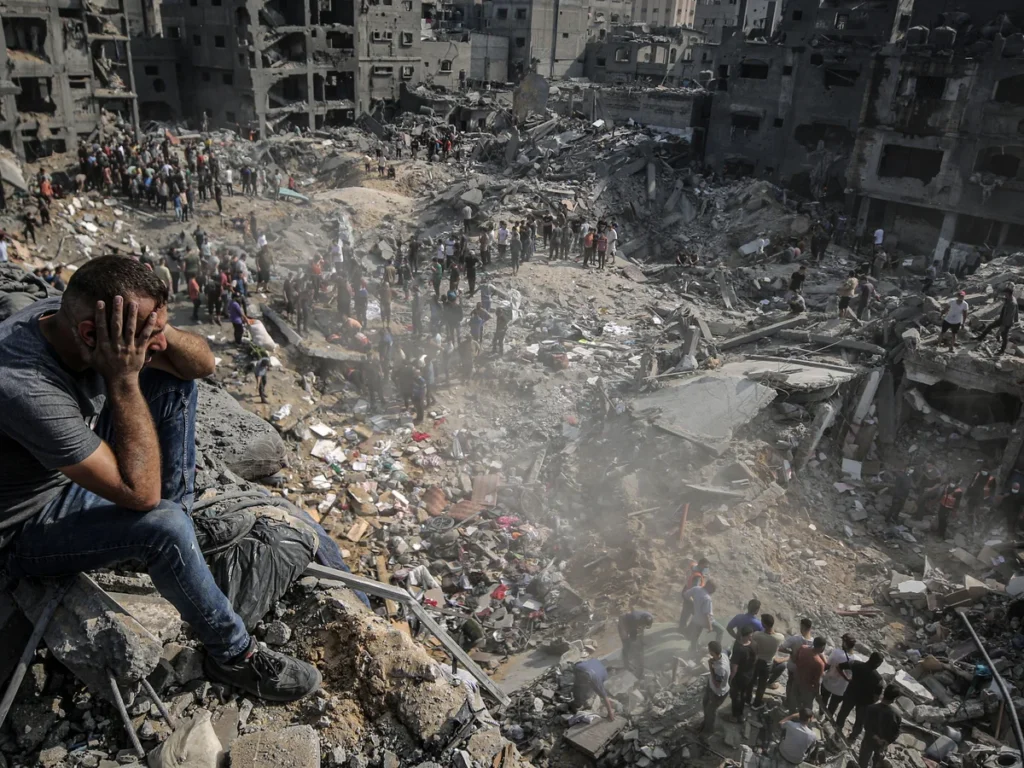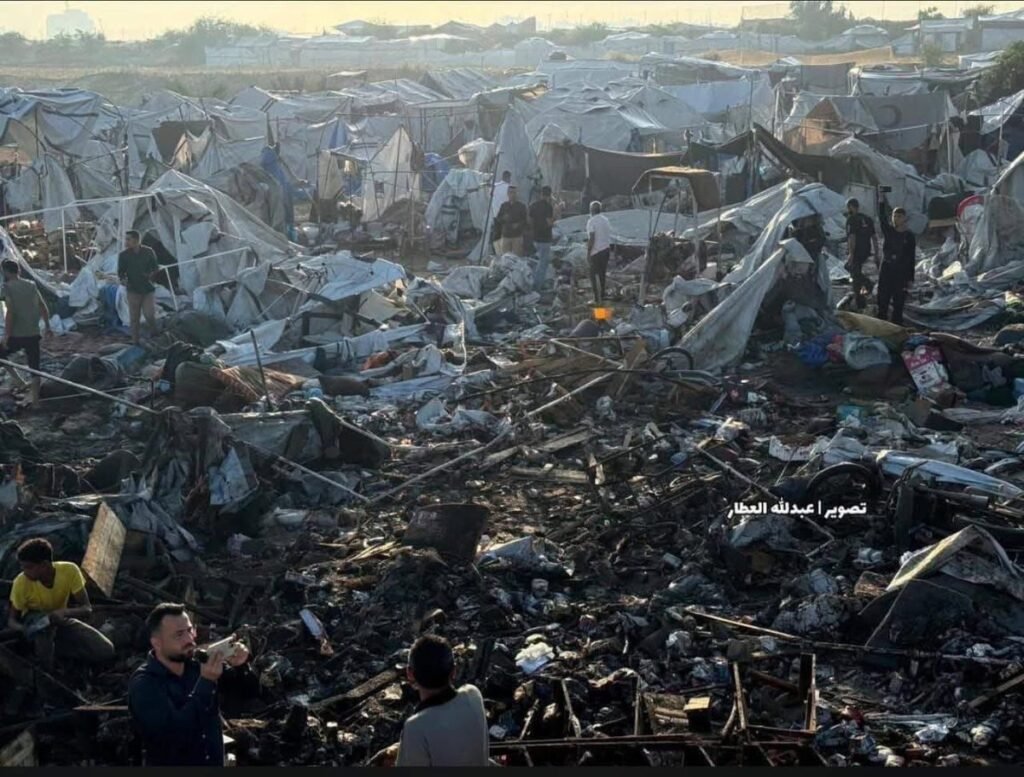
Gaza Herald — In Gaza’s overcrowded displacement camps, danger does not only come from above. Sometimes, it lurks directly beneath a family’s feet.
For displaced Palestinians crammed into makeshift tent camps amid ongoing military operations and restrictions, open sewage pits have become a hazardous necessity. Families are forced to dig primitive latrines because destroyed municipal sewage networks and damaged pumping stations have left them with few alternatives. Yet each new pit creates severe hazards: unstable and collapsing soil, overflowing wastewater, unbearable odors, and raw sewage contaminating the ground where children live and play.
For 60-year-old Saeed Naim, forcibly displaced from Beit Hanoun in northern Gaza, every time the sewage pit beside his family’s tent fills up, they face another ordeal. They must find a new patch of ground to dig, often moving the tent itself to make room, all while fearing that the saturated soil could collapse or raw sewage could flood their sleeping area.
Across the encampments, crudely covered pits have become ubiquitous. Tightly packed tents leave virtually no distance between living spaces and human waste, while the lack of municipal vacuum trucks and fuel for wastewater management forces families to continually dig new holes or reuse overflowing ones. The result is a severe public health and environmental crisis unfolding both above and below ground.
When Primitive Sanitation Becomes an Immediate Environmental Hazard
At Unknown Soldier Square, west of Gaza City, a former public landmark that has become a dense tent camp housing hundreds of displaced families, Naim says residents have dug dozens of primitive pits as older ones fill up, with no access to municipal wastewater management services.
“We are forced to rely on primitive solutions, even though they pose a direct danger to children moving around the tents,” Naim says.
He recalls an incident in which the ground gave way beneath a relative, who nearly fell into an overflowing sewage pit.
Mahir Barda, displaced from Gaza City’s Shujaiya neighborhood, lives with the same constant fear. A pit adjacent to his tent has become a persistent hazard as wastewater accumulates and saturates the surrounding soil.
The danger persists long after the digging is complete. Barda explains that untreated wastewater seeps into the earth, weakening the ground and increasing the risk of collapse. Families attempt to maintain a safe distance between new and old pits, but overcrowded conditions often make this impossible. Beyond the stench, residents fear that children already weakened by malnutrition and repeated displacement could be exposed to infectious diseases and contaminated wastewater.
“Children’s immunity is already severely compromised,” Barda says. “Even adults are suffering from constant illness.”
A Million Pits and the Threat to Gaza’s Coastal Aquifer
The crisis extends far beneath the surface, threatening Gaza’s already severely compromised water resources.
Enormous volumes of untreated wastewater are seeping into the soil in areas where sewage infrastructure has been destroyed or rendered inoperable. Munther Salem, director general of water resources at Gaza’s Water and Environmental Quality Authority, warns that Gaza’s coastal aquifer faces potentially irreversible contamination from the massive flow of untreated sewage, particularly through absorption pits.
Around two million Palestinians depend on Gaza’s remaining, heavily compromised water sources. Under current conditions, specialized assessments estimate daily water availability at just 20 to 30 liters per person, leaving households with dangerously limited supplies for drinking, hygiene, and other basic needs.
At the same time, Salem estimates that roughly 80 percent of consumed water ultimately becomes wastewater. With treatment plants destroyed, damaged, or deprived of fuel, Gaza lacks sufficient functioning infrastructure to collect, treat, or safely discharge these flows.
Untreated wastewater is now contaminating both the sea and the ground. Residual and damaged sewage networks discharge an estimated 50,000 to 60,000 cubic meters of untreated wastewater into the Mediterranean Sea each day. In areas without functioning sewage networks, more than one million displaced Palestinians, representing roughly 200,000 to 250,000 families, rely on primitive absorption pits, allowing sewage to seep into the surrounding soil and potentially threaten underground water resources.
A single absorption pit typically fills within two to four months, forcing families to dig another and creating an accumulating environmental and sanitation crisis.
Human rights and health organizations have stressed the urgent need to restore basic municipal water services, sanitation equipment, fuel, and materials needed to repair damaged infrastructure in order to reduce the risk of disease outbreaks and further deterioration of Gaza’s primary groundwater source.