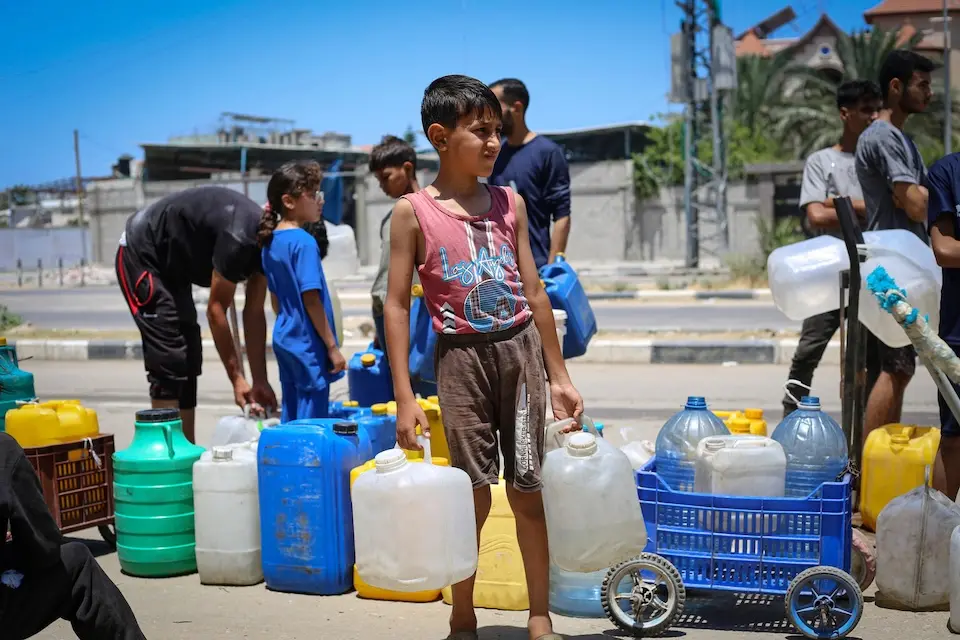
Gaza Herald – Results from groundwater quality tests conducted on municipal wells in the Gaza Strip during June 2026 highlight severe ongoing challenges facing the aquifer. The findings, released on Tuesday, show that 77 out of 93 municipal wells were contaminated either chemically or biologically. This means that 83 percent of the wells tested in June 2026 had water unfit for drinking.
The primary concern cited is the high concentration of Total Dissolved Solids (TDS). The average TDS level reached approximately 3,657 milligrams per liter. This figure significantly exceeds the guideline limit of 1,000 milligrams per liter recommended by the World Health Organization and Palestinian standards for drinking water.
There was a clear spatial variation in salinity levels across different municipalities. Deir al-Balah Municipality recorded the highest average TDS at about 6,653 milligrams per liter. Gaza Municipality followed with an average of 4,756 milligrams per liter. In contrast, North Gaza Municipality recorded the lowest average at roughly 934 milligrams per liter, which is closest to the recommended limits.
The data revealed a wide disparity in water quality between areas. The highest recorded TDS value was 13,000 milligrams per liter. The lowest value was 381 milligrams per liter, found in the Atatira well. These figures reflect significant differences in water quality across the sector.
Regarding microbiological tests, fecal coliform bacteria were detected in 18 wells. This indicates microbial contamination in several groundwater sources, necessitating enhanced monitoring and continuous disinfection procedures to protect public health. Escherichia coli bacteria were found in two specific wells: Al-Zarqa in Jabalia and Al-Sawariha in Az-Zawayda.
The report emphasized the need for continued periodic testing and preventive measures to stop pollutants from reaching groundwater and consumers. It noted that 61 of the 93 wells, representing about 66 percent, are equipped with chlorine dosing devices. However, 32 wells, or 34 percent, lack chlorination systems or require maintenance.
The results indicate that the Gaza aquifer continues to face significant environmental pressures. These include over-exploitation of groundwater, seawater intrusion, and pollution from sewage and human activities. These factors have contributed to increased salinity in most municipalities.
The report stressed the urgent need to strengthen periodic water quality monitoring programs. It called for the development of disinfection systems and effective measures to protect the aquifer. These steps are essential to ensure improved drinking water quality, safeguard public health, and maintain water resource sustainability in Gaza.
The study relied on laboratory analysis of water samples taken from 93 municipal wells distributed across various Gaza municipalities in June 2026. Spatial analysis using Geographic Information Systems (GIS) was used to map salinity levels and bacterial contamination sites.
The findings confirm that environmental pressures continue to impact the aquifer, resulting in elevated TDS concentrations in most wells. While some areas showed relatively better water quality, others exhibited very high salinity levels requiring immediate attention.
This report was produced in the Gaza Herald newsroom.