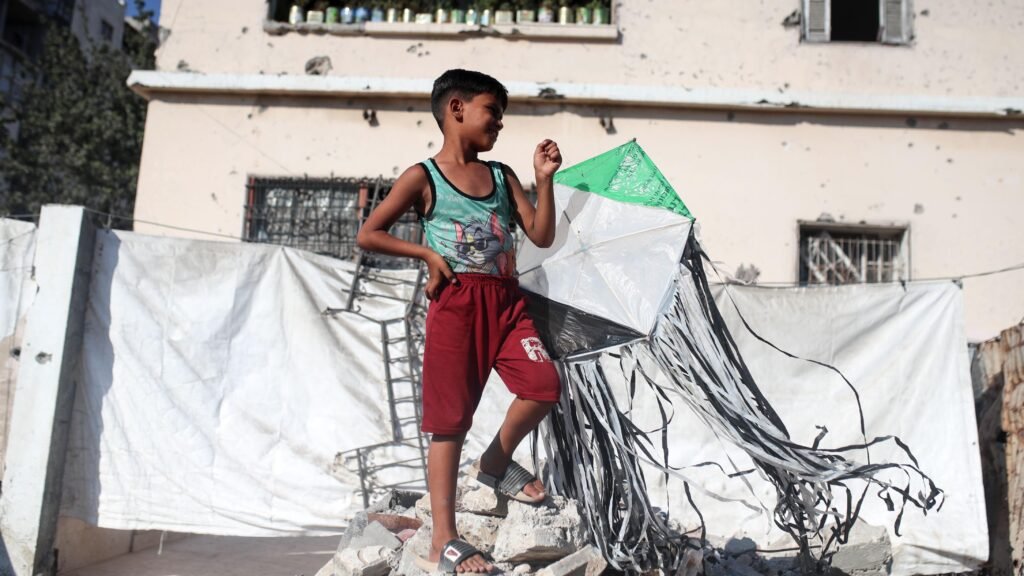
Gaza Herald— Framing an innocent childhood activity such as flying kites as an alleged security threat reflects a recurring pattern in Israel’s approach to Gaza, according to Dr. Rami Abdu, head of the Euro-Med Human Rights Monitor.
 Abdu said ordinary civilian activities are repeatedly portrayed as provocations or security threats in ways that can be used to justify military attacks, forced displacement and unlawful evacuations.
“This approach is used to divert attention from the nature of the aggression imposed on Gaza for years and from Israel’s rejection of the roadmap agreed upon in Cairo,” Abdu told Felesteen. “It also seeks to create a media and legal justification before international public opinion for any military escalation, which has already begun to take shape through an intensified wave of airstrikes in recent days.”
Children’s Play and International Law
From a legal perspective, Abdu stressed that punishing or targeting children because they are playing conflicts with international law.
The Convention on the Rights of the Child guarantees children special protection during armed conflicts, while Article 31 explicitly recognizes their right to rest, leisure, play and participation in recreational activities appropriate to their age.
Abdu argued that portraying a recreational activity as a security offence, particularly when such rhetoric comes from official or semi-official authorities, can amount to a violation of children’s rights and reflect a broader logic of collective punishment.
He said this is especially serious in Gaza, where children have endured years of war, displacement and deprivation.
More than 20,000 Palestinian children have reportedly been killed, while hundreds of others remain missing and hundreds of thousands of children have been displaced amid catastrophic humanitarian conditions.
“In such circumstances, the very least these children deserve is the ability to play and experience moments of childhood without restrictions or coercion,” Abdu said.
Calls for Stronger International Action
Abdu acknowledged that some European and international actors have issued statements condemning Israeli conduct, but said these positions have not matched the scale of the violations taking place.
“What is needed are effective measures and concrete steps that support Palestinian rights and put an end to the continuing culture of impunity,” he said.
He called for Israeli statements and actions concerning Palestinian children to be incorporated into complaints submitted to international mechanisms, including the International Criminal Court, as additional evidence of alleged violations of children’s rights.
He also urged activists and civil society organizations to intensify political pressure in European parliaments.
Among the proposed forms of advocacy, he suggested campaigns in which children around the world fly kites in solidarity with Gaza’s children, highlighting that kite flying is fundamentally a form of childhood play rather than a military activity.
Israeli Threats Over Kites
The controversy escalated despite Palestinian denials that the kites were being used deliberately for hostile purposes.
Israeli officials issued increasingly aggressive warnings over the activity.
Israeli Defense Minister Israel Katz said he had instructed the military, together with Prime Minister Benjamin Netanyahu, to adopt what he described as a “zero containment, zero tolerance” policy toward what Israel alleged was the launching of kites from Gaza.
Katz warned that if the activity continued, Israel would take forceful measures to stop it and suggested that a kite should be treated in the same manner as a drone.
The statements sparked criticism because the object at the center of the dispute was being associated with military threats despite its longstanding place in children’s recreational activities.
Israeli Media Amplifies the Issue
Hebrew-language media also contributed to portraying the kites as a security concern.
Channel 12, for example, published photographs of a kite hanging from a tree near the Nahal Oz kibbutz and another kite that had fallen on the ground in Re’im.
The coverage helped amplify an issue that began with children flying kites and transformed it into a subject of military and political debate.
The U.S.-led “Peace Council,” which oversees implementation of the Gaza ceasefire plan, also entered the controversy. After Israel threatened retaliatory strikes, the council warned against launching kites, effectively echoing Israel’s framing of the activity as part of what it described as “armed activities.”
For Abdu, however, the dispute illustrates a much broader concern: the increasingly expansive definition of what can be portrayed as a security threat in Gaza.
When even an ordinary childhood activity can be invoked to justify military threats, he argued, the issue extends beyond the kites themselves to the fundamental rights of children living under siege and conflict.