
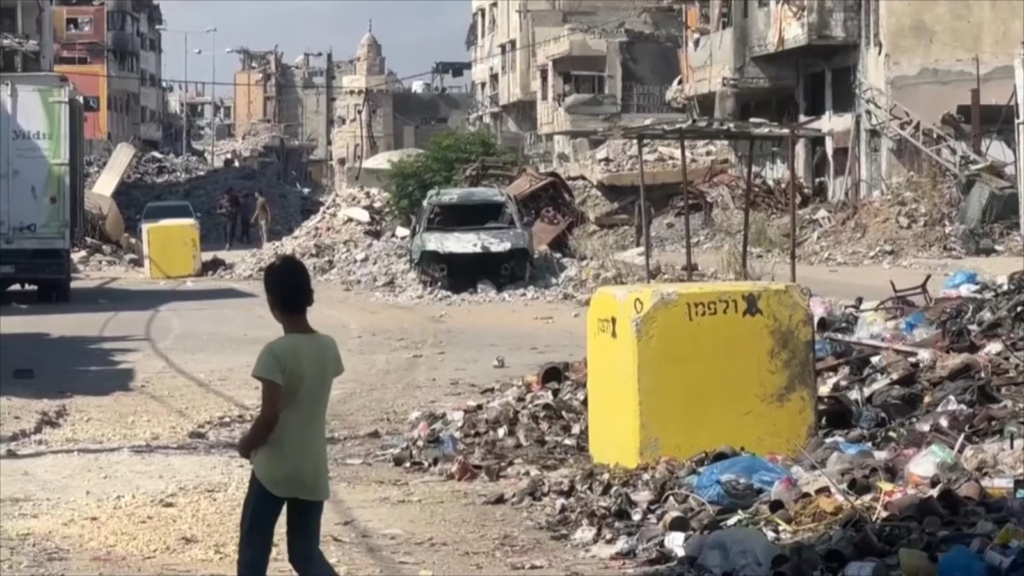
Gaza Herald _ Just a few yards from the “Yellow Line” in northern Gaza, 11-year-old Moayad Al-Tanani went outside to play soccer in front of his home, just as children anywhere would.
But within minutes, his ordinary game turned into a tragedy. Israeli forces struck a nearby house, sending shrapnel into Moayad’s head. The fragment pierced his skull and lodged in his brain, leaving him in critical condition and requiring emergency surgery.
Moayad’s family had believed that staying close to home was safer than venturing farther away, especially given the dangerous conditions surrounding the area. But when the neighboring house was struck, the impact reached the child who had been playing nearby.
According to his mother, Sabrin Al-Tanani, Moayad had asked his uncle, Amin, to bring him a ball so he could play. Once the ball arrived, he went outside with several other children from the neighborhood. Not long afterward, the sound of an attack rang out. Sabrin found her son injured and rushed him to the hospital.
Medical examinations showed that a piece of shrapnel had penetrated Moayad’s head and lodged inside his brain. Doctors admitted him to the hospital as preparations began for surgery to remove the fragment.
His mother says his condition remains critical. He repeatedly loses consciousness and briefly regains it, while his family waits for surgery amid Gaza’s devastating humanitarian and medical conditions.
A Family Living on the Edge of Danger
The Al-Tanani family has not lived a normal life since the war began. About four months ago, their home was bombed, killing three members of the family and destroying the house.
After losing their home, the family moved to another house near Kamal Adwan Hospital. But the new home is itself located close to the “Yellow Line” and requires extensive repairs, according to the family.
Sabrin says they have no real option to move somewhere safer. There is nowhere else for them to go, and leaving their home does not necessarily mean reaching a place where they would be out of danger.
For Moayad and other children in the neighborhood, playing outside their homes had become one of the few ways left to pass the time after the war destroyed many of the spaces where children once played.
The Yellow Line Shrinks the Space for Life
The impact of the “Yellow Line” goes far beyond movement and access. For Palestinians living near it, the line has created a new reality in which daily life unfolds under the constant threat of Israeli gunfire and bombardment.
According to reports, the line runs east of Salah al-Din Street and serves as a military boundary separating areas controlled by Israeli forces from the rest of the Gaza Strip. The areas beyond it extend roughly two to seven kilometers into Gaza.
For residents, however, the Yellow Line is more than a geographical boundary. The areas surrounding it have become synonymous with fear and the possibility of being targeted, making ordinary activities—including children simply going outside to play—potentially deadly.
Moayad’s injury highlights an aspect of Gaza’s suffering that is often hidden behind casualty figures: the way the continuing military threat has invaded the smallest details of children’s daily lives.
Play: A Part of Childhood That Has Disappeared
Before the war, children playing in streets and open spaces was an ordinary part of life. Today, that reality has been transformed by destruction, displacement and the shrinking number of places where children can feel relatively safe.
Children who have lost their homes or been forced to flee live in overcrowded conditions. Other spaces have been turned into rubble or shelters, while areas near front lines carry additional restrictions and dangers.
Under these conditions, playing is no longer something children can simply do. It has become difficult, dangerous and, in many areas close to the Yellow Line, almost impossible.
Moayad’s story captures that contradiction with painful clarity: an 11-year-old boy went outside to play soccer in front of his home—a familiar place that should have offered at least some sense of safety. Instead, he ended up in a hospital with a piece of shrapnel lodged in his brain.
Victims Despite the Ceasefire
Moayad’s injury is part of a broader reality in Gaza, where Palestinians continue to be killed and wounded despite the ceasefire.
According to documented figures, 1,303 Palestinians, including 300 children, have been killed since the ceasefire took effect on October 10, 2025, as Israeli attacks have continued.
These figures underscore that the ceasefire has not brought an end to the danger facing civilians across Gaza, particularly those living near areas where military operations and gunfire continue.
In these communities, people can no longer separate ordinary life from the military reality surrounding them. A home is not necessarily a safe place. A road can become a danger zone. And even the small patch of ground outside a house where a child plays can suddenly become the site of a devastating injury.
Moayad Is Not Alone
Moayad’s story is not simply the story of one child. It reflects the reality faced by countless children across Gaza as the spaces where they can safely live, play and experience an ordinary childhood continue to disappear.
A child who once could simply walk outside to play now has to think about how close they are to danger, listen for the sounds of aircraft and explosions, and rush home whenever tensions escalate.
In Moayad’s case, even staying close to home was not enough to protect him. He was playing outside his house when shrapnel from an attack on the neighboring home reached him.
As that fragment remains lodged in his head while he waits for surgery, his mother is left confronting a question far larger than her son’s injury:
How can children live their childhood when even a few minutes of play are filled with fear?
In Gaza, protecting children no longer means simply keeping them away from battlefields. It means finding a place where a child can stand, play and experience the most basic moments of childhood without that very place becoming a source of danger in an instant.

