Gaza Herald_ Across the besieged Gaza Strip, where three years of Israel’s relentless, genocidal war have systematically targeted civilian life and natural heritage, the ancient olive tree stands not merely as a seasonal harvest, but as an enduring monument to Palestinian rootedness, memory, and unbreakable identity.
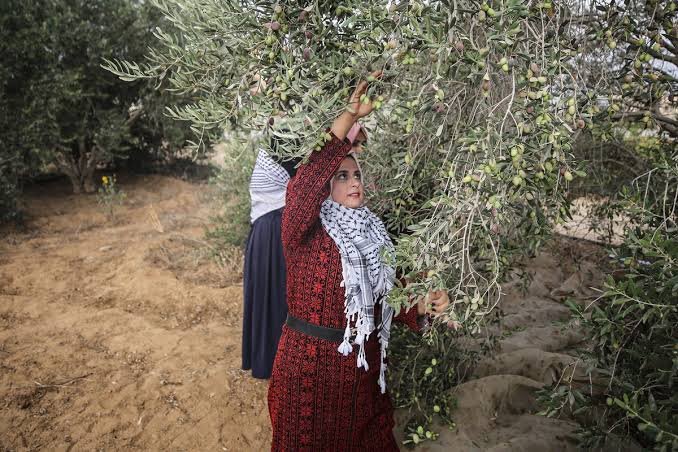
“I swear, I haven’t eaten a single olive in four years. It’s such an injustice, such a terrible wrong.” With these words, Kariman Sharab, a resident of Khan Younis in southern Gaza, captures a profound pain that extends far beyond being deprived of an olive she once picked from her own land. It reflects the heart-wrenching loss of an entire season of memories and a generational way of life that once connected Palestinians to their trees and fields. Sharab recalls the olive harvests she eagerly awaited, when she would pick the fruit and sit among the trees, distinguishing black olives from green ones.
Today, she dreams of seeing olive trees return to Gaza, of families being able to reclaim their stolen land, and of the return of locally produced olive oil and the vibrant life shattered by three years of Israel’s ongoing war of genocide. After three years of this genocidal war on the Gaza Strip, the olive tree is no longer merely a seasonal crop that farmers await each year. It has become a resilient witness to the catastrophic scale of the losses inflicted on the land, its people, and their basic livelihoods.
The surviving trees and remaining fruit are struggling to endure the widespread, systematic destruction of agricultural land and olive presses, while access to areas under Israeli military control remains completely impossible. In western Al-Zawayda, in central Gaza, farmers bring their meager harvest to an olive press where a single production line has been painstakingly restored amid the rubble. Their shared goal is to extract oil from the few remaining olives and salvage what they can of a harvest that bears almost no resemblance to those of the pre-war years.
Seven Production Lines Reduced to One: Saving What Remains
Nasr Odeh, an olive farm owner, recalls what his thriving olive press looked like before it was completely leveled. The facility once operated seven production lines with a combined capacity of 15 tons per hour and held internationally recognized ISO and HACCP quality certifications. Relentless Israeli bombardment destroyed the facility, leaving only fragments of the heavy production lines that could be recovered from the rubble and debris. Odeh managed to salvage just one line, transport it to Al-Zawayda, near Deir al-Balah, and reinstall it to resume minimal operations. Odeh explains that the press, which once processed massive quantities of olives, can no longer operate at its former capacity.
What is happening today is merely an attempt to extract oil from the fraction of remaining fruit after the devastation also destroyed the trees themselves, leaving only a tiny portion of the harvest available. According to his estimate, only around 15 percent of Gaza’s olive trees have survived, while a staggering 85 percent have been wiped out. He considers the destruction of these ancient trees a devastating blow to the agricultural sector and to one of the most enduring symbols of Palestinian rootedness in their land. Odeh emphasizes that the olive tree represents an unbreakable connection to previous generations and a deep attachment to the homeland, encompassing memory, identity, and belonging far beyond its economic value. According to his account, the devastation has impacted not only trees and industrial facilities, but also the dedicated people who worked in the olive industry and its presses.
His facility lost several workers and engineers who were killed during the war, including the son of the lead engineer overseeing the group of olive presses, another engineer, and an employee from the Al-Louh family. Restoring a single production line is therefore much more than an attempt to revive a damaged business. It has become part of a vital, broader effort to keep the olive season alive, even on a limited scale, as farmers struggle to reconnect with the land that many have been violently prevented from accessing.
Olives at 45 Shekels a Kilogram: A Harvest Unlike Any Before
In the markets of Khan Younis, the harsh reality of this season is starker than ever. Olives that were once readily available to families, farmers, and traders, carrying rich memories of solidarity and the exchange of gifts among relatives and neighbors, have turned into scarce luxury items priced far beyond the reach of ordinary people. An olive trader in Khan Younis recounts how the first small quantities of olives finally returned to the market for sale after three years of war, but at an exorbitant price of 45 shekels per kilogram.
This arrives as families face exceptionally difficult living conditions, with their savings completely depleted and their livelihoods utterly devastated. The trader notes that the quantities of olives available to him have dwindled dramatically since the war began. Before the conflict, he owned approximately 12 dunams of olive trees in the Al-Shawka area east of Rafah. Today, he cannot reach his land and has no idea what has happened to it or the trees growing there. His relationship with olives has changed completely. He once harvested his own crop and distributed part of it among relatives and friends, with selling the fruit never being his primary goal.