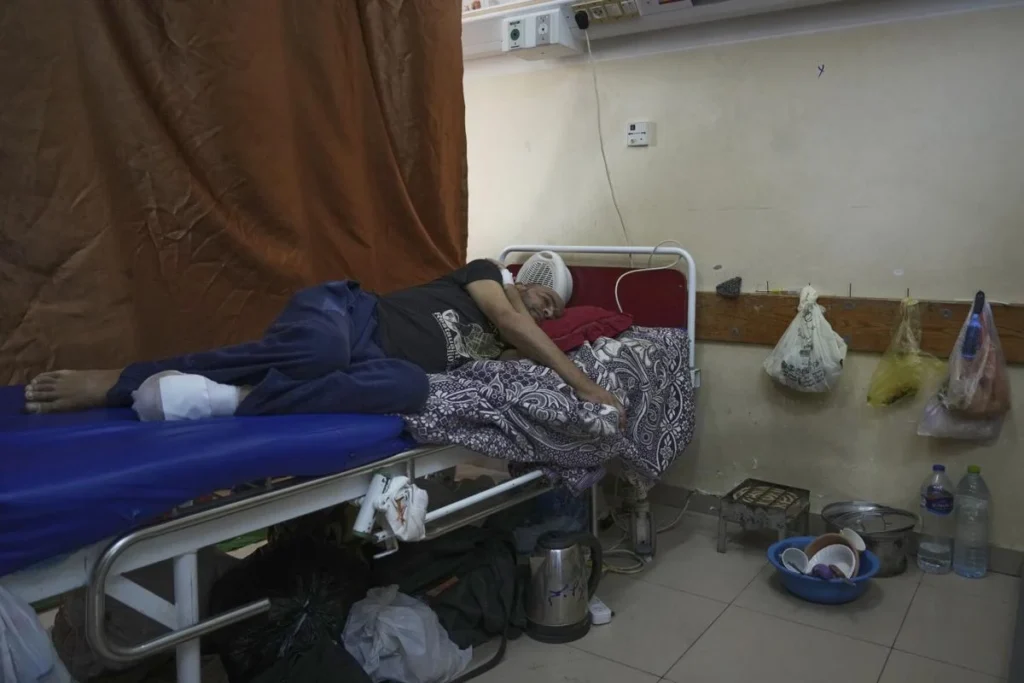
Gaza Herald _Inside the oncology department of Al-Shifa Hospital, 63-year-old Hanan Al-Ajab lay on a hospital gurney struggling to breathe. Her daughter, Fatma, held a nasal cannula near her mother’s face, but the tube was not connected to an oxygen cylinder because none was available.
“There is no oxygen cylinder. Nothing is available,” Fatma said, describing her mother’s deteriorating condition.
Hanan, who was diagnosed with pancreatic cancer several months ago, is among thousands of cancer patients in Gaza who require specialised medical treatment. Severe shortages of medicines, chemotherapy drugs, oxygen supplies and functioning medical equipment have left many patients without the care they need.
Her daughter said her mother requires continuous oxygen, warning that when her oxygen levels fall, her condition rapidly deteriorates.
Across Al-Shifa Hospital, other patients were also struggling to breathe, some connected to oxygen cylinders while others relied on equipment that could not be fully supplied.
Gaza’s oxygen system on the brink
Gaza’s Ministry of Health recently issued an urgent warning that the few remaining oxygen-generation plants were operating beyond their capacity and repeatedly breaking down.
The ministry called for crossings to be opened to allow spare parts, technical equipment and new oxygen plants to enter Gaza.
“Access to oxygen is not a medical luxury, it is a lifeline,” the ministry said, stressing its importance to neonatal units, intensive care departments, operating rooms and inpatient wards.
Mazen Al-Aryashi, head of the Ministry of Health’s Engineering Department, said Gaza had 34 oxygen-generation plants before the war. Twenty-two have since been rendered inoperable, leaving 12 plants requiring urgent maintenance.
The shortage extends to oxygen filling units. Of the 30 units previously available, only four remain operational.
Al-Aryashi warned that the failure of a central oxygen plant could force hospitals to shut down several critical departments and place patients’ lives at immediate risk.
Engineers keep damaged equipment alive
As replacement parts remain difficult to obtain, engineers in Gaza have turned to damaged medical equipment as a source of spare parts.
Inside Al-Shifa’s medical equipment maintenance room, shelves are filled with dismantled machines, circuit boards, wires and tools. Engineers take components from damaged equipment, repair what can be salvaged and use the parts to restore other machines.
Ahmed Younis, an engineer at Al-Shifa, said the hospital can no longer rely on the regular supply of replacement parts that was available before the war.
Instead, engineers collect damaged equipment, dismantle machines of the same type and reuse functioning components.
Through these efforts, they have restored roughly 15 percent of the hospital’s equipment, he said, while much of the remaining equipment is beyond repair or requires replacement.
Al-Shifa’s diagnostic capacity devastated
Al-Shifa, once Gaza’s largest medical facility and a centre responsible for a substantial share of the territory’s healthcare capacity, has suffered extensive destruction during repeated Israeli military operations.
Many diagnostic machines, laboratory devices, X-ray systems, echocardiography machines and ultrasound equipment have been refurbished using salvaged parts.
But engineers warn that even repaired machines do not always operate at their intended capacity.
MRI machines, CT scanners, lithotripsy equipment and catheterization systems were destroyed, leaving Al-Shifa without these essential diagnostic services.
Dr Mohammed Amin Matar, head of the hospital’s radiology department, said the destruction has severely affected doctors’ ability to diagnose and treat patients.
Diagnosis is often the first step toward effective treatment, he explained, but many advanced tests that were available before the war can no longer be performed.
In some cases, the lack of diagnostic capabilities has contributed to severe complications and deaths because doctors were unable to determine the precise condition of patients.
A healthcare system under prolonged strain
The collapse of Gaza’s medical infrastructure comes after nearly three years of attacks, destruction and severe restrictions affecting hospitals, medical workers, medicines, fuel and equipment.
UNRWA has described Gaza’s healthcare system as experiencing systemic collapse, with services affected across primary healthcare, specialized treatment, maternal care, emergency response and medical referrals.
The agency has also reported that no health facility in Gaza had returned to full functionality despite the ceasefire, while shortages of medical personnel, medicines, supplies and fuel continue to place enormous pressure on the remaining services.
According to WHO data cited in the report, shortages of medical equipment affected 97 percent of health facilities, while shortages of medicines affected more than 80 percent.
Medical supplies remain severely restricted
The shortage of equipment is compounded by continued restrictions on humanitarian supplies entering Gaza.
UNRWA reported that between March and May 2026, more than 42 percent of planned aid missions were cancelled or obstructed, with many involving essential medical, water and sanitation supplies.
During the same period, the volume of aid entering Gaza fell by more than 43 percent compared with the first three months of the ceasefire.
Only around 1.2 percent of the aid entering the territory consisted of medicines and health supplies.
The consequences extend beyond hospitals. A recent Israeli strike on a desalination facility in Gaza City and the destruction of a humanitarian warehouse in Deir al-Balah further damaged infrastructure and supplies needed by civilians.
The warehouse contained nutritional supplies intended for children, pregnant women and breastfeeding mothers.
Patients waiting for treatment outside Gaza
For patients requiring specialized treatment unavailable inside Gaza, leaving the territory has become another life-threatening challenge.
Gaza’s Health Ministry says hundreds of patients have died while waiting for medical evacuation since the ceasefire began, while thousands remain on waiting lists for permission to leave.
Among them is 59-year-old Raed Al-Hagag, who suffers from serious heart disease and requires specialised treatment.
Three of his main arteries are blocked, while another is severely narrowed. His doctors referred him for treatment abroad, but he remains in Gaza waiting for permission to leave.
“Before, hospitals had the resources,” he said, recalling how he previously received stents that helped keep him alive. “After the war, the hospitals have no resources.”
He described the remaining medical equipment as scarce, worn out and increasingly unreliable.
“The longer this continues, the greater the danger,” he said. “Our lives are at risk.”
A healthcare system surviving on what remains
Gaza’s hospitals are now operating through a combination of limited supplies, damaged equipment, salvaged parts and the efforts of medical and engineering teams working under extreme conditions.
For patients like Hanan, however, even the most basic medical necessity can become a matter of survival.
For cancer patients, people in intensive care, premature babies and those undergoing surgery, oxygen is not an additional service. It is essential to staying alive.
And as oxygen plants fail, diagnostic machines remain destroyed and replacement parts stay out of reach, Gaza’s healthcare workers continue trying to keep a severely damaged medical system functioning with whatever remains.