
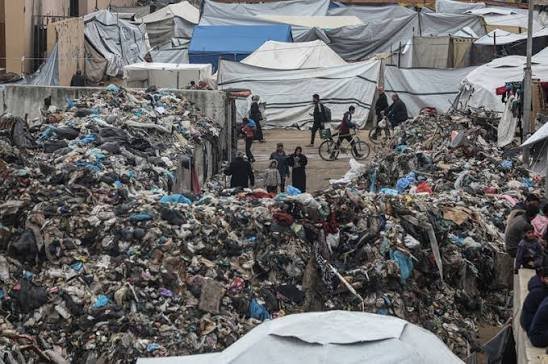
Gaza Herald — For displaced Palestinians in the Gaza Strip, the struggle for survival no longer revolves only around finding food and water or seeking shelter from bombardment. A new danger is increasingly creeping into their tents after dark: snakes and other reptiles appearing around overcrowded displacement sites.
As families try to adapt to the harsh conditions created by the war, they are confronting growing environmental and health hazards. Tents that are supposed to provide basic shelter have instead become places where families must remain constantly alert to threats on the ground.
A video circulating online in recent days has drawn renewed attention to the problem after showing a snake inside a displacement tent, alarming families already living without adequate protection or basic safety measures.
Nights Without Sleep
Umm Mohammed Hawash has been living in a small tent with her husband and five children for months. She says fear of snakes and other reptiles has become part of her family’s daily routine.
Each morning, she cleans the area surrounding the tent, removing piles of waste, dry grass and other debris that could provide shelter for snakes.
At night, the anxiety intensifies. She checks the corners of the tent and warns her children never to walk barefoot.
“Sleep is no longer normal for us,” she says. “We wake up several times during the night whenever we hear a sound or notice movement. Sometimes it is only a cat or a mouse, but the fear that it could be a snake keeps us constantly on alert. My children ask me every night whether the tent is safe, and I have no reassuring answer.”
Her greatest concern is for young children, who may not notice a snake or scorpion nearby while playing or sleeping.
Night Watches Around the Tents
Abu Ahmed Muhanna says displaced residents have been forced to rely on one another because they lack the equipment and resources needed to control the spread of reptiles and pests.
He says he and several neighbors regularly patrol the area around the tents at night, carrying flashlights and wooden sticks.
Seeing snakes is no longer an unusual occurrence, he says.
“Before displacement, we used to hear about snakes in agricultural areas or near the borders,” Muhanna says. “Today, they are appearing near tents and in places where children gather. This terrifies people, especially at night.”
Families have tried to block gaps beneath their tents and build simple barriers using sand and stones. But residents say these measures offer only limited protection.
A Childhood Haunted by Fear
For 11-year-old Yusuf, the fear has changed the way he spends his evenings.
He says he no longer likes going outside after sunset as he once did. He remembers seeing a snake moving near an area where children were playing, and says the experience left him frightened whenever he walks across the sandy ground around the camp.
“I check the ground before taking every step,” he says. “Even when I wake up at night, I am afraid that something might be moving next to my mattress.”
Yusuf says children in the camp frequently exchange stories about seeing snakes and scorpions, further fueling anxiety among them.
A Hazard Fueled by Environmental Collapse
Specialists warn that accumulated waste, piles of rubble, the absence of regular pest-control operations and rising temperatures can create conditions favorable to the spread of reptiles and rodents in displacement areas.
With the humanitarian crisis continuing and the number of displaced people remaining high, overcrowded camps are increasingly exposed to such environmental hazards.
For families living in packed tents under harsh conditions, the fear of snakes has become another chapter in Gaza’s expanding humanitarian crisis.
The danger is no longer coming only from the sky. It is also creeping across the ground and into the tents where displaced families are trying to survive.

