
Gaza Herald – Early in the morning, Saber Al-Ashqar pushes his wheelchair along a dirt road scattered with stones and broken asphalt. Holding two bottles of water in his hands, he moves slowly between rows of tents, navigating potholes and rubble that turn every meter into a difficult journey.
Since losing both of his legs in an Israeli airstrike, the road is no longer just a distance to cross, it has become a daily test of survival.
Al-Ashqar does not speak of his story as something extraordinary. He says he is simply trying to return to his tent carrying enough water for his children.
“There is no treatment, no prosthetic limbs, not even psychological support,” he says quietly before adding, “If I stay inside the tent, nothing will change. So I go out every day despite everything.”
In Gaza, the impact of an injury does not end in the operating room or when the bleeding stops. For thousands of amputees, another battle begins, one that lasts for months and years amid a collapsing healthcare system, restrictions on the entry of medical supplies, hunger that slows wound healing, and an almost complete absence of rehabilitation services.
Nearly two and a half years into the genocide, many survivors now live between the pain of their initial injuries and the growing risk of complications caused by inadequate treatment and malnutrition.
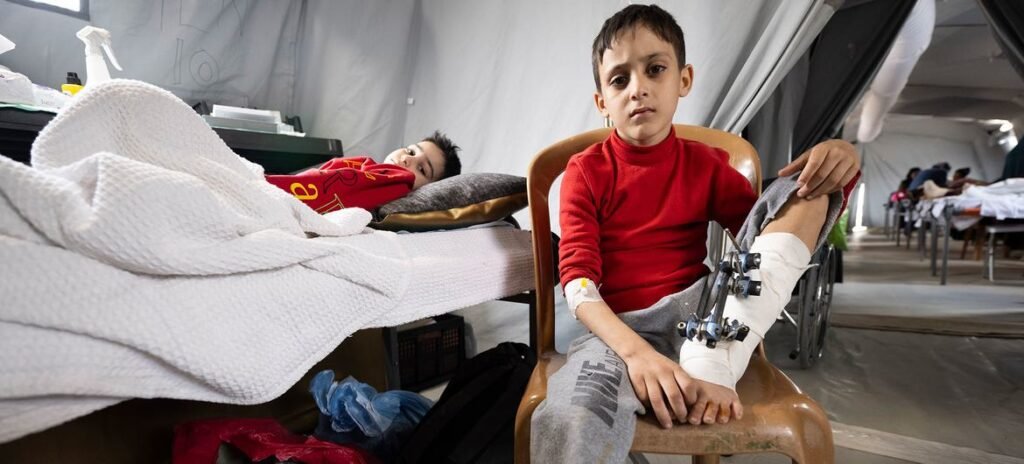
In one hospital ward, Mohammed Haboub lies in bed after being wounded for a second time in an Israeli attack. His first injury cost him parts of his hand and foot. The second reopened wounds that had never fully healed.
Metal plates now hold his bones together, but it is not only the pain that worries him.
“The food I need isn’t available, and the medical supplies that protect my wounds from infection are missing,” he says, pointing to bandages that are changed less frequently because of severe shortages.
He adds that doctors are doing everything they can, but the resources available are simply insufficient to deal with the growing number of complex injuries arriving at hospitals every day.
In Beit Lahia, northern Gaza, the life of 14-year-old Mohammed Saleh changed in a single moment. He lost one of his feet, and with it disappeared the everyday joys that once defined his childhood, playing football, running through the neighborhood, and spending time with friends after school.
For Diaa Ismail, leaving his hospital bed depends on one hope alone: obtaining permission to travel abroad for medical treatment.
Looking more often at the ceiling than at his wound, he says time itself has become part of the illness. Every day without specialized treatment reduces his chances of recovery.
According to Gaza’s Ministry of Health, the number of amputations resulting from direct war injuries has exceeded 11,000 cases, including more than 4,000 children, while the healthcare system remains unable to provide prosthetic limbs or adequate rehabilitation services for most patients.
The ministry also reports shortages exceeding 80% in many surgical supplies, anesthetics, and antiseptics, increasing the risk of serious infections and delaying wound healing.
Malnutrition has further deepened the crisis. Poor nutrition directly weakens the body’s ability to recover, while many injured patients survive on meals that lack the minimum nutrients needed for tissue repair or repeated surgeries.
Doctors say patients with metal plates or orthopedic implants require proper nutrition, continuous medical monitoring, and long-term physical rehabilitation, services that have become increasingly difficult to provide as hospitals struggle with overwhelming demand and limited resources.
The Ministry of Health adds that hundreds of injured Palestinians urgently need to travel abroad for specialized treatment or advanced prosthetic limbs, but restrictions on leaving Gaza continue to prevent many from accessing the care they need.
For Gaza’s amputees, the challenge extends far beyond the loss of a limb. It reaches into every aspect of daily life, fetching water, moving between tents, finding food, securing medicine, and supporting their families.
When Saber Al-Ashqar finally returns to his tent, the two bottles of water in his hands represent far more than a daily necessity.
In a place where the human body itself has become another battlefield, he continues to prove that losing both legs has not taken away his role as a father, even if the simplest tasks now demand the strength of an entire journey.
Yet for thousands of amputees across Gaza, one question remains unanswered:
How can a life be rebuilt when the destruction has not yet ended?

