
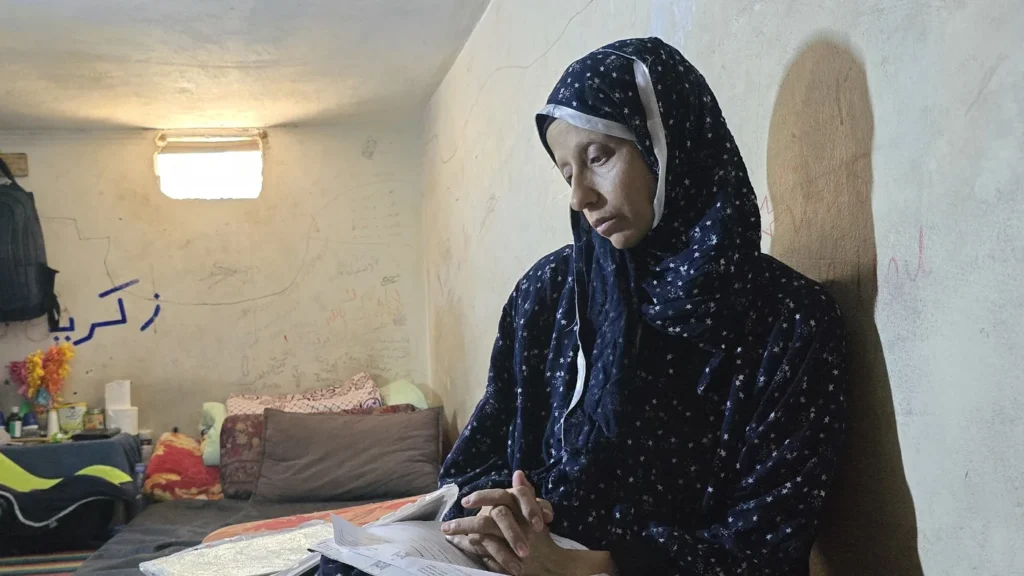
Gaza Herald _Beneath the staircase of a crowded school shelter in southern Gaza, 33-year-old university professor Kholoud Abu Sahmoud spends her days battling advanced liver cancer while waiting for medical treatment that remains out of reach.
A mother of two, Abu Sahmoud has undergone 15 rounds of chemotherapy, but doctors eventually informed her that the medications available inside Gaza were ineffective for her condition.
“I was diagnosed with liver cancer shortly after giving birth to my daughter about nine months ago,” she told Middle East Eye. “Despite months of chemotherapy, my condition continued to get worse.”
“The treatment never stopped the cancer. Instead, it caused my hair and nails to fall out. Almost every day, another piece of my nails breaks away.”
Nearly ten months after the October 2025 ceasefire, Israel continues to limit the entry of vital medicines and medical supplies into Gaza, including chemotherapy drugs, antibiotics, anesthesia medications, laboratory materials, diagnostic equipment, and surgical supplies.
The ongoing restrictions have pushed Gaza’s healthcare system deeper into crisis, leaving thousands of patients without access to life-saving treatment.
Cancer Care Reaches a Breaking Point
According to UN agencies and humanitarian organizations, nearly half of Gaza’s essential medicines and roughly two-thirds of its medical supplies had already run out by March.
Earlier this month, Gaza’s Ministry of Health announced that chemotherapy services for several forms of cancer, including breast, colorectal, gastrointestinal, head and neck cancers, and sarcomas, had largely stopped because specialized oncology medications had been depleted.
Health officials estimate that nearly 11,000 cancer patients live in Gaza, while approximately 4,000 have received medical referrals and continue waiting for permission to travel abroad for treatment unavailable inside the territory.
Dr. Muhammed Abu Nada, director of the Gaza Cancer Center, said doctors have exhausted nearly every option.
“We’ve even had to use medications that had already expired because there were no alternatives,” he said. “Now those supplies are gone as well, and this is increasing the number of patients who lose their lives.”
He described the current shortage of chemotherapy drugs as the worst Gaza has experienced in years.
“For example, the breast cancer medication we still have barely covers patients already receiving treatment. If someone is newly diagnosed, we have nothing available for them.”
Because of the shortages, physicians have increasingly abandoned internationally recognized treatment protocols and instead rely on single-drug therapies that offer fewer benefits and increase the risk of complications.
Medical teams are also facing severe shortages of immunotherapy medications, further reducing treatment options for patients.
Approved to Travel, But Still Trapped
Soon after her diagnosis, Abu Sahmoud received a medical referral because the treatment she requires is unavailable in Gaza.
Nine months later, she is still waiting.
“My doctors told me the care I need is available in Jordan or Turkey,” she said. “There is nothing more they can do for me here.”
“My health gets worse every single day while I wait.”
Medical referrals allow Palestinians to seek specialized treatment in hospitals outside Gaza, including in the occupied West Bank, East Jerusalem, Egypt, and Jordan. Although the Palestinian Authority issues these referrals, patients cannot leave without approval to cross border checkpoints controlled by Israel or Egypt.
Since October 2023, medical evacuations from Gaza have fallen dramatically, leaving thousands of critically ill and wounded Palestinians unable to reach hospitals capable of treating them.
Following the October 2025 ceasefire, Israel partially reopened the Rafah crossing under a tightly controlled medical evacuation system that permits only about 50 patients each day to leave, subject to Israeli authorization.
According to Gaza’s Ministry of Health, more than 20,000 people—including around 4,000 children—remain on urgent evacuation lists.
Since Rafah reopened in February, only 1,655 patients had been evacuated by the end of June, while more than 1,570 people have died waiting for permission to leave Gaza since October 2023.
A Slow Decline Inside a Shelter
Abu Sahmoud says her health has steadily deteriorated during months of waiting.
She struggles with severe shortness of breath, abdominal swelling caused by fluid retention, and dramatic weight loss.
“I’ve already lost about 20 kilograms,” she said. “Sometimes I can’t eat at all because the fluid in my abdomen becomes worse whenever I try.”
The mother of a five-year-old son and a nine-month-old daughter says illness has robbed her of even the simplest moments with her children.
“I haven’t been able to carry my baby since she was born,” she said.
“I can’t care for my children anymore. I’m confined to bed most of the time. Even walking a short distance leaves me completely exhausted.”
“I am dying slowly.”
Displacement Deepens the Crisis
Like thousands of seriously ill Palestinians, Abu Sahmoud’s medical struggle has unfolded alongside repeated displacement.
Since Israel’s military campaign began, she says she has been forced to flee around 30 times after her home was destroyed.
Her latest displacement brought her to a tent in Al-Mawasi, west of Khan Younis. As her condition worsened, she moved again—this time beneath the staircase of Ahmed bin Abdul Aziz School, where her older sister was already sheltering.
Today, nearly ten family members share the cramped space.
“The conditions here are impossible,” she said. “Even a healthy person would struggle to live like this, let alone someone fighting cancer.”
Next to her mattress sits a small box of medicine carefully protected from rats. Beside it rests another bag holding nearly 50 academic certificates documenting years of education and professional achievement.
Dreams Put on Hold
Before illness changed her life, colleagues and relatives knew Abu Sahmoud for her passion for education.
After earning her master’s degree, the Islamic University of Gaza honored her as the first student in its history to complete a two-year graduate program in just sixteen months.
She later began doctoral studies and became an assistant professor specializing in curriculum development and teaching methods.
“I’ve always loved learning,” she said.
“My entire life has been devoted to education. My dream was to become a professor and continue my academic career beyond my PhD.”
“But cancer has taken all of that away.”
“The hardest part isn’t only the illness, it’s waiting for treatment with no end in sight.”

