DaysOfPal — For more than two million Palestinians struggling to survive amid the ruins of the Gaza Strip, the prospect of Israeli Prime Minister Benjamin Netanyahu losing power offers little reassurance that the siege, military attacks, and displacement shaping their daily lives will come to an end. While Israeli politicians compete for power ahead of elections, Palestinian families remain trapped in a humanitarian catastrophe created by years of bombardment, destruction, and restrictions on essential supplies.
The question facing Gaza is not simply whether Netanyahu will remain in office, but whether any future Israeli government will abandon the policies that have devastated the territory, restricted its access to food and medicine, and denied Palestinians control over their own lives.
Netanyahu has become a central figure in Israel’s war on Gaza, but the structures sustaining the occupation, blockade, and military control extend beyond his government. A change in leadership, without a corresponding change in policy, would do little to restore destroyed neighborhoods, reopen crossings, or guarantee the safety of Palestinian civilians.
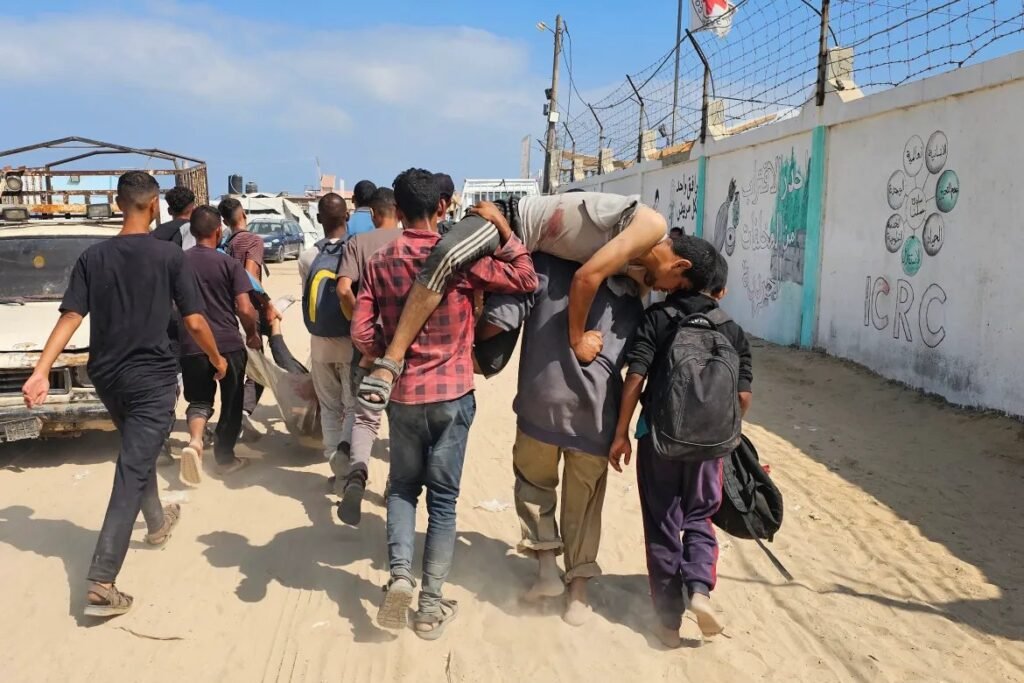
For families living in overcrowded displacement camps, the consequences of Israeli policy are measured not in election results but in the availability of bread, clean water, medicine, and a safe place to sleep.
Gaza’s Humanitarian Catastrophe Cannot Be Resolved by Replacing Netanyahu
Across Gaza, displaced Palestinians continue to face severe shortages of food, drinking water, adequate shelter, and medical supplies, while much of the territory’s civilian infrastructure remains destroyed or severely damaged.
Israeli military operations have devastated residential neighborhoods, hospitals, schools, water networks, and essential public facilities, leaving families struggling to survive in tents, damaged buildings, and makeshift shelters.
Even where fighting has subsided, reconstruction remains obstructed by restrictions on the entry of construction materials, heavy machinery, fuel, and other supplies needed to clear rubble and restore basic services.
For Palestinians who have lost their homes, the identity of Israel’s next prime minister will have little practical significance unless the policies governing access to Gaza and the movement of essential goods are fundamentally changed.
A new government would not automatically reopen border crossings, rebuild hospitals, restore electricity, or allow displaced families to return safely to their neighborhoods.
The destruction cannot be reversed through political promises alone. Recovery requires sustained humanitarian access, reconstruction materials, freedom of movement, and an end to the military operations that continue to threaten civilian lives.
Israel’s Occupation Policies Extend Beyond Netanyahu
Although Netanyahu’s government has pursued an aggressive military campaign in Gaza and expanded Israeli control over Palestinian territory, key elements of Israel’s policies toward Palestinians have existed under successive governments.
Israel’s blockade of Gaza, restrictions on Palestinian movement, military operations, and opposition to full Palestinian sovereignty have been sustained through different political coalitions.
Prominent figures in Israel’s opposition have also supported military operations against Hamas and advocated continued Israeli security control, although their positions differ on the conduct of the war, governance arrangements, and prospects for a political settlement.
These differences may influence the scale and direction of future Israeli policies, but they do not establish that an electoral defeat for Netanyahu would bring an end to the occupation or guarantee Palestinian self-determination.
The danger for Palestinians is that an election could produce a change in political leadership while leaving the fundamental mechanisms of military control and restrictions on daily life largely intact.
A government that changes its rhetoric but maintains the blockade, restricts humanitarian supplies, and denies Palestinians meaningful political rights would leave the underlying causes of Gaza’s suffering unresolved.
Palestinians Bear the Consequences of Decisions They Cannot Influence
One of the deepest inequalities underlying Israel’s political system and its control over Palestinian territory is that millions of Palestinians are directly affected by decisions made by Israeli authorities without having a vote in Israeli national elections.
For Palestinians in Gaza, Israeli government decisions can determine whether crossings open, whether humanitarian supplies enter, whether military operations continue, and whether reconstruction equipment reaches devastated communities.
Yet the people whose homes, livelihoods, and lives are affected by those decisions have no electoral means of holding Israeli leaders accountable.
This imbalance reflects the broader reality of occupation and the denial of Palestinian self-determination.
While Israeli political parties debate security, military strategy, and relations with the Palestinians, families in Gaza confront the immediate consequences of those policies through displacement, hunger, interrupted medical treatment, and the destruction of essential infrastructure.
For a Palestinian parent searching for food for their children, the central question is not which Israeli party gains seats in parliament, but whether the next government will allow the conditions necessary for their family to survive.
International Accountability Cannot Depend on Israeli Elections
The humanitarian catastrophe in Gaza has also exposed the limitations of relying on Israeli domestic politics to resolve violations of Palestinian rights.
International humanitarian law applies regardless of which political party controls Israel’s government. Obligations concerning civilian protection, humanitarian access, the conduct of military operations, and the prohibition of forcible transfer cannot be suspended or deferred until an election produces a different governing coalition.
International institutions have already subjected Israel’s conduct in Gaza to significant legal scrutiny, including proceedings before the International Court of Justice and investigations by international human rights bodies.
A United Nations Commission of Inquiry has concluded that Israel committed genocide in Gaza, while Israel rejects that characterization. The International Court of Justice has ordered provisional measures in the genocide case brought by South Africa, but has not issued a final judgment on the merits.
These legal processes underscore why international accountability cannot be replaced by expectations that a new Israeli administration will voluntarily change course.
Governments supplying Israel with weapons and maintaining political or military cooperation also face questions about their responsibilities under international law, particularly when credible evidence indicates a risk of serious violations against civilians.
For Gaza’s population, meaningful protection requires more than diplomatic statements or speculation about who might succeed Netanyahu. It requires concrete action to ensure compliance with international legal obligations and prevent further civilian suffering.
Changing Israel’s Leadership Is Not the Same as Ending the Occupation
The possibility of Netanyahu leaving office may alter Israel’s domestic political landscape, but it would not, by itself, dismantle the system of restrictions and military control that has shaped Palestinian life for decades.
Gaza’s humanitarian emergency is not simply the consequence of one leader’s decisions. It is also rooted in longstanding policies of blockade, occupation, and restrictions on Palestinian sovereignty that have persisted through successive Israeli governments.
Any future administration seeking to bring genuine relief to Gaza would need to demonstrate that change through actions: ending attacks on civilians, allowing sustained humanitarian access, lifting unlawful restrictions, enabling reconstruction, and respecting Palestinian rights under international law.
Without such measures, a change of prime minister risks becoming a political transition that leaves Palestinians facing the same deprivation and insecurity under a different Israeli leadership.
For the families who have spent years moving between displacement camps, searching for food, and mourning relatives killed during the war, the measure of change will not be a new face in Israel’s government.
It will be whether their children can sleep without fear, whether hospitals can function, whether homes can be rebuilt, and whether Palestinians can live with safety, dignity, and self-determination.
Until those conditions are met, Israel’s political changes will offer no guarantee that Gaza’s suffering is coming to an end.