
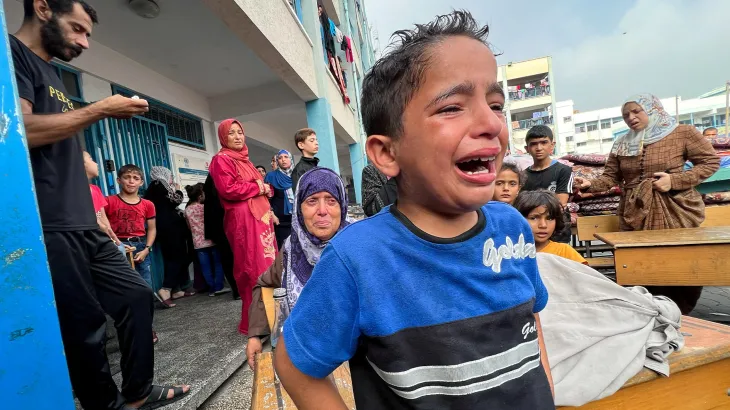
Gaza Herald- Long before war claims a child’s physical life, it strips away the basic experience of growing up. Three years after the start of Israel’s genocidal campaign on Gaza in October 2023, normal childhood routines have been replaced by a brutal fight for survival, marked by severe hunger, profound grief, and life-altering physical disabilities. Joint evaluations by the UN, EU, and World Bank indicate that roughly 1.9 million Palestinians remain displaced, frequently forced to move multiple times, with over 1.2 million left completely homeless.
For the younger generation, this destruction manifests as a life spent among shattered classrooms, collapsed medical systems, and constant loss. UNICEF estimates that around 19,000 children in Gaza are now unaccompanied or orphaned. Early in the conflict, aid personnel with Médecins Sans Frontières (MSF) created the chilling medical code WCNSF, “wounded child, no surviving family”, to identify young, solitary patients arriving at emergency rooms with horrific blast injuries, crushed limbs, and deep burns requiring extensive care.
A Catastrophic Health and Physical Rehabilitation Crisis
The scale of physical injury among Gaza’s youth is unprecedented. UN assessments report that over 5,000 limb amputations have occurred since October 2023, with children accounting for one in five amputees. Furthermore, up to 56,000 survivors require long-term, specialized physical rehabilitation.
According to MSF, more than 43,000 individuals in Gaza have suffered potentially permanent, life-altering trauma. The influx of severe injuries persists despite diplomatic arrangements; in July 2026 alone, MSF medical staff treated 567 patients suffering from acute traumatic injuries, including severe burns, blast damage, and gunshot wounds. Delivering even basic medical attention remains an uphill battle, as more than half of Gaza’s hospitals are non-operational and severe supply blockades continue to cripple humanitarian operations.
Psychological Collapse and the Transformation of Play
Beyond physical scars, the mental health toll of continuous bombardment and loss has permeated every aspect of daily life. Even after the October 2025 ceasefire announcement, living conditions remain dire, with severe overcrowding, broken infrastructure, and crippling resource shortages. By September 2026, UN OCHA reported that 91 percent of households were enduring moderate to severe water insecurity.
Humanitarian organizations like Save the Children and War Child report a severe deterioration in youth psychological health. Assessments reveal that many children live with a persistent expectation of death and manifest their trauma through behavior. In play, children have been observed turning games like hide-and-seek into mock combat, simulating air strikes, playing dead, or holding funerals for damaged dolls.
Even for those who manage to leave the enclave, psychological wounds endure. Salma, a 14-year-old who escaped to Egypt via the Rafah crossing after losing her mother and siblings in a building collapse, explains that sudden noises trigger rapid heart rates and panic. Her father describes their family’s emotional state as “buried, but not yet dead,” noting that the horror his daughter witnessed has permanently altered her ability to feel normal or secure.
The Path to Long-Term Healing
Addressing this profound psychological crisis requires an environment where safety is guaranteed. While relief agencies like UNRWA continue to deliver emergency psychosocial assistance and first aid to hundreds of thousands of displaced residents across Gaza City and Khan Younis, experts emphasize that therapy alone cannot solve the crisis.
Dr. James Gordon, an American psychiatrist with two decades of experience working in Gaza through the Center for Mind-Body Medicine, emphasizes that while trauma can be processed and healed, true recovery demands baseline stability. For Gaza’s children, meaningful psychological recovery depends on structural security: dependable shelter, restored educational routines, safe spaces for play, and supportive adult care. To help these children heal, we must first restore the conditions that let them imagine a normal, safe future.

