Gaza Herald — Gaza’s remaining hospitals are struggling to keep patients alive with dwindling medical supplies, damaged equipment, and limited operating capacity. Now, renewed Israeli accusations against medical facilities are raising fears that the health system could face another wave of threats and attacks, placing already vulnerable patients at even greater risk.
Nearly three years into Israel’s genocidal war on Gaza, the territory’s healthcare system remains severely weakened by widespread destruction, restrictions on essential supplies, and continued violations of the ceasefire announced in October 2025. For thousands of patients, access to treatment depends on facilities operating far below their former capacity.
Against this backdrop, renewed allegations that Palestinian resistance groups use hospitals for military purposes have prompted warnings from human rights organizations, Gaza’s Ministry of Health, and Hamas. They caution that such accusations must be independently verified and must not become a pretext for further attacks on facilities that remain essential to civilian survival.
The European-Mediterranean Human Rights Monitor has warned that Israeli military and media messaging directed against Gaza’s hospitals could increase the danger facing the remaining healthcare infrastructure. The organization has called for independent scrutiny of the allegations and urgent measures to prevent further harm to medical facilities.
Renewed Accusations Put Remaining Medical Facilities at Risk
On October 6, the Israeli military released a video accusing Hamas of exploiting civilian infrastructure, including hospitals, for military purposes. According to the Euro-Mediterranean Human Rights Monitor, the material did not provide sufficient evidence to substantiate the broader allegations against medical facilities.
The organization also reported six messages it characterized as incitement against hospitals and medical centers over two days.
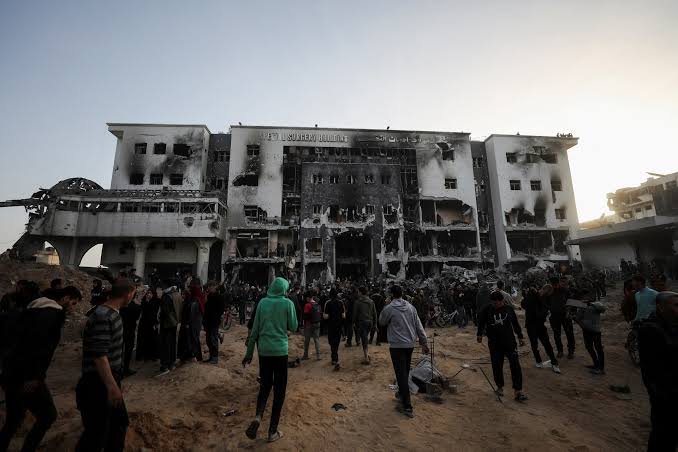
Among the material circulated was footage that the Israeli military said showed two individuals linked to Hamas, one of whom allegedly planted explosive devices transported from Kamal Adwan Hospital in northern Gaza.
The monitor questioned whether the video established the claims being made. It said the footage did not conclusively demonstrate that an individual had left the hospital or that explosives had been removed from inside the facility. Nor did it independently establish the connection between the footage and the destroyed building shown afterward.
The distinction is significant. An allegation does not become verified evidence simply because it is repeated in official statements or circulated through military footage. Even proof of military activity outside a hospital would not, by itself, establish that the hospital itself was being used for military purposes.
The allegations therefore require independent examination, particularly given the consequences that renewed attacks could have for patients, medical personnel, and civilians seeking emergency treatment.
For Gaza’s healthcare system, the concern extends beyond the possibility of a direct strike. Public accusations and threats can also undermine confidence in the safety of medical facilities, discourage patients from seeking treatment, and complicate the movement of ambulances, medical teams, and essential supplies.
Gaza’s Health Authorities Reject the Allegations
Gaza’s Ministry of Health has rejected Israeli allegations that armed personnel or weapons are present inside hospitals and other healthcare facilities. It has described the accusations as misleading and warned that they could be used to justify further attacks on the medical infrastructure left standing after years of destruction.
The ministry has stressed that functioning hospitals are treating patients and wounded people whose lives depend on continued access to medical care. Healthcare workers are operating under exceptional conditions, with shortages of medicines, disposable medical supplies, equipment, and other essential resources.
It has also emphasized that international, United Nations, and human rights organizations can enter medical facilities to examine their operations and independently assess the allegations.
Hamas has likewise denied using hospitals for military purposes, describing the renewed accusations as part of a broader campaign against Gaza’s civilian and healthcare infrastructure.
The movement has called on the World Health Organization, international journalists, and United Nations bodies to enter Gaza and establish independent teams to investigate the claims on the ground. It has also urged mediators and the US administration to intervene to prevent further attacks on medical facilities.
Independent verification is essential in this context. Neither official accusations nor blanket denials can substitute for credible investigations. But the urgency of those investigations is heightened by the consequences of any attack on facilities already struggling to provide basic treatment.
A Health System Operating Far Below Its Capacity
Figures published by Gaza’s Government Media Office illustrate the extent of the damage to the territory’s healthcare infrastructure.
According to the office, only 19 of Gaza’s 38 hospitals remain operational, and those that continue to function are working with limited capacity. The number of available hospital beds has fallen to 2,623, compared with 3,412 before the genocidal war.
The same figures indicate that 96 healthcare centers have been bombed, destroyed, or forced out of service. More than 197 ambulances have been targeted, while approximately 70 percent of electricity generators have become nonfunctional following direct attacks. The office has also documented 793 attacks on healthcare services, including incidents involving facilities, vehicles, medical personnel, and supply chains.
These figures describe more than damaged buildings and equipment. They represent fewer beds for critically ill patients, reduced capacity to perform surgery, disrupted emergency services, and greater pressure on the medical teams still working.
When a hospital loses power, its ability to operate essential equipment and maintain critical services can be compromised. When ambulances are damaged or cannot move safely, injured people may struggle to reach treatment in time. When medicines and surgical supplies run short, conditions that could otherwise be treated may become life-threatening.
The impact is especially severe for patients requiring specialized care, including those with serious injuries, chronic illnesses, and conditions that demand continuous treatment.
In such circumstances, the loss of even one additional hospital can place an overwhelming burden on the remaining facilities. Gaza’s medical system has little spare capacity to absorb further closures, making the protection of functioning hospitals an immediate humanitarian priority.
Medical Protection Cannot Be Removed by an Unverified Claim
International humanitarian law provides special protection for civilian hospitals and medical personnel. Under the Geneva Conventions and customary international humanitarian law, medical facilities must be respected and protected, and parties to a conflict must take all feasible precautions to spare patients, wounded people, and healthcare workers from harm.
A hospital does not automatically lose its protected status because one party accuses an opposing force of using it for military purposes. The relevant circumstances must be established, and any legal assessment must meet the applicable requirements.
Even where a medical facility is being used for acts harmful to the enemy outside its humanitarian function, international humanitarian law imposes conditions before its special protection can cease. Where a warning is legally required, it must be issued with a reasonable time limit and remain unheeded before protection may be lost. The principles of distinction, proportionality, and precaution continue to govern any attack.
Patients and wounded people who cannot participate in hostilities do not become legitimate targets because of the conduct of others. Medical personnel performing their humanitarian duties must also remain protected.
The Euro-Med Human Rights Monitor has warned that threats against hospitals can cause harm even before an attack takes place. Fear of bombardment may deter patients from seeking care, force medical teams to suspend services, or obstruct the delivery of medicines, fuel, and equipment.
The consequences can be particularly dangerous for people who have no alternative place to receive treatment.
Protecting Hospitals Means Protecting the Possibility of Survival
The monitor has called on international institutions, including the World Health Organization and the International Committee of the Red Cross, to intervene urgently, independently examine the Israeli allegations, and publicly clarify their findings.
It has also urged the international community to press for the protection of medical facilities, the entry of medicines, fuel, and equipment, and safe medical evacuations for patients whose conditions cannot be treated inside Gaza.
These demands address an emergency that extends far beyond the fate of individual buildings. Hospitals provide surgery, emergency treatment, maternity care, dialysis, intensive care, and other services that cannot simply be transferred elsewhere when a facility closes.
For patients already waiting for treatment, another hospital shutdown could mean longer delays, fewer available beds, and a reduced chance of survival. For medical workers, continued threats add another layer of pressure to work already shaped by shortages, exhaustion, and the destruction of the facilities on which they depend.
After nearly three years of genocidal war, Gaza’s healthcare system remains caught between enormous medical needs and severely diminished capacity. Renewed accusations against hospitals have therefore raised concerns about the future of the few facilities still operating.
Any allegations of military use must be investigated through credible and independent means. They cannot be treated as facts without sufficient evidence, nor can they justify disregarding the protections afforded to hospitals and the people inside them.
The question facing Gaza is no longer simply how many hospitals remain standing. It is whether those hospitals will be allowed to function, whether patients can reach them without fear, and whether the international community will act before the remaining capacity to save lives is further eroded.
In a territory where access to treatment has already become a daily struggle, protecting hospitals is not merely a matter of safeguarding infrastructure. It is about preserving the last remaining lifelines for a population whose chances of survival depend on them.