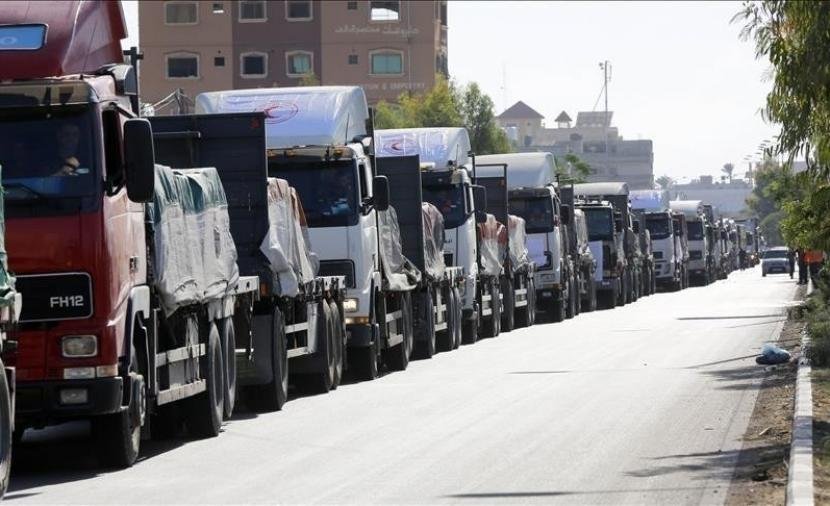
Gaza Herald – Ahmad Abu Qamar, an economic specialist, stated that 938 aid trucks vanished from their routes to Gaza within a single month. He noted that the number of entering trucks fell from 2182 in August 2026 to 1244 in September, marking a sharp decline of 43 percent.
Abu Qamar emphasized that this reduction represents a decrease in supplies reaching residents who rely on aid for approximately 95 percent of their families, according to UN reports. He highlighted that commercial trucks rose by only 2.5 percent during the same period, moving from 3688 to 3781 units.
Meanwhile, fuel trucks, which he described as the most requested and urgent category, dropped by 16.7 percent, falling from 288 to 240 units. Commercial trucks accounted for roughly 71.8 percent of total movement in September, compared to 23.6 percent for aid and 4.6 percent for fuels.
The broader picture shows that total trucks entering Gaza declined by 14.5 percent during September, decreasing from 6158 to 5265 units. Abu Qamar pointed out that if aid continues to shrink while commercial trucks rise, the nature of inflow to Gaza is shifting from relief supplies targeting needy families to a market dependent on commercial goods with high tariffs and prices.
He added that the entry of commercial goods does not indicate that residents can afford to buy them. In an economy where many families have lost income sources and purchasing power, increasing commercial goods while reducing aid could widen the gap between what is available in the market and what people can actually access.
Abu Qamar argued that September figures deserve careful reading as they reflect what can be economically described as a “engineering of starvation.” This involves sharply reducing the aid channel while expanding reliance on the commercial market, even as humanitarian needs remain widespread and prices are much higher than pre-war levels.
He concluded that the 43 percent drop in aid during one month cannot be read in isolation from the flow composition. Beyond the number of incoming trucks, the issue lies in what they carry, who they reach, and who can obtain or purchase them.
This report was produced in the Gaza Herald newsroom.