DaysOfPal — For nearly three years, their families had no graves to visit. Their loved ones remained beneath mountains of shattered concrete in Gaza City, buried where they were killed when Israeli bombs struck the Al-Taj residential complex in October 2023. On Thursday, 105 of them were finally brought out of the rubble and laid to rest.
Among the remains recovered were 47 children and 32 women, according to Gaza’s Civil Defense. They were retrieved during a painstaking 17-day operation carried out in coordination with an Egyptian committee, ending almost three years of waiting for families who knew their relatives were beneath the ruins but had been unable to reach them.
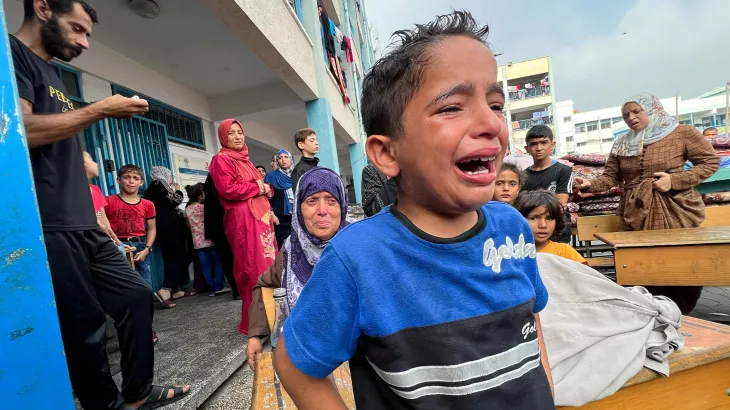
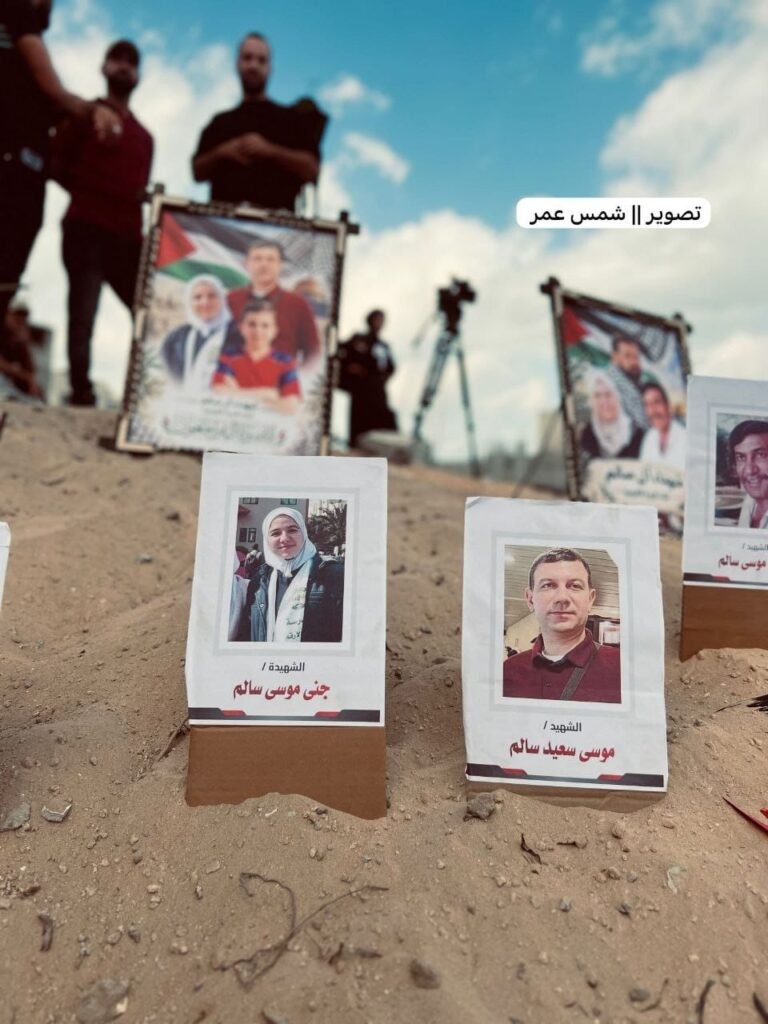
Hundreds of Palestinians gathered for the mass funeral before the remains were taken to Sheikh Radwan Cemetery in northern Gaza City. Families carried photographs of their loved ones and accompanied them on a final journey that had been delayed for more than 1,000 days. For some, it was the first time since October 2023 that they could finally mourn beside the bodies of those they had lost and give them a grave bearing their names.
The victims had been killed on October 25, 2023, when Israeli forces bombed the Al-Taj residential complex and surrounding buildings near Yarmouk Square in Gaza City. According to Al Jazeera, at least 20 bombs struck the seven-story Al-Taj 3 building and neighboring residential structures. A UN report cited by the network said the destruction extended across approximately 5,700 square meters.
Airwars, which investigated the attack, documented at least 118 civilians killed, including at least 48 children and 37 women, as well as hundreds reportedly wounded. It also identified one person killed as a militant. The scale of the destruction devastated entire extended families, with parents, children, grandparents and siblings killed beneath the same buildings.
Among the hardest hit was the Sharaf family. Al Jazeera reported that 37 members of the family were killed, while another 15 members of the al-Mahlawi family also died. Journalist Doaa Sharaf, a presenter at Al-Aqsa Radio, was among those killed. Airwars documented her death alongside that of her one-year-old son, Obaida Mahmoud Abdel Karim Haniyeh, and numerous members of her extended family.
Some bodies were recovered in the immediate aftermath of the attack. Many others could not be reached. Gaza’s Civil Defense lacked the heavy excavators and machinery necessary to remove enormous slabs of concrete, while continuing Israeli military operations repeatedly obstructed access to devastated areas. Families were therefore left with an especially painful form of grief: knowing where their relatives had been killed, but being unable to recover them for burial.
For nearly three years, the ruins of Al-Taj became their graves.
The latest recovery operation finally changed that. Osama Sharaf told Al Jazeera that 37 members of his family had been killed in the attack. Sixteen of his relatives, including his parents and siblings, were recovered during the latest search. For his family and many others, the operation brought renewed grief but also something they had been denied since 2023 — the ability to receive their dead, carry them to a cemetery and say goodbye.
The presence of 47 children among the 105 recovered gave Thursday’s funeral an especially painful weight. While nearly three years passed above ground, the children killed at Al-Taj remained beneath the ruins of the homes where they had lived. Their families had no graves at which to mourn them, even as birthdays passed and years changed.
Thursday finally gave them graves.
But Al-Taj is only one part of a much larger story still buried beneath Gaza’s ruins. Around 8,000 Palestinians killed during the war are believed to remain beneath destroyed buildings, according to figures cited by Al Jazeera. Palestinian Civil Defense teams continue to report shortages of excavators, bulldozers and other heavy equipment required to reach them.
Across the Gaza Strip, that means thousands of families continue to live with the same uncertainty that haunted the families of Al-Taj for almost three years. Some know the building where their relatives disappeared. Others have searched repeatedly through ruins. Many still have no body to bury, no grave to visit and no place where they can finally say goodbye.
Thursday’s funeral therefore represented more than the burial of 105 Palestinians. It exposed another dimension of Gaza’s devastation: even years after people were killed, the destruction has prevented families from carrying out one of humanity’s oldest and most basic acts of mourning.
After more than 1,000 days beneath the rubble, 105 Palestinians were finally returned to their families. Forty-seven were children. Thirty-two were women. They were carried through Gaza and laid to rest in Sheikh Radwan Cemetery, bringing an agonizing wait to an end for their surviving relatives.
But beneath destroyed homes across Gaza, thousands of others remain missing.
Their families are still waiting for the day when they, too, will have a grave to visit.