Gaza Herald — Exactly one year after US President Donald Trump unveiled his 20-point plan to end the war in Gaza, the diplomatic framework endorsed by UN Security Council Resolution 2803 remains a hollow blueprint. While presented on September 29, 2025, as a definitive roadmap toward an immediate ceasefire, phased Israeli military withdrawal, Palestinian technocratic governance, and large-scale reconstruction, the reality on the ground paints a vastly different picture.
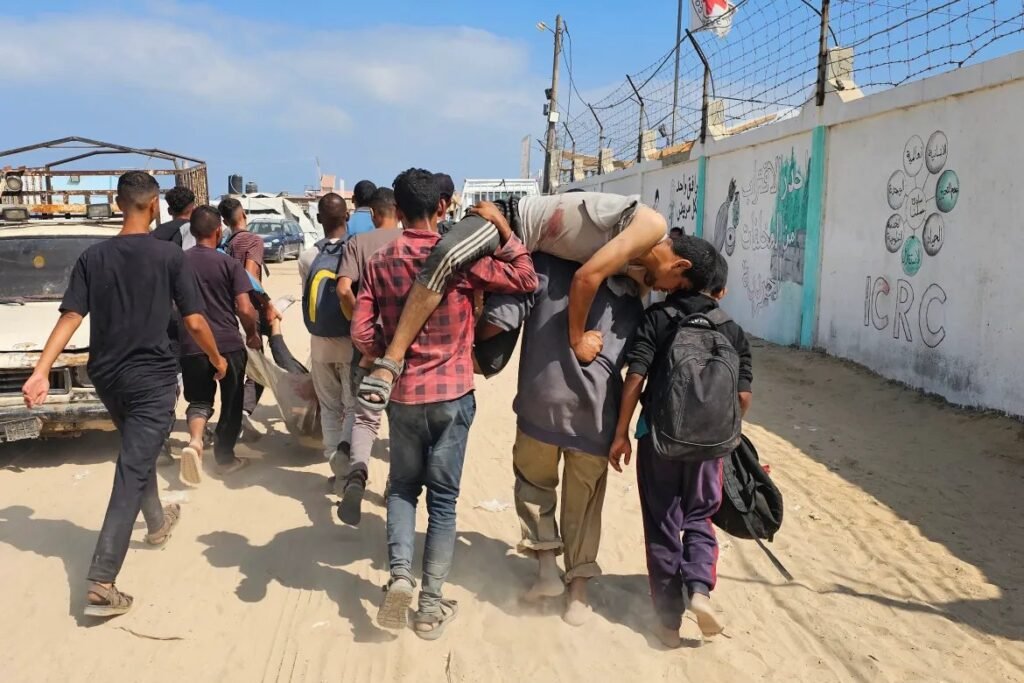
Far from facilitating a transition toward Palestinian self-determination, the past twelve months have seen Israeli military control expand to cover up to 70 percent of the Gaza Strip, leaving the enclave’s displaced population trapped in shrinking, heavily targeted enclaves.
Expanding Military Control Replaces Promised Withdrawals
The central pledge of Trump’s framework was a staged withdrawal of Israeli occupation forces to agreed demarcation lines, paving the way for full demilitarization and Palestinian administration. Instead of retreating, Israeli forces have systematically expanded their operational footprint. At the onset of the October 2025 truce, the military established the “Yellow Line,” encompassing approximately 53 percent of Gaza. By mid-2026, following explicit directives from Prime Minister Benjamin Netanyahu, the restricted-access military zone expanded to cover nearly two-thirds of the territory. UN monitoring confirms that physical barriers have repeatedly been moved deeper into civilian areas, effectively annexing vast tracts of land, severing access to agricultural regions, and reducing the accessible space for Gaza’s 2.1 million residents to a fraction of the enclave.
Ongoing Casualties and the Non-Deployment of International Forces
While diplomatic statements frequently tout the reduction in full-scale aerial bombardments, the ceasefire has failed to bring safety to Palestinian civilians. According to Gaza Ministry of Health records, 1,421 Palestinians have been killed and nearly 5,000 injured by Israeli artillery, sniper fire, and drone strikes since the truce took effect on October 11, 2025, bringing the total death toll since October 2023 past 74,000. Crucially, the International Stabilization Force (ISF), authorized by UNSC Resolution 2803 to protect civilians, oversee demilitarization, and facilitate the Israeli military’s exit, remains entirely on paper.
Despite troop-contributing declarations signed in February 2026 by nations including Indonesia, Morocco, and Kosovo, the ISF has failed to deploy a single soldier inside Gaza, leaving the occupation army as the sole armed authority enforcing the line.
Governance in Exile: The Barred Technocratic Committee
A key political element of the 20-point plan was the transfer of civilian administration to the National Committee for the Administration of Gaza, a Palestinian technocratic body meant to operate under the oversight of a U.S.-led “Board of Peace”. Formed in January 2026, the committee was tasked with managing public services, restoring civil infrastructure, and coordinating relief efforts.
However, Israeli authorities have systematically blocked the committee’s members from physically entering the Gaza Strip through the Rafah crossing or setting up administrative headquarters. Consequently, Gaza’s domestic governance remains completely disenfranchised, forced to operate remotely while local populations navigate a collapse in basic municipal services without official representation.
A Chasm Between Pledged Billions and Ground-Level Reality
The gap between diplomatic rhetoric and physical recovery is nowhere more glaring than in the stalled reconstruction efforts. Joint assessments by the UN, European Union, and World Bank estimate that Gaza requires $71.4 billion for long-term recovery, facing $35.2 billion in direct physical damage and 61 million tonnes of war debris concealing up to 10,000 unrecovered bodies. Although international donors pledged over $7 billion alongside a $10 billion U.S. commitment, the official Board of Peace Gaza Reconstruction and Development Fund administered by the World Bank remained empty months after its establishment, as contributors opted to bypass the mechanism. While the Board unveiled a new $2.45 billion short-term blueprint in September 2026, clearance operations have processed barely 1.5 to 2 percent of the total rubble due to strict Israeli bans on heavy machinery and spare parts. One year on, Trump’s plan has served not as a bridge to Palestinian recovery, but as an umbrella under which the permanent occupation of Gaza is being consolidated.