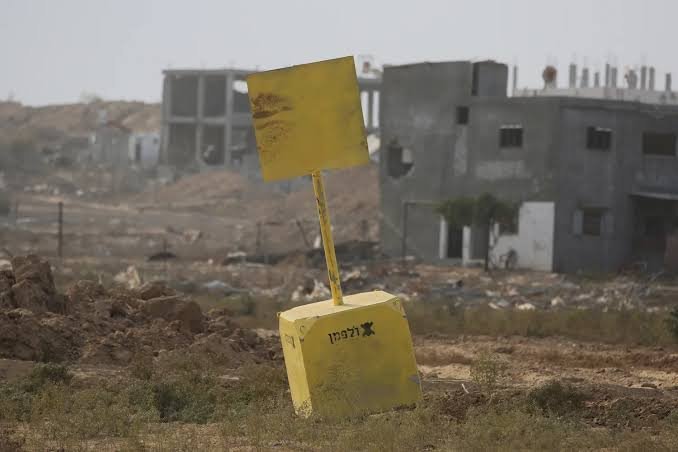
Gaza Herald — In eastern Gaza, displacement does not always begin with an evacuation order or an airstrike. Sometimes it begins with a yellow concrete block appearing closer to a family’s home than it was the day before.
Since the US-brokered ceasefire took effect in October 2025, the so-called “Yellow Line” has divided Gaza between areas accessible to most Palestinians and territory remaining under Israeli military control. The original ceasefire map placed roughly 53% of Gaza on the Israeli-controlled side, but the boundary has repeatedly shifted westwards, deeper into Palestinian residential areas.
By June 2026, UN-linked figures indicated that the restricted zone associated with the line had expanded to nearly 65% of the Gaza Strip. The result is a steadily shrinking space for a population of around two million Palestinians already living amid extraordinary destruction and displacement.
Behind every movement of the line are families who believed the ceasefire meant they could finally return home.
Many had gone back to damaged houses in Zeitoun, Tuffah, Shujaiya, Deir al-Balah, Khan Younis and other areas after months or years of displacement. They repaired rooms, erected tents beside destroyed homes and tried to reconstruct fragments of ordinary life. Then the Israeli military boundary began moving towards them.
A Boundary That Moves Overnight
The Yellow Line was introduced as part of the ceasefire arrangements defining where Israeli forces would initially redeploy. On the ground, however, it has increasingly functioned as an internal military frontier.
Yellow concrete blocks mark sections of the boundary, but investigations and residents’ accounts have documented those markers being moved hundreds of metres westwards in some areas. The Guardian reported that residents have awakened to discover the line moved overnight, suddenly placing homes and shelters inside areas controlled by Israeli forces. Satellite and open-source investigations have similarly found discrepancies between the line shown on official maps and Israeli positions on the ground.
In June, the UN Office for the Coordination of Humanitarian Affairs documented further Israeli encroachment towards populated areas of Gaza City, with troops marking a revised route using cement blocks and triggering new displacement.
By July, the same pattern was being reported across several areas of Gaza. Reuters documented residents fleeing as the Yellow Line advanced in Zeitoun and reported similar developments in Tuffah, Shujaiya, Deir al-Balah, Khan Younis and Rafah.
For families living beside it, the line is therefore not simply a mark on a military map. It determines whether they can remain in their homes, reach their land or return to communities they have already been displaced from repeatedly.
Returning Home, Only to Flee Again
This is what makes the expansion particularly devastating.
The ceasefire encouraged thousands of Palestinians to believe that the cycle of displacement might finally be ending. Families returned to neighbourhoods that had been heavily damaged, often living in partially destroyed buildings or makeshift shelters because there was nowhere else to go.
Now some are being uprooted again.
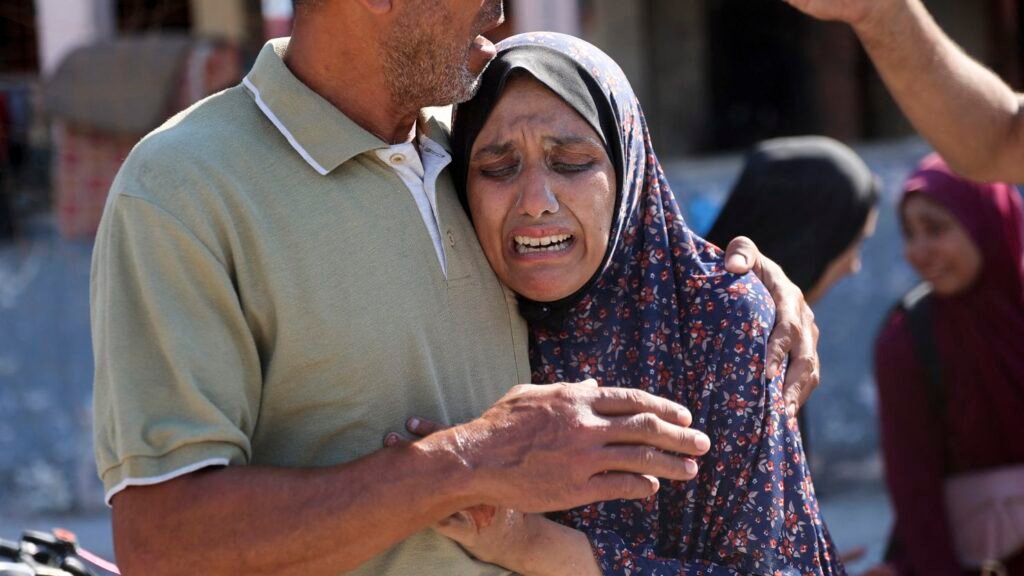
Reuters documented Gaza City resident Assem Dawla loading mattresses and belongings onto a truck in Zeitoun as Israeli yellow blocks stood nearby. He said his family had already been displaced seven or eight times since the war began.
In Tuffah, other families have described waking to find yellow blocks pushed towards the centre of Salah al-Din Road, one of Gaza’s most important north-south arteries. In Deir al-Balah, residents reported blocks being moved hundreds of metres westwards, bringing the military boundary within metres of homes and cutting families off from agricultural land.
The displacement is often almost invisible internationally. There is no single convoy of hundreds of thousands crossing a border and no formal announcement that an entire district has been permanently seized. Instead, Gaza loses pieces of itself street by street and neighbourhood by neighbourhood.
A concrete block moves. Gunfire follows. Families pack what remains of their belongings. Another piece of Palestinian land becomes inaccessible.
Gaza Shrinks While Its Population Remains Trapped
The humanitarian consequences extend far beyond the families living directly beside the line.
As Israeli-controlled areas expand, Palestinians are increasingly concentrated into the remaining accessible parts of Gaza, many of which are already devastated and overcrowded. Families displaced from the east often have few realistic alternatives because shelters are full, tents are scarce and intact housing is extraordinarily limited.
OCHA has documented families living within yards of the Yellow Line because they have nowhere safer to relocate. At one school-turned-shelter in Bureij, 18 displaced families were living about 50 yards from the military boundary while facing severe shortages of water, food, healthcare, sanitation and education.
The line is also swallowing livelihoods. Agricultural land has fallen behind the restricted boundary, preventing farmers from reaching fields that once sustained their families. In some communities, Palestinians can still see their land but cannot safely reach it.
The result is a form of territorial pressure that extends beyond military control. The shrinking geography affects where Palestinians can sleep, cultivate food, rebuild homes, recover bodies and imagine a future.
From Temporary Line to New Reality
The deeper concern is whether a boundary presented as part of a ceasefire is gradually becoming a new territorial reality.
The Yellow Line was supposed to accompany a process of further Israeli withdrawal. Instead, the ceasefire process has stalled while Israeli positions have moved in the opposite direction in several areas.
The Palestinian Centre for Human Rights has warned that the advancing line, combined with continued demolitions behind it, is creating facts on the ground that could entrench forced displacement and long-term Israeli control.
That concern has become even more serious amid increasingly explicit calls by senior Israeli officials for Palestinians to leave Gaza.
When proposals for large-scale Palestinian emigration are considered alongside an expanding Israeli-controlled zone, continued demolitions and repeated displacement of families returning home, the Yellow Line becomes more than a military boundary. It raises the question of whether temporary wartime displacement is being converted into a lasting reorganisation of Gaza’s geography.
For Palestinians living beside the advancing blocks, however, that political question is already painfully concrete.
A ceasefire was supposed to allow them to stop running. Instead, families who survived bombardment, displacement and the destruction of their neighbourhoods are watching the boundary move towards them again.
Gaza is not only being divided by the Yellow Line. With every westward advance, the space in which Palestinians can return, rebuild and remain on their land becomes smaller.