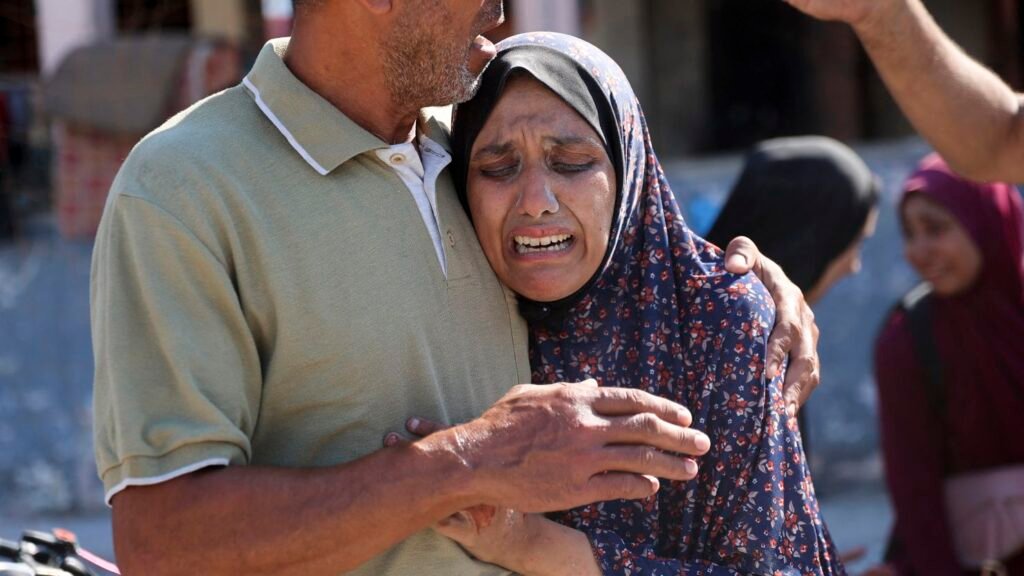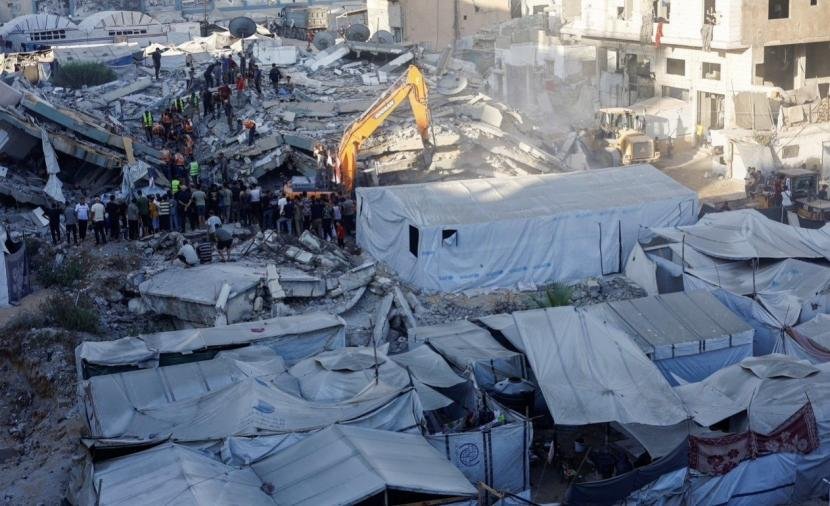
Gaza Herald — For families uprooted by Israel’s genocidal war on Gaza, securing shelter has become a desperate choice between two deadly outcomes: enduring horrific conditions in overcrowded, weather-worn tents, or returning to homes shattered by Israeli bombardment that risk collapsing at any moment.
The collapse of the al-Saada residential building in Gaza City, which martyred around 21 displaced Palestinians and left dozens more injured or buried under the rubble, has starkly exposed the consequences of this impossible dilemma.
The building had suffered repeated damage throughout the war, its foundations severely compromised by relentless Israeli airstrikes in the neighborhood. Yet families were forced back inside because the conditions in displacement camps have become completely unlivable, and safe housing has been utterly wiped out.
This tragedy brings a critical question to the forefront across Gaza: how can Palestinians be expected to leave structurally compromised buildings when Israel’s continuous assault leaves them with nowhere safe to go?
Returning to Bombarded Homes
The al-Saada building was not just a structure where families happened to take refuge when it gave way. For many, it represented the only alternative to a canvas tent exposed to the elements.
Dozens of families, mostly women and children, moved back into the compromised building simply to survive.
Their decision highlights the stark reality facing Gaza’s displaced population. Months of forced displacement have left families completely exhausted, while widespread destruction by Israeli forces has rendered habitable homes almost non-existent.
Mohammed Mansour, spokesperson for the Egyptian Committee in Gaza, emphasized that displaced Palestinians should never be forced to choose between makeshift tents and crumbling ruins.
“We are not looking at caravans or tents. We are looking at rebuilding the Gaza Strip and restoring it,” he stated.
He condemned the ongoing suffering caused by deteriorating tents and noted that the Egyptian Committee was prepared to assist in evacuating residents from buildings at immediate risk of collapse.
Evacuation Into Continued Displacement
Mansour noted that the committee operates a camp in central Gaza’s Netzarim region, spanning roughly 38 dunams and accommodating about 15,000 tents.
According to Mansour, the site includes basic utilities, medical clinics, and school spaces.
He urged residents in unstable structures to contact the committee for free evacuation support.
However, emergency relocations do not fix the root cause of the housing catastrophe caused by the ongoing military offensive.
Moving a family from a dangerous building back into a temporary tent may remove the immediate threat of a structural collapse, but it condemns them to unending displacement.
For Palestinians who have already been forcibly displaced multiple times throughout this aggression, another move exacts a severe physical and psychological toll.
Thousands of Homes Under Threat
The disaster at al-Saada is only a fraction of a vastly larger crisis.
Palestinian Civil Defense estimates that approximately 2,000 occupied structures across Gaza are on the verge of collapse due to prior Israeli shelling.
While some residents have received warnings to evacuate, the total devastation of Gaza’s housing infrastructure means that warnings offer no real alternative.
The tragic fall of al-Saada exposes the deep divide between telling Palestinians to leave dangerous sites and actually ensuring they have safe, dignified shelter.
Rescue Teams Crippled by Blockade
The housing disaster is further exacerbated by a severe, enforced shortage of heavy machinery required for search-and-rescue operations when damaged buildings collapse.
Mansour highlighted that rescue capabilities inside Gaza remain severely constrained due to the ongoing siege, leaving emergency teams without the heavy equipment necessary to clear heavy debris.
The committee received alerts regarding the al-Saada building early Wednesday morning, when an estimated 80 people were trapped inside. Using whatever minimal equipment was available, responders managed to rescue dozens.
Yet, life-saving efforts remain hampered by the lack of excavators and heavy gear needed to shift massive concrete slabs and free those buried beneath.
The Palestinian Government Media Office has demanded the immediate opening of all border crossings to allow heavy rescue equipment and humanitarian supplies into Gaza, holding Israel and its international backers fully responsible for the ongoing humanitarian disaster.
The Reality of Life Under Siege
The catastrophe at al-Saada makes clear that Gaza’s shelter crisis cannot be solved by endlessly shuffling families from one unsafe location to another.
Displaced Palestinians urgently require structurally sound, permanent housing, not an endless cycle of forced displacement, fragile tents, and temporary camps.
Mansour stressed that the Egyptian Committee and Egypt are advocating for full reconstruction rather than treating tents as a permanent state of existence.
The required scale of recovery is monumental.
Israel’s bombardment has systematically destroyed Gaza’s basic infrastructure and housing stock, with United Nations estimates placing the cost of reconstruction at approximately $70 billion.
Until reconstruction can begin and the siege is lifted, families surviving amid the ruins are left with a heart-wrenching choice: endure the misery of tent encampments or seek shelter in bombed-out buildings, the only structural remnants left to call home.
For Palestinians in Gaza, the threat is no longer just the immediate danger of collapsing concrete.
It is the stark reality that Israel’s military campaign has left them with no safe place to exist.