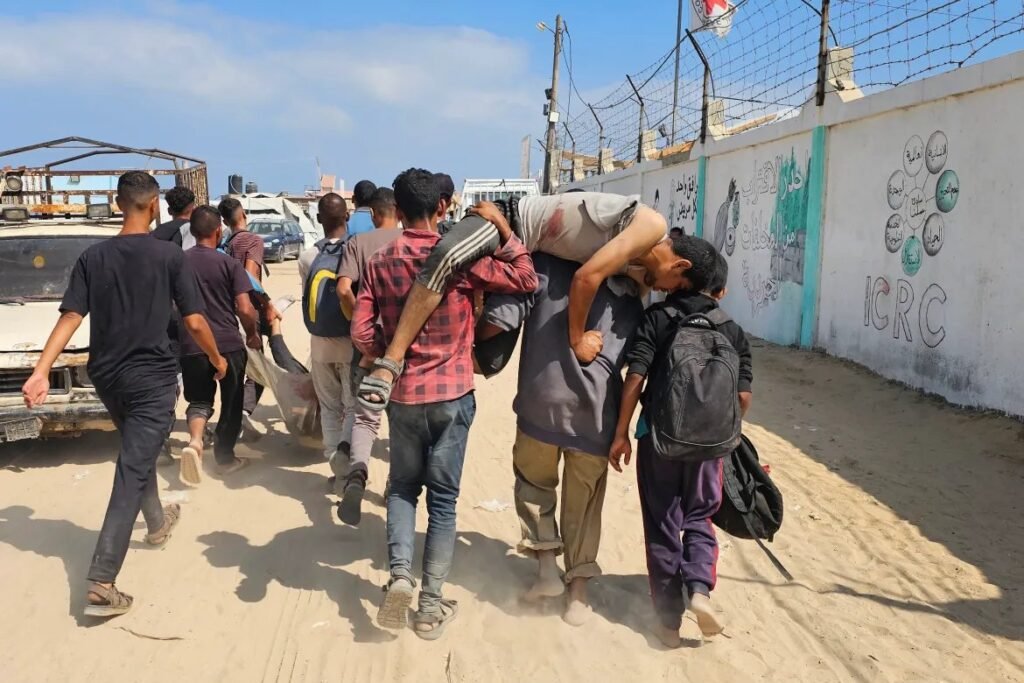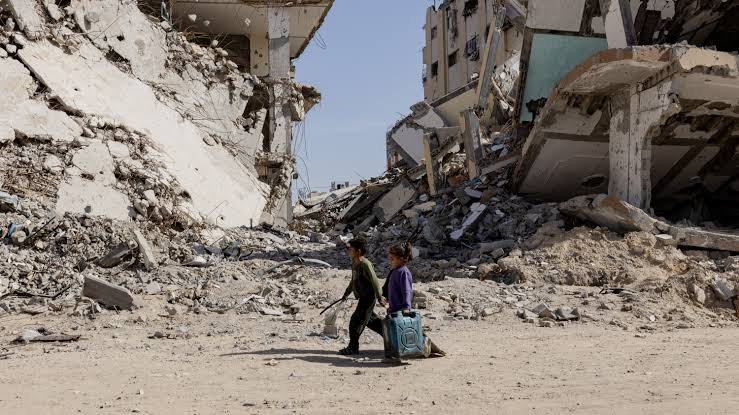
Gaza Herald — The humanitarian catastrophe in Gaza is not merely a crisis of restricted border crossings; it is the deliberate result of a total siege. The collapse of life-sustaining infrastructure, caused by continuous Israeli bombardment and strict import blockades, has left the territory stripped of the vehicles, warehouses, and logistical networks required to distribute food, medicine, fuel, and shelter to a displaced population struggling for survival.
Humanitarian agencies emphasize that Gaza requires a minimum of 800 to 1,000 aid trucks daily to meet basic human needs. However, the Israeli occupation permits only 200 to 260 trucks to enter. Compounding this restriction, Palestinian transport officials report that continuous military strikes have reduced Gaza’s pre-assault fleet of 1,200 operational trucks to a mere 300. The result is an engineered bottleneck, forcing severely limited supplies into an infrastructure systematically rendered incapable of distributing them.
With over 90% of Gaza’s population forcibly displaced and made dependent on humanitarian aid, the impact is devastating. Desperate families face skyrocketing prices, hundreds of thousands remain exposed to the elements in decaying tents, municipal water grids have been completely dismantled, and an entire generation of children is forcibly denied their right to education.
Blockaded Entry and the Target of Distribution Networks
Before the ongoing assault, Gaza’s local private transport sector maintained roughly 1,200 trucks supplying food, medicine, fuel, and construction materials.
Israeli military action has destroyed two-thirds of this fleet, leaving only around 400 intact. Of those remaining, 100 are completely out of service due to the strict blockade on essential spare parts, tires, motor oil, and batteries. Palestinian mechanics have been forced to dismantle damaged trucks to salvage parts to keep the remaining 300 vehicles functional. Meanwhile, the blockade has driven maintenance costs to astronomical levels: a single truck oil change, previously costing 450 shekels, has soared to nearly 100,000 shekels due to artificially manufactured scarcity.
This crisis has directly endangered frontline workers’ lives. More than 150 aid vehicles have been targeted and destroyed, particularly on access routes surrounding the Israeli-controlled Kerem Shalom crossing. Over 20 Palestinian drivers have been killed while attempting to deliver aid, and 15 others have been detained by Israeli forces.
The physical infrastructure of distribution has been similarly targeted. Over 150 Palestinian transport and logistics companies have seen their offices, cold-storage facilities, and central warehouses destroyed. Without refrigerated storage, temperature-sensitive vaccines, insulin, and fresh foodstuffs frequently spoil on the tarmac before reaching those in desperate need.
Gaza Requires an End to Siege, Not Just Scraps of Aid
The internal distribution crisis exists in tandem with the deliberate throttling of incoming aid.
Muhammad Saleh, coordinator-general of the Network of Palestinian Non-Governmental Organizations (PNGO), notes that current entry levels cover less than 40% of basic survival needs. He warns that the ongoing restriction of relief operations is driving Gaza into a human-made famine.
This starvation policy works alongside the total destruction of Gaza’s economy.
“Over 85% of Gaza’s population has been pushed into unemployment due to the destruction of factories, farms, and small businesses,” Saleh stated. “Purchasing power has completely collapsed. Families are forced to rely on direct relief because their livelihoods have been systematically destroyed.”
This creates a brutal dynamic: Israeli restrictions prevent sufficient aid from entering, local markets remain empty, prices skyrocket beyond reach, and indigenous economic capacity is erased, leaving families entirely reliant on external emergency support.
Forced Displacement into Shrinking “Safe Zones”
The crisis is exacerbated by the forced displacement of the Palestinian population into ever-shrinking pockets of land.
Saleh reports that roughly 800,000 Palestinians are enduring severe weather conditions in threadbare, inadequate tents. Overall, 77% of Gaza’s population is living under plastic sheeting or basic canvas as Israeli military orders continuously push people out of their homes.
This systematic compression has forced nearly the entire population into just 30% of Gaza’s total land area, with 10% of that remaining area directly adjacent to active military zones (the “Yellow Line”).
This overcrowding hampers logistical operations. Delivering clean water, food rations, and medical supplies across densely packed tent encampments, where roads have been turned to rubble, presents severe physical hurdles. The water crisis is especially acute: with municipal wells in northern and eastern Gaza out of service due to fuel bans and destroyed generators, families depend on water trucks that can only provide 60 to 80 liters per day for large households—far below the basic WHO standard for health and sanitation.
The Systematic Destruction of Civil Infrastructure
The breakdown of distribution cannot be separated from the broader destruction of Gaza’s civil infrastructure.
By flattening commercial centers, factories, and agricultural lands, the military campaign has dismantled the interconnected network that once enabled self-sufficiency. Simply increasing the count of aid trucks at a border checkpoint will not resolve the emergency; Gaza requires the immediate entry of heavy machinery, fuel, vehicle components, building materials, and an immediate end to targeting distribution routes.
Concurrently, international relief operations face immense political pressure. UN agencies, particularly the UN Relief and Works Agency (UNRWA), face ongoing political campaigns aimed at dismantling their mandate. Saleh warns that crippling UNRWA strips Palestinians of their primary safety net and further weakens the collective humanitarian response.
A Generation Robbed of a Future
The devastation extends directly to Gaza’s youth.
Over 60% of Gaza’s children have been completely deprived of access to formal education due to the targeting of schools and universities. Saleh warns that without an immediate cessation of hostilities and massive rebuilding efforts, an entire generation risks missing crucial developmental and academic years.
Rebuilding Gaza’s education sector involves far more than reconstructing brick and mortar; it requires lifting the blockade so that school furniture, books, electrical components, and basic learning materials can enter, alongside securing stability for Palestinian educators.
The same principle applies to humanitarian assistance as a whole. An aid truck passing through a checkpoint does not mean food has reached a starving child. A shipment of medical supplies does not guarantee that a damaged, under-resourced clinic can administer them.
The physical destruction of Gaza’s infrastructure has turned the simple act of carrying aid to a family into a dangerous challenge.
The siege must end, as Gaza’s emergency is directly defined by the stark, deliberate gap between the minimum requirements for human life and the fraction of aid allowed to enter. Behind every critical shortage lies a systematically dismantled infrastructure: Gaza needs food, but it requires intact trucks to transport it safely; it needs medical supplies, but also functional clinics and cold storage; it needs clean water, but also fuel for municipal wells and distribution networks; and it needs schools, but fundamentally requires the lifting of the blockade so educational supplies can reach its children.
The humanitarian crisis in Gaza cannot be measured solely by counting trucks at border crossings. It is visible on destroyed roads, inside burnt-out warehouses, in overcrowded tent camps, and in silenced classrooms. True recovery requires more than trickle-in relief; it demands an immediate end to the blockade, the cessation of military attacks on civilian infrastructure, and the complete restoration of the systems that allow Palestinians in Gaza to survive and live with dignity.