
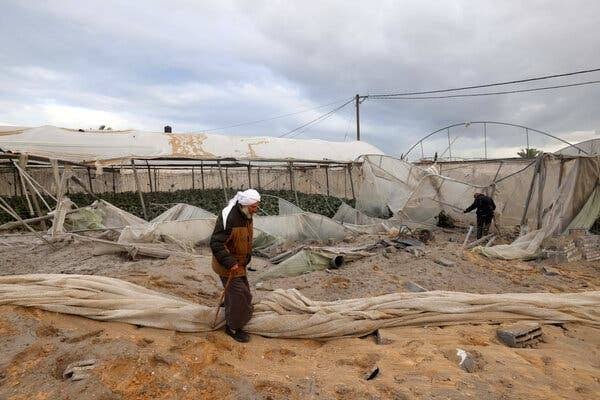
Gaza Herald — Along the edge of the Israeli military’s so-called “Yellow Line,” Palestinian farmers in Beit Lahia are carrying out a quiet but powerful act of sumud, steadfastness. They are returning to fields devastated by Israeli bombardment, clearing rubble, searching for scarce seeds, improvising irrigation systems and planting again, often within sight of Israeli military positions.
Their return is unfolding across only a fraction of what was once one of Gaza’s richest agricultural areas. According to local estimates, around 20,000 dunams of Beit Lahia’s agricultural land have become inaccessible because of Israeli military control around the Yellow Line, while large areas of remaining farmland have been damaged or destroyed. For farmers trying to revive them, cultivation is about far more than income: it is about food, survival and preserving Palestinians’ connection to their land.
Farming Under Israeli Fire
In Aslan, an agricultural district bordering the Yellow Line, farmers work under the persistent threat of Israeli gunfire. During a recent visit, shooting erupted from Israeli military positions near the Atatra roundabout, forcing farmers to drop to the ground until it stopped. They then stood up, picked up their tools and returned to work.
When Ahmed Majdi Tanbura returned after the ceasefire, he could barely recognise land his family had cultivated for generations. Israeli military operations had transformed orchards and farmland into stretches of rubble and damaged soil.
“There was the largest flower nursery in Gaza,” he recalled. “Over there was a large livestock farm, and where we are walking now there used to be dense trees. It was a paradise on earth before our eyes.”
Clearing his field took nearly 40 days of manual labour before he could begin planting. Seeds and basic agricultural supplies were scarce and prohibitively expensive, and some of the crops he planted failed to grow.
“I did not stop or give up,” Ahmed said.
Today, green plants are emerging from land that only months earlier appeared lifeless. Ahmed grows eggplants and other vegetables, experimenting to determine what the damaged soil can still sustain. Financial profit remains uncertain, but for him, returning the land to cultivation is itself a victory.
Water, Seeds and Survival
For 70-year-old farmer Abu Osama Tanbura, returning to agriculture has also meant finding ways to overcome the destruction of water infrastructure. He constructed a makeshift reservoir from plastic sheets and now carries buckets of water to individual plants because the irrigation system he once depended on no longer functions.
Before the war, strawberries, citrus trees and flowers covered fields across Beit Lahia, irrigated through functioning agricultural networks. “I only had to open the water valve, and the water would reach the crops without me carrying a bucket,” Abu Osama recalled.
He has cultivated this soil since childhood and refuses to abandon it now. With seeds increasingly difficult to obtain, he has returned to traditional seed-saving methods, allowing vegetables to fully ripen and dry before collecting their seeds for the following season.
Farmers are also experimenting with locally available alternatives to commercial fertilisers. Azhar Tanbura, director of the Popular Initiatives Department at Beit Lahia municipality, says residents have used materials including fermented lentils, yeast and fish waste to nourish damaged farmland.
Water remains one of the greatest obstacles. According to municipal estimates, more than 80% of Beit Lahia’s agricultural wells were destroyed or rendered unusable during Israeli military operations. Residents have nevertheless begun repairing whatever they can, including a century-old well whose surface infrastructure was demolished.
With conventional supplies unavailable, residents have improvised even the smallest details, at times using locally available olive oil to lubricate mechanical components of water pumps.
A Harvest of Steadfastness
Despite enormous destruction and shortages, agriculture is slowly returning. Beit Lahia municipality says around 900 dunams have been cleared and cultivated, with another 1,200 dunams undergoing rehabilitation. Approximately 450 household gardens have been established, while 729 farmers have returned to work their land.
The numbers remain small compared with Beit Lahia’s agricultural production before the war, but their importance extends beyond acreage. Locally grown vegetables provide families with food, reduce dependence on scarce commercial supplies and help restore a degree of food sovereignty to communities devastated by war.
Beit Lahia was once known as one of Gaza’s agricultural hearts, famous for its strawberries, citrus groves and flowers. Municipal estimates put direct damage to its agricultural sector at around $30 million, with reconstruction expected to require at least $40 million.
Yet those figures cannot fully capture what is happening along the Yellow Line. Farmers are returning with damaged tools, scarce seeds, makeshift fertilisers and buckets of water, cultivating fields within sight of Israeli military positions because abandoning the land would mean surrendering something far greater than a livelihood.
In Gaza, planting has become an act of survival and resistance. Every seed placed in damaged soil is an assertion that Palestinians remain rooted in their land, and every green shoot emerging from the rubble carries the same message: destruction has not succeeded in severing Gaza’s farmers from the soil they have cultivated for generations.

