Gaza Herald — Heavy Israeli airstrikes are once again tearing through crowded residential areas across the Gaza Strip, destroying homes, damaging surrounding buildings and forcing already displaced Palestinian families to flee yet again, reviving one of the most devastating patterns of Israel’s war: turning civilian neighborhoods into expanding zones of fire.
Over recent days, Israeli attacks have struck homes and densely populated areas from Gaza City and the central refugee camps to Khan Younis in the south. On September 9, an Israeli strike devastated a home in al-Shati refugee camp and heavily damaged surrounding houses, while other attacks destroyed residential buildings in Nuseirat and Khan Younis, displacing dozens of families.
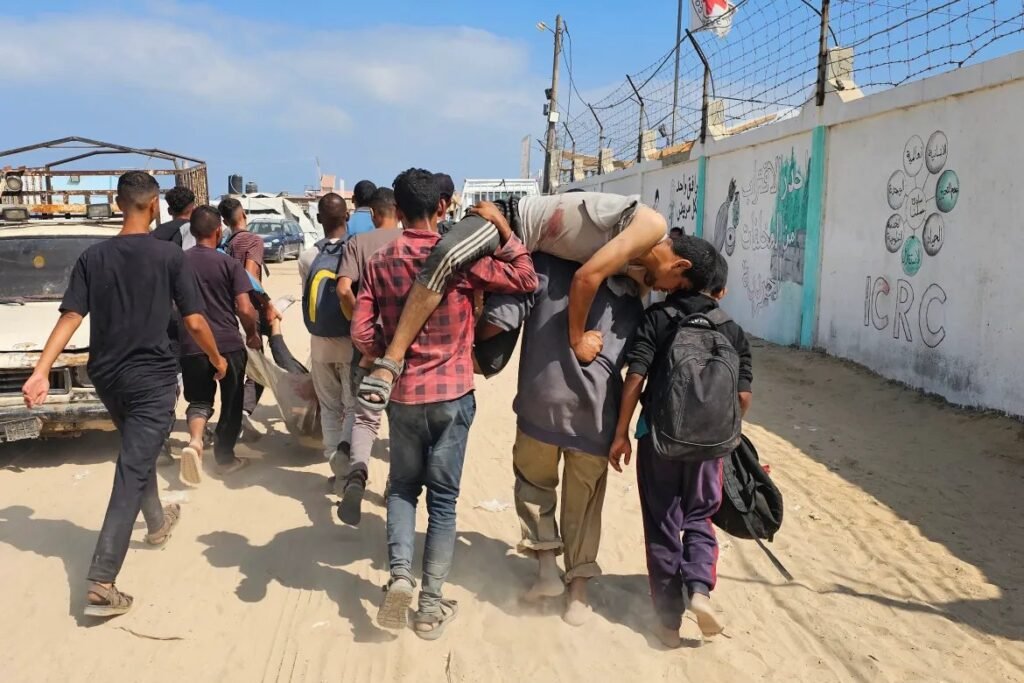
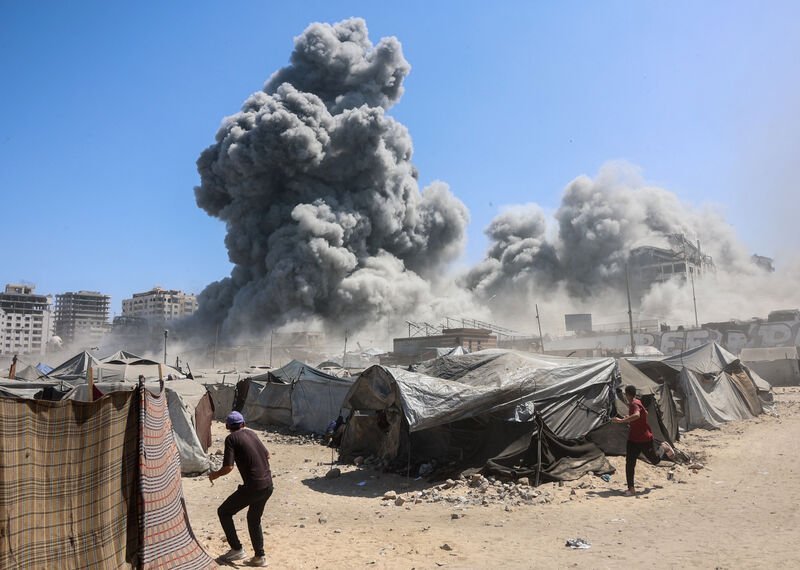
The destruction rarely ends with the building directly struck. Missiles send blast waves, debris and fire through surrounding homes, tents and civilian infrastructure, transforming a single targeted structure into a much wider area of devastation. Families living nearby are consequently pushed into another cycle of displacement, often with little more than the belongings they can carry.
For Palestinians who have already been displaced repeatedly, an evacuation warning offers no meaningful guarantee of safety. Leaving one threatened neighborhood frequently means moving to another overcrowded area where families live in tents or damaged buildings with limited water, food, sanitation and medical care — and where Israeli strikes may still reach them.
Displacement Without Safety
The renewed bombardment comes amid a humanitarian landscape already shaped by extraordinary levels of destruction and displacement. The UN Office for the Coordination of Humanitarian Affairs said in early September that most of Gaza’s 2.1 million Palestinians remain displaced, while Israeli restrictions have confined most of the population to less than 40% of the Strip.
This concentration of civilians makes renewed attacks on residential areas particularly dangerous. A destroyed home can displace not only its original occupants but several families sheltering inside or around it, while damage to neighboring buildings can make an entire residential block uninhabitable.
The pattern was visible again this week. Residents in Nuseirat said an Israeli attack destroyed a residential block and displaced more than 60 families after people were reportedly given only minutes to leave. In Khan Younis, another Israeli airstrike destroyed a residential home after an evacuation warning, sending residents running through a densely populated neighborhood as smoke engulfed the area.
The human cost continues even when civilians manage to evacuate before a strike. Each displacement means another loss: a mattress left behind, food abandoned, medicine forgotten, another tent to find and another fragile network of neighbors and relatives broken apart.
For families already living at the limits of survival, displacement itself becomes a form of attrition.
When the Home Becomes the Battlefield
The renewed attacks also expose the increasingly blurred distinction between Gaza’s civilian spaces and the battlefield Israel has imposed upon them. Homes, refugee camps, tents and neighborhoods containing displaced families repeatedly become sites of military attack, while the population has progressively fewer places to escape.
On September 10, an Israeli airstrike in northern Gaza killed a Palestinian man, his wife and their daughters, aged eight and 12, while they were sleeping, according to health officials cited by Reuters. Israel said it had targeted a “military structure” and alleged that the man was involved in attacks against Israeli forces.
The case captures the central reality facing Gaza’s civilians: Israel may identify a person or structure as a military target, but the weapon falls within a civilian environment where families sleep, children live and displaced people crowd into whatever shelter remains.
This is why the consequences of an airstrike cannot be measured only by the coordinates of the building hit. Every attack can destroy another portion of Gaza’s shrinking civilian space and push more Palestinians into areas already struggling to sustain them.
Israel maintains that its military operations target Hamas and other armed groups and says it takes measures to reduce civilian harm. Yet after years of destruction and repeated displacement, the practical reality for Palestinians is that the geography of safety has steadily disappeared.
Nowhere Left to Flee
The latest bombardment therefore represents more than another escalation in airstrikes. It revives a pattern that has followed Palestinians throughout the war: an area becomes dangerous, families flee, their new shelter becomes overcrowded, and then violence reaches them there as well.
Every new wave of attacks reduces the number of intact homes and viable shelters while increasing the number of people competing for diminishing space and humanitarian resources. Displacement ceases to be temporary when families have nowhere secure to return to and nowhere safe to move next.
For Gaza’s repeatedly displaced population, the question is no longer simply whether an individual building will be bombed. It is whether any civilian space can remain beyond the reach of war.
As Israeli aircraft once again strike residential blocks and families gather what remains of their belongings to flee, Gaza is being forced back into a brutal cycle its people know intimately: bombardment, destruction, displacement, and another search for safety in a territory where safe ground is disappearing.