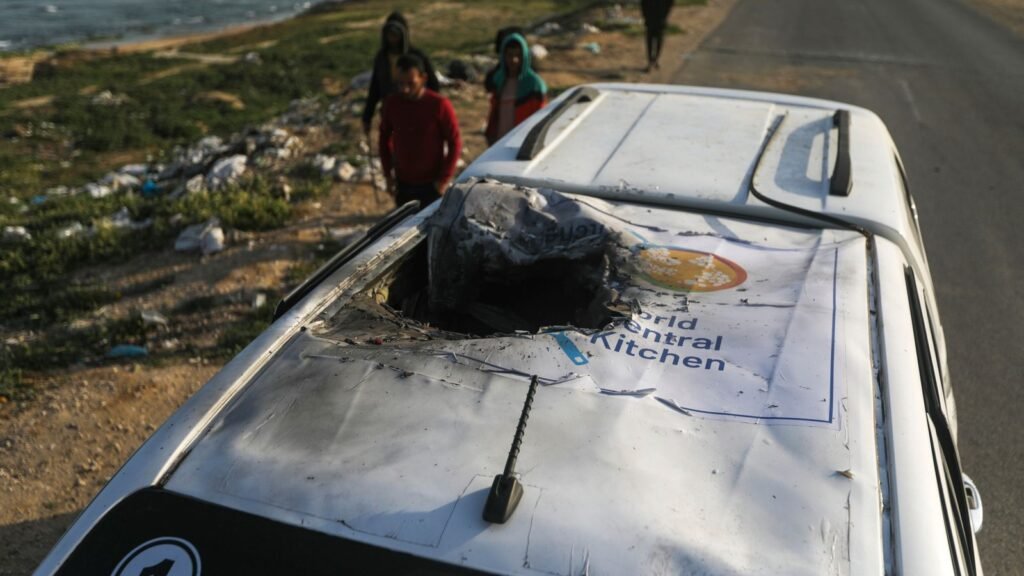
Gaza Herald – The Israeli military officer who ordered the drone strike that killed seven World Central Kitchen (WCK) aid workers in Gaza has defended the decision, saying he is “not sorry” for the attack despite the deaths of international humanitarian workers.
Colonel Nochi Mendel, who commanded the operation, told Australia’s ABC that he continues to stand by the decision to strike the aid convoy on April 1, 2024.
The seven WCK workers killed in the attack included Palestinian, British, Australian, Canadian and Polish nationals. According to ABC, Mendel made the comments during an interview recorded in October 2025.
“I’m the commander, and I’m the one who gave the order to carry out the operation. I didn’t run away from the situation. I said I gave the order; don’t look for anyone else,” Mendel said.
Following the attack, Mendel was removed from his position as chief of staff of the Israeli military’s Nahal infantry brigade.
The Israeli military previously said the strike resulted from a series of operational failures, including violations of its rules of engagement and standard operating procedures.
No criminal investigation
Despite the deaths of seven humanitarian workers, the Israeli military announced earlier this month that it would not open a criminal investigation into the strike.
The decision drew criticism from the governments of the United Kingdom, Canada and Australia, whose nationals were among those killed.
In a joint statement, the three governments described the decision as “shameful,” saying the Israeli military had not provided an adequate explanation for declining to pursue a criminal investigation.
They also highlighted the timing of the decision, noting that it was announced on World Humanitarian Day.
“The victims of this incident and their families deserve justice and accountability, and we will continue to seek answers on their behalf,” the three governments said.
Mendel told ABC that he did not intend to kill the WCK workers. However, he also said: “I’m not sorry for what I did.”
Officer blames WCK and battlefield conditions
During the interview, Mendel attributed the deaths to what he characterized as mistakes by World Central Kitchen, as well as the difficult circumstances surrounding military operations in Gaza.
He also alleged that there had been “an intermingling between the WCK and Hamas operatives” on the night of the attack.
“So the WCK, too , unfortunately, they aren’t really a neutral organisation. Not really an organisation you can say is innocent and completely clean,” he said.
“It had ties to Hamas,” he added.
World Central Kitchen rejected the statements, describing them as “false and outrageous.”
“This is the latest attempt to shift blame away from the IDF’s own actions,” a WCK spokesperson told ABC.
The organization also questioned Mendel’s credibility, pointing to his direct involvement in the decisions that preceded the April 1 strike and his removal from his military position afterward.
“He was directly involved in the decisions that led to the 1 April strikes and was immediately removed from his post for serious failures and breaches of standard operating procedure,” the spokesperson said.
WCK reiterated its call for an independent investigation into the attack.
“We demand truth and justice for our seven colleagues who were killed, through a full, independent investigation into the attack,” the organization said.
The deaths of the seven aid workers have remained a major point of concern for humanitarian organizations and the governments of the countries whose citizens were killed. The decision not to pursue a criminal investigation, together with Mendel’s continued defense of the strike, has renewed questions over accountability for the attack and the circumstances that led to the convoy being targeted.