
Gaza Herald — As Israel continues targeting Palestinian police officers in Gaza, deadly family disputes and armed confrontations are spreading across the besieged enclave, raising growing concerns over the erosion of community safety and social cohesion.
Residents in several parts of Gaza say armed disputes have become increasingly common, with gunfire heard almost daily in neighborhoods, markets and areas crowded with displaced families. Some confrontations have resulted in deaths and serious injuries, while others have involved knives and other weapons.
The escalation has placed tribal elders and community leaders under mounting pressure as they attempt to mediate a growing number of violent disputes and prevent individual disagreements from turning into wider family conflicts.
Residents say the deterioration is particularly alarming because Gaza’s already weakened police force is struggling to maintain public order after repeated Israeli attacks on its officers and facilities.
Disputes Turning Into Family Conflicts
One Gaza City resident, who asked not to be identified, described witnessing armed men step out of a vehicle and immediately open machine-gun fire on a group of people in the street.
“The scene was terrifying. Armed men suddenly got out and started shooting,” he said.
He said several young men fell to the ground, while people nearby were unable to reach them until the attackers left.
The incident occurred north of Gaza City and killed two members of the Abu Warda family, who had been displaced from their original home after Israeli forces took control of the area.
Another resident, known as Abu al-Abd, said he now rarely goes a day without hearing about a dispute between families.
“Almost every day we hear gunfire,” he said, particularly in areas housing large numbers of displaced people and around popular markets.
Abu Mohammed Shaker, a community elder involved in mediating family disputes, said one of the most dangerous developments after months of war has been the transformation of personal disagreements into conflicts involving entire families.
“In the past, we would resolve a dispute between two individuals. Today, the same problem can turn into a conflict between two families, with weapons being brought into it,” he said.
He warned that the growing disputes threaten Gaza’s already fragile social stability.
Community mediators who previously managed to settle disputes are increasingly struggling as the number of conflicts rises and families feel compelled to demonstrate their strength in the absence of effective law enforcement.
War, Displacement and Extreme Pressure
Community leaders say the worsening disputes cannot be separated from the devastating conditions created by Israel’s war on Gaza.
Mass displacement, overcrowded shelters, poverty, prolonged psychological stress and the destruction of homes and basic services have placed enormous pressure on families already living through extraordinary hardship.
Large numbers of displaced Palestinians are being forced to live in severely overcrowded areas, leaving families with little privacy or space and increasing tensions within communities.
In one recent dispute, a man was killed during a confrontation between two displaced families. Members of the victim’s family later surrounded the area where the other family was staying and detained several of its members until the suspected killer surrendered.
Mediation efforts eventually secured the release of those detained, but the wider dispute remained unresolved.
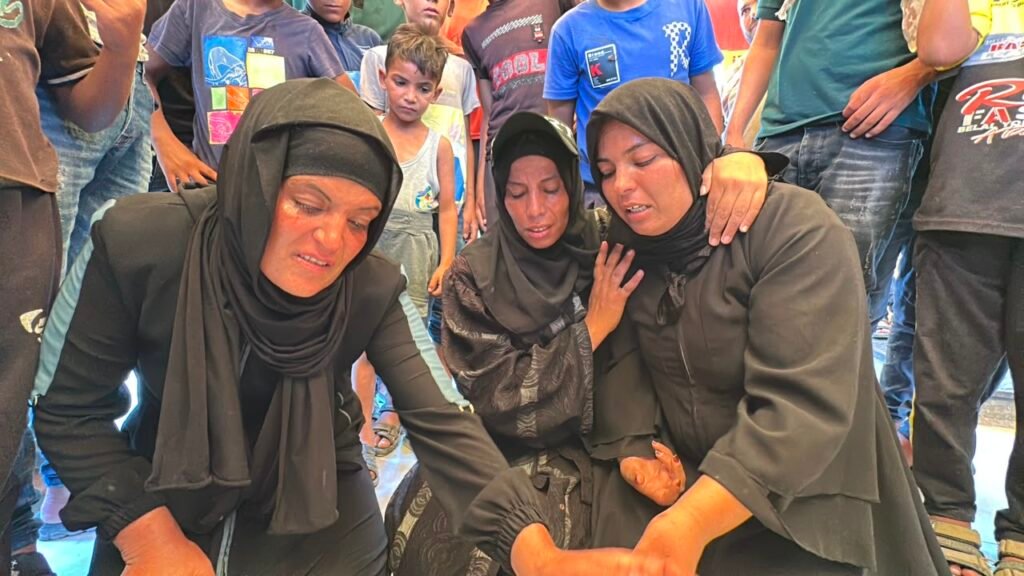
In another case, the family of two men killed in an armed attack did not open a traditional mourning house, a step understood within tribal customs as a demand for retaliation.
Community figures and political groups subsequently visited the family as tensions continued to rise.
Similar armed disputes have also erupted in southern and central Gaza, with automatic weapons and knives used in some confrontations and several people injured.
Rights Group Warns of Growing Gun Violence
The Al-Dameer Association for Human Rights in Gaza has warned of the growing misuse of weapons in family and personal disputes and the increasing number of civilian casualties.
The group said it has documented repeated armed confrontations in recent days.
In one incident, a dispute that began while people were filling drinking-water containers in western Gaza City escalated into gunfire, killing 52-year-old Salman al-Sarsawi and critically injuring three others.
In another incident, masked gunmen in a vehicle opened heavy fire on members of the Abu Warda family in northwestern Gaza City. Two people were killed and others suffered critical injuries, with two remaining in intensive care.
The rights group warned that the danger extends far beyond those directly involved in the disputes.
Gunfire in densely populated neighborhoods puts children, women and elderly people at risk and can transform a private dispute into a threat to an entire community.
It called for urgent measures to prevent the spread and misuse of weapons and urged families, tribal leaders and community groups to reject armed retaliation and protect Gaza’s social fabric.
Israel’s Targeting of Police Deepens the Security Crisis
The deterioration comes as Gaza’s police force faces repeated Israeli attacks on its officers and facilities.
Israeli forces recently struck a police post in Gaza City, killing eight police officers, including the city’s police chief, according to Gaza’s Interior Ministry.
The attack followed the killing of the former Gaza City police chief approximately a week earlier, as part of a wider pattern of Israeli attacks against police officers since the current fragile ceasefire took effect.
Gaza’s Interior Ministry has warned that Israel’s repeated targeting of police personnel is weakening the institution responsible for maintaining public order and preventing internal violence.
The ministry said police officers are being killed while carrying out duties related to maintaining security and protecting the civilian population.
It urged families and tribal leaders to recognize their responsibility during an exceptionally dangerous period and place the broader interests of Palestinian society above local disputes.
The ministry also warned that using firearms during family confrontations constitutes a serious crime because it kills civilians, spreads fear and threatens public safety.
It said security forces would take legal action against those who open fire and confiscate weapons used in such incidents.
A Society Under Extraordinary Pressure
Journalist Mohammed al-Ajlah said the growing disputes risk becoming stronger than the social, moral and national bonds that have helped Gaza’s communities endure years of Israeli violence.
He stressed that the enormous sacrifices made by Gaza’s families should strengthen social solidarity rather than create another source of suffering.
He also linked the weakening of the police force to Israel’s continued targeting of its officers, saying the resulting security vacuum could contribute to greater disorder.
Preventing the crisis from spreading will require collective efforts from families, community leaders and civil society, he said.
For Gaza’s population, the danger is no longer confined to Israeli bombardment and displacement. As Israel continues to weaken the institutions responsible for maintaining public order, families are increasingly being forced to navigate disputes and tensions without the protection of functioning civilian structures.
In a society already devastated by war, every new armed confrontation threatens to deepen wounds that extend far beyond the immediate victims, and further fracture a social fabric that Palestinians have struggled to preserve amid Israel’s relentless assault.

