
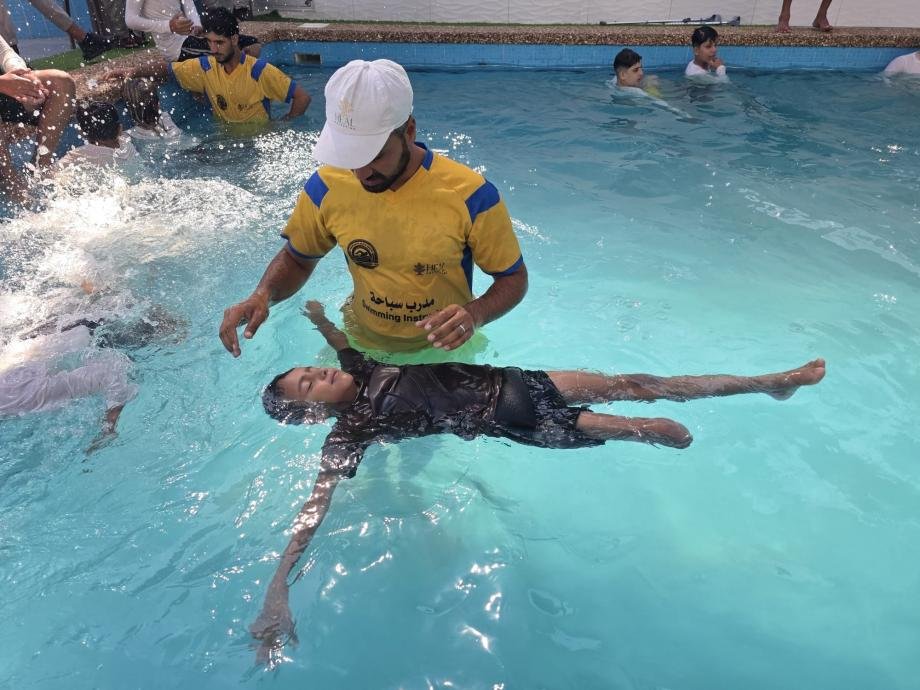
Gaza Herald — In a small swimming pool in al-Mawasi, Khan Younis, southern Gaza, Palestinian children who lost limbs during the war are learning to move through the water again, and, with every stroke, reclaim a piece of the childhood the war took from them.
For these children, swimming is far more than a sport. It has become a space for psychological recovery, rebuilding confidence, overcoming fear, and reconnecting with other children despite the injuries and trauma they have endured.
Among them is 14-year-old Mahmoud Rafiq Abu Shadaq, who still carries vivid memories of the day his life changed.
On August 1, 2025, Mahmoud was displaced when he was injured during the war and lost one of his legs. He was taken to hospital, where he remained under treatment for about a month.
He describes that period as the hardest time of his life. He could not leave his bed or even go to the bathroom without assistance, while learning to use crutches and a wheelchair proved extremely difficult.
His suffering was compounded by Gaza’s hunger crisis and severe food shortages. At times, Mahmoud searched for anything that could ease his hunger.
“I was starving,” he recalled, describing how he sometimes had to eat bread mixed with sand because there was nothing else available.
Months of pain and limited mobility eventually gave way to a new source of strength through swimming lessons organized by Heal Palestine.
At first, Mahmoud was afraid to enter the water. Gradually, however, that fear began to disappear.
“I used to be afraid of the water, but now I can swim,” he said with a smile.
He has learned several basic swimming techniques, including the “dog paddle” and “star” float, despite having never learned how to swim before his injury.
Today, Mahmoud dreams of becoming a swimmer and continuing his training to learn new techniques. The pool is no longer simply a place where he exercises—it has become a place where he feels excitement, happiness and a renewed sense of possibility.
From Fear to Confidence
Thirteen-year-old Mena Ashour is sharing a similar journey.
Mena lost her leg after shrapnel from a strike hit her and her siblings near the place where her family was displaced in the Chalets area of Deir al-Balah in July 2025.
The attack also injured her siblings, resulting in the amputation of Mena’s leg and her sister’s leg.
Her injury came as her family was already struggling with Gaza’s severe shortages of food and medicine and soaring prices. Mena recalled how her mother once paid 60 shekels for only a small amount of grapes.
Today, Mena arrives at the pool to train and learn new swimming techniques, including the star float, “rocket,” dog paddle and backstroke.
“My feeling is beautiful,” she said, while acknowledging that although her confidence has returned, “not completely.”
For Mena and the other children, each new movement in the water represents more than physical progress. It is a small victory over the fear and limitations imposed by their injuries.
Swimming as Rehabilitation
Swimming instructor Najwa Abu Amr said the transformation among the children has been clear since the program began.
Abu Amr works with Tantish Swimming Academy in partnership with Heal Palestine on a rehabilitation program designed specifically for children who have lost limbs.
She said many of the children initially arrived carrying deep fear of the water. Some believed that their injuries and the conditions created by the war made swimming impossible.
But through gradual training, instructors helped them overcome that fear and eventually swim independently, strengthening their confidence, determination and hope.
The sessions do not begin with the children immediately entering the pool. They first receive psychological support, followed by warm-up exercises and recreational activities designed to make them comfortable before entering the water.
Abu Amr said swimming goes beyond physical exercise.
It helps move children from a state of fear and withdrawal toward greater positivity, while giving them an opportunity to enjoy an activity and feel like an ordinary part of their community again.
The program currently serves around 30 children, with organizers hoping to expand it as Gaza continues to face a large number of children living with limb loss and in need of rehabilitation and supportive activities.
“Nothing Is Impossible”
For the children in the pool, the message behind the program is simple: “Nothing is impossible.”
Losing a limb should not mean losing a child’s right to learn, play, exercise or dream.
In the water, these children are learning how to move with bodies permanently changed by war. But they are also learning something deeper: their injuries do not define the rest of their lives.
Every new stroke, every movement mastered and every moment of laughter helps them reclaim a piece of the childhood that violence disrupted.
The war may have changed the way they move, but it has not taken away their determination to move forward.

