
Gaza Herald _For Mohammad al-Halabi, farming is more than a livelihood. It is a profession he has known since childhood, and a connection to land that war has failed to erase.
The 50-year-old now tends a 300-square-meter plot in Nuseirat refugee camp in central Gaza, carefully growing tomatoes and eggplants and watching over seedlings that offer a modest chance to rebuild what was lost.
Before the war, al-Halabi farmed around 40,000 square meters of land in Jabalia, northern Gaza, alongside his father and four children. His farm produced strawberries, tomatoes, flowers, potatoes and eggplants and supported the family financially.
“I have been working in agriculture since I was a child,” al-Halabi said. “The land is my life, and I have spent my whole life farming it.”
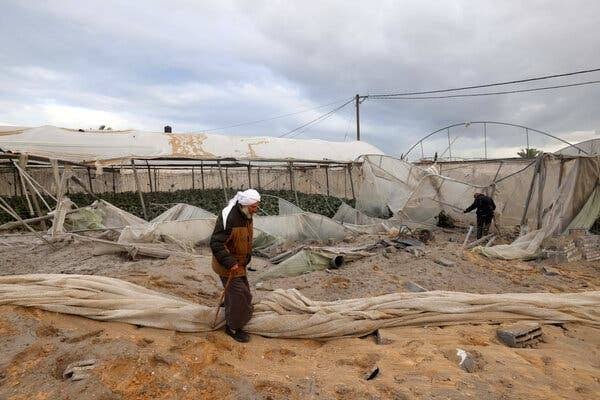
Israeli forces bulldozed his farmland in February 2024 during the destruction of Jabalia, he said. The land is now buried beneath rubble and remnants of the war, including pieces of missiles and other weapons. Returning it to production will require extensive rehabilitation.
After being displaced, al-Halabi rented the small plot in Nuseirat and began planting whatever seeds and supplies he could find.
The harvest is modest—only a few kilograms of each crop, barely enough for his family and far from sufficient to create a sustainable commercial income. Yet watching the plants grow has become a source of hope.
“When I see the plant growing and producing a fruit, I feel that I can still farm,” he said. “The land is small, but it has potential.”
Agriculture devastated
Al-Halabi’s experience reflects the wider destruction of Gaza’s agricultural sector.
Data from Gaza’s Government Media Office indicates that more than 87% of agricultural land has been destroyed. Around 8,700 agricultural wells have been damaged and taken out of service, while thousands of livestock and poultry farms have also been destroyed.
More than 87% of greenhouses have reportedly been damaged, while annual fruit and vegetable production has plunged from roughly 524,000 tonnes to around 20,000 tonnes.
Naser Deeb, director-general of Agricultural Extension at Gaza’s Ministry of Agriculture, said the damage extends across nearly every part of the agricultural system, including farmland, water sources, irrigation networks, wells and agricultural facilities.
Even farmers who manage to return to their land cannot necessarily resume cultivation immediately, he said.
“Farmers today are facing several problems at the same time,” Deeb said. “Even if a farmer returns to his land, that does not mean the land is ready for cultivation.”
Soil rehabilitation, damaged water systems, irrigation networks, seeds, fertilisers and farming equipment are all needed before production can resume.
The consequences extend beyond individual farmers, affecting agricultural families, food supplies and local markets while making it increasingly difficult for Gaza to restore domestic production of fresh produce.
Small plots, new beginnings
For some farmers, small-scale projects have become a way to regain both income and independence.
Mohammad Abdul Naser Hassan al-Jadba, 40, lost access to his farmland in Sheikh Ajleen after it fell on the Israeli-controlled side of Gaza’s so-called Yellow Line.
With access to the land considered too dangerous, al-Jadba rented a small plot in Deir el-Balah and established a nursery and greenhouse where he now grows tomatoes, eggplants and peppers.
Financial assistance from a Belgian development fund helped him construct the greenhouse and purchase agricultural supplies.
Before launching the project, al-Jadba said, he had no income. He now earns around 3,000 shekels a month and has been able to employ two farmers who were previously without work.
“For me, this project was not just agricultural support,” he said. “It was a real opportunity to return to work, regain my source of income and become self-reliant again.”
Across Gaza, these small plots cannot compensate for the destruction of the territory’s agricultural sector. But for farmers like al-Halabi and al-Jadba, cultivating even a few rows of vegetables represents something larger than a harvest: an attempt to preserve their profession, restore their livelihoods and keep the possibility of rebuilding alive.

