
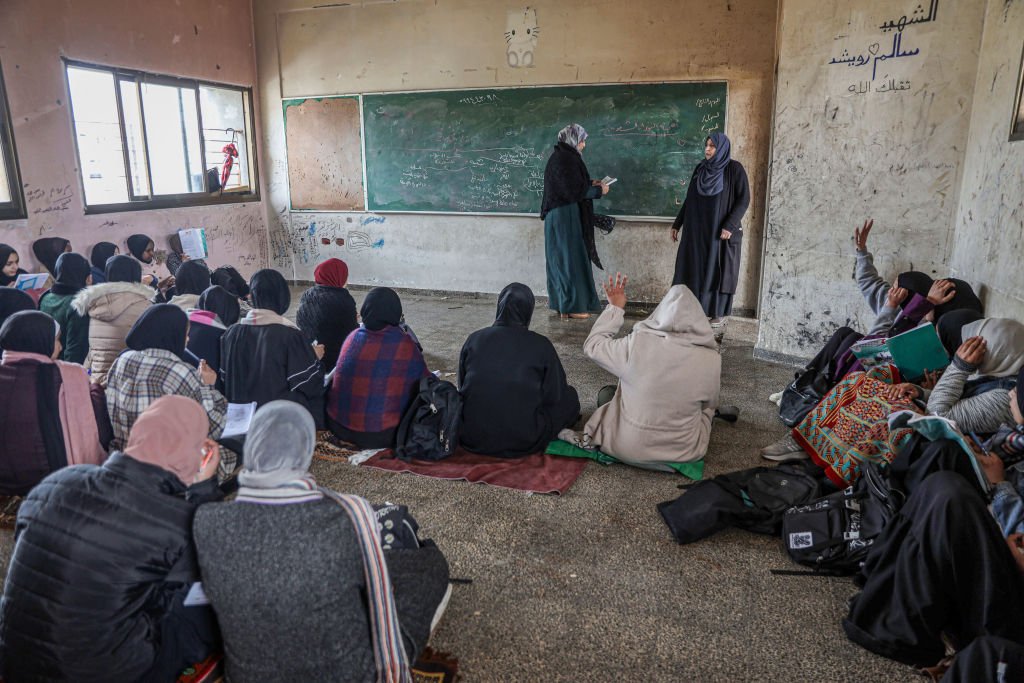
Gaza Herald _Nearly three years of war have disrupted almost every aspect of life in Gaza, including education. But as universities and colleges attempt to restore academic life, students are also seeking to reclaim something beyond the classroom: their sense of community, purpose and ability to contribute.
At the University College of Applied Sciences, the revival of its Volunteer Work Center in May 2026 has reopened a space where students can engage with their communities after years of extraordinary disruption.
For many students, volunteering is about far more than completing required hours or taking part in campus activities. It offers an opportunity to reconnect with others, develop skills that were difficult to cultivate during the war and regain a sense that they can still make a meaningful contribution despite the devastation around them.
More than volunteer hours
Nursing diploma students Nada Al-Haddad and Ghadeer Al-Dalu describe their experience as an important stage in their personal development. They say volunteering strengthened their sense of responsibility, taught them the value of giving and helped them discover abilities they had not previously recognized.
For Maryam Shamallakh, a legal studies student, the experience was marked by the guidance and support she received throughout her volunteer work. She described it as an experience she would carry with her long after completing her hours.
Sama Shalh, a diploma education student, similarly said volunteering gave her valuable lessons and memorable experiences, including the opportunity to meet fellow students and build new relationships.
For digital marketing student Rawan Salem, the experience was not simply about accumulating volunteer hours. She viewed it as an opportunity to strengthen her character, develop resilience and learn to shoulder responsibility.
Despite their different academic backgrounds, the students’ experiences share a common thread: volunteering benefits not only the communities being served, but also the young people who take part.
Rebuilding a culture of initiative
Naseem Al-Zeinati, head of the Volunteer Work Center, said restoring the center after two years of war came at a time when collective action and community initiatives had become more important than ever.
He said the center’s reopening in May was not simply a return to its previous activities. Instead, it was an effort to rebuild volunteer work on a more organized, professional and sustainable foundation.
For Al-Zeinati, volunteering is not merely a number of hours a student completes. It is a process through which young people develop leadership, communication, teamwork, decision-making, and problem-solving skills.
He also believes students who have lived through displacement, disruption and the collapse of many aspects of daily life need opportunities to reclaim their role as active members of their communities.
“Students have energy, knowledge and skills,” he said. “Volunteering gives them a space to turn those abilities into action and impact.”
Volunteering amid devastation
The reality in Gaza has made organizing volunteer activities significantly more difficult. Field and living conditions remain challenging, resources and funding are limited, and students continue to face enormous social and psychological pressures.
Yet Al-Zeinati says these circumstances have made volunteer work more necessary, not less.
The center has adopted a flexible approach, adapting activities when conditions make planned events impossible and maintaining contact with students even during periods when activities are suspended, such as examination periods.
Since its reactivation, students have participated in humanitarian, social, environmental, educational and university-based initiatives. These have included campaigns such as “Beginning and Impact,” “Smile and Impact,” “Return and Hope” and “Resilience Seedlings,” as well as training programs, empowerment activities, competitions and support for newly admitted students.
More than 300 students participated in four different activities during May alone.
But Al-Zeinati says participation numbers do not tell the whole story.
An event may end in a few hours, he explained, while the knowledge and confidence a student gains from it can continue long afterward. The center, therefore, looks beyond the number of activities it organizes and asks what students learned, what changed in them, and what they will carry forward.
Connecting classrooms to real life
One of the center’s central goals is to bridge the gap between academic knowledge and practical experience.
The classroom gives students theoretical knowledge, Al-Zeinati said, while real-world engagement provides lessons that textbooks cannot offer. Working with the public, taking responsibility for a task, collaborating with a team or finding solutions to unexpected problems all help students develop practical skills.
The center therefore seeks to make volunteering a sustained part of university life rather than a seasonal activity tied to individual events.
Its approach begins with recruiting students, followed by training, participation, supervision, evaluation and documentation of volunteer hours. The process is intended to create a long-term relationship between students and community service.
The reception of new students and assistance with enrollment applications provided one example, involving recruitment, interviews, training, assignments, supervision, evaluation and documentation.
Students as agents of change
For Al-Zeinati, students should not be viewed simply as recipients of university services but as partners capable of creating change.
The ultimate measure of success, he said, is not whether an activity was completed, but whether students leave it with the motivation and skills to continue taking initiative in their personal, professional and community lives.
As Gaza’s universities attempt to restore fragments of campus life after years of war, the return of organized volunteering represents more than the revival of extracurricular activities.
It is an attempt to restore a sense of agency among a generation that has endured extraordinary disruption ,and to remind students that even amid devastation, they can still contribute, organize and create an impact in their communities.

