Gaza Herald _“These are the last moments you will see me. They brought me here to kill me. I do not see myself leaving alive. This is the end.”
From an Israeli solitary confinement cell, detained Palestinian pediatrician Dr. Hussam Abu Safiya used these words to appeal to the world’s conscience as his health continues to deteriorate amid what his lawyer says is systematic abuse intended to break him. His case has raised growing concerns over his safety and renewed questions about the international legal system’s ability to protect a physician being prosecuted by Israel as an “unlawful combatant.”
The image of Abu Safiya wearing his white medical coat and walking through the rubble of northern Gaza toward Israeli military vehicles on the day of his arrest has become one of the defining symbols of Gaza’s medical community during the war. As director of Kamal Adwan Hospital, he remained with his patients despite repeated Israeli attacks on the facility, refusing to leave until safe passage for the wounded could be secured. He was later detained outside the hospital and transferred into Israeli custody.
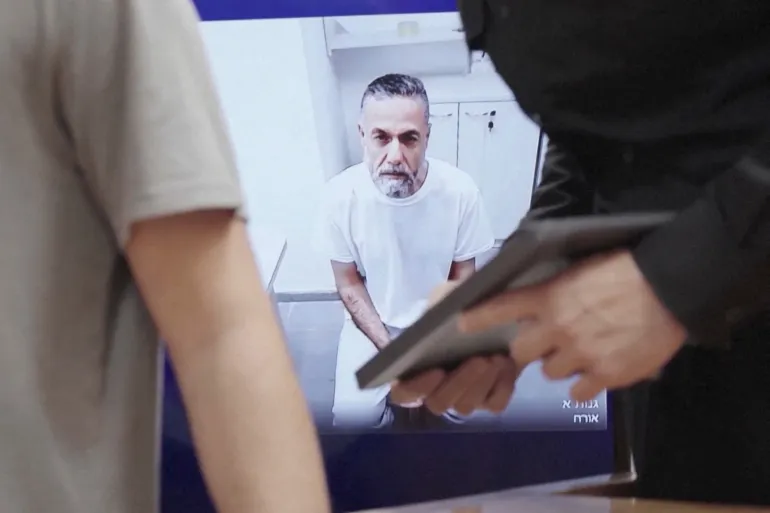
Nearly a year and a half after his arrest in December 2024, Abu Safiya appeared before an Israeli court on June 10, 2026, via video link from solitary confinement. He appeared handcuffed and shackled, visibly weak, and in severely deteriorating health.
According to his lawyer, Nasser Odeh, Abu Safiya said that immediately after the hearing, five prison guards violently assaulted him using their hands, batons, and hammers, while denying him medical treatment.
Systematic abuse behind bars
During a legal visit on July 6, 2026, Odeh found Abu Safiya with his hands and feet restrained and struggling to move. He reported that the doctor had suffered serious injuries to his head and face, leaving him with difficulty breathing and in urgent need of medical care.
Another detail revealed the depth of Abu Safiya’s isolation. During the visit, he asked his lawyer to deliver a message to Al Jazeera correspondent Anas Al Sharif, urging him to continue highlighting the suffering of Palestinian detainees. Abu Safiya did not know that Al Sharif had been killed months earlier in an Israeli airstrike that targeted Al Jazeera’s media tent outside Al-Shifa Hospital on August 10, 2025, killing the entire crew working there.
Throughout the war, Abu Safiya remained in northern Gaza despite repeated evacuation orders, refusing to abandon his patients. He continued treating the wounded while Israeli tanks surrounded the hospital and shelling intensified, insisting that patients could not be left behind without a safe evacuation.
His determination came at enormous personal cost. Working with almost no food, medicine, electricity, or clean water, he became a symbol of Gaza’s collapsing healthcare system and the resilience of its medical workers. In one of his final public appeals before his arrest, he said, “We are dying, and no one feels our pain.”
Fears for his life
Although international campaigns demanding his release have intensified, Abu Safiya’s health has continued to deteriorate, prompting growing warnings that his life is in danger.
The photograph of him walking calmly through the destruction in his white coat remains deeply etched in Palestinian and international memory. Israeli forces transferred him first to the Sde Teiman detention facility and later to Ofer Prison, where he remains in custody.
“I don’t know what I’m accused of,” Abu Safiya said during his first public appearance after his arrest in footage broadcast by Israel’s Channel 13 in February 2025. He appeared exhausted, handcuffed, and visibly weakened following months of reported torture and starvation.
A symbol of resilience
According to his son, Ilyas Abu Safiya, international solidarity campaigns have increased pressure on Israel while exposing the treatment of Palestinian detainees, particularly medical workers.
He rejected Israeli allegations against his father, saying they contradict the reality that Abu Safiya is one of approximately 375 Palestinian doctors currently detained by Israel after carrying out their humanitarian duties.
Addressing an image circulated by Israeli media showing his father in a military medical uniform, Ilyas explained that Abu Safiya had served as a government physician employed through the Palestinian Authority’s Military Medical Services, a civilian public health institution affiliated with the Ministry of Health. He stressed that his father’s work focused on providing medical care to civilians and retirees and had no connection to military activity.
A family’s ordeal
While Abu Safiya remains behind bars, his wife, Albina Saadallah Abu Safiya, has endured profound emotional hardship. Originally from Kazakhstan, she met him while he was studying medicine there and moved to Gaza after their marriage 27 years ago, making Palestine her home.
She remained beside him throughout the war, sharing the siege, repeated displacement, hunger, and the hardships endured inside Kamal Adwan Hospital. Together they also experienced the devastating loss of their son Ibrahim, who was killed on October 24, 2024.
The couple raised six children during more than two decades of marriage built on sacrifice and resilience.
Abu Safiya graduated from medical school in Kazakhstan in 1996 before earning advanced degrees in neonatal and pediatric medicine in 2003 and 2004. He later received the Palestinian Board certification in Pediatrics in 2015.
As Gaza’s healthcare system collapsed during the war and medical staff became scarce, he expanded his role beyond pediatrics, helping treat mass casualties and participating in emergency surgical procedures alongside retired surgeon Dr. Saeed Joudeh, who was later killed during the war.
Today, the story of Dr. Hussam Abu Safiya extends far beyond the fate of a single detained physician. It reflects the broader reality faced by thousands of Palestinian detainees held in Israeli prisons, where they continue to face allegations of torture, prolonged isolation, denial of medical care, and other severe violations while awaiting justice.